How Finnish Wave Technology Could Change How Cities Use Their Water
An avid skier and snowboarder, Andersen returned home to Finland, where surfable waves appear only briefly on stormy days. He realized the country needed waves of its own.
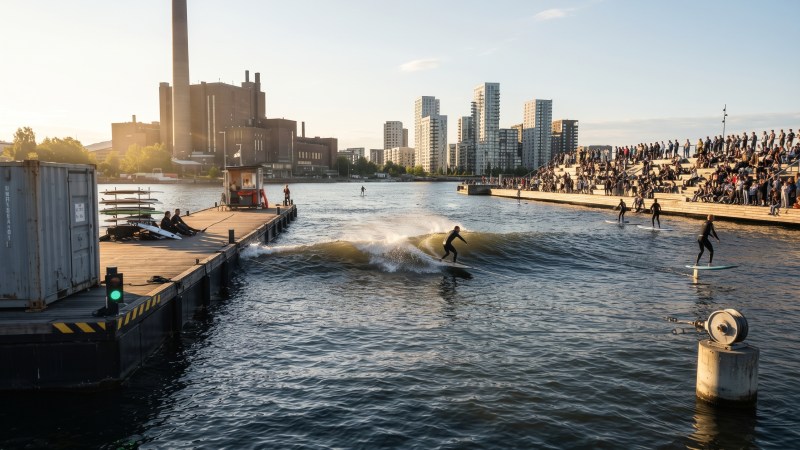
Artwave Surf
You're reading Entrepreneur United Kingdom, an international franchise of Entrepreneur Media.
In many cities, rivers, canals, and harbors may be best known as working infrastructure for shipping, industry, and drainage. In some places, that view could be starting to shift. The City of Paris reports that 120,000 people swam in the Seine in summer 2026, a year after it reopened to the public. That kind of turnout suggests residents may welcome new ways to use the water around them. What might change if urban waterways became part of everyday city life?
Atso Andersen, founder of Artwave Surf, believes the answer could begin with a wave. His Finnish company has spent about a decade developing a way to generate surfable waves in open, natural bodies of water. Andersen says visitors can already surf at its test site in Finland, and the company is now seeking partners abroad. He sees that expansion as the start of a wider conversation about how cities use their water.
The idea was formed after a family surfing trip to Portugal. An avid skier and snowboarder, Andersen returned home to Finland, where surfable waves appear only briefly on stormy days. He realized the country needed waves of its own. He says, “We realized that if we wanted to keep surfing, we would either need to create waves here or move the family to Portugal.”
Traditional surf pools, in his view, depend on extensive technology, infrastructure, and investment. “We studied the physics of how waves form and found that water naturally tends to create them,” Andersen says. “Our approach is to work with that tendency, using as little technology as possible.”
Andersen explains that the system relies on underwater wings positioned roughly 1.5 to 2 meters below the surface, a depth intended to keep surfers safe. He likens the technology to an airplane, with wings interacting with moving water and lifting it into a wave. “Because the system requires no pool or permanent construction, we can follow a leave-no-trace principle,” he says. “Once we remove it, the site returns to exactly the condition it was in before.”
Per the company’s testing, the system’s average energy use per wave is similar to the most efficient surf pools. “Making waves also mixes oxygen into the water, and that aeration may help lower algae levels,” he adds. “Even where the waves are not surfable, the same technology could help improve water quality. Still, the system is not a purification method, and any site must already be swimmable.”
The larger opportunity, for Andersen, lies in former commercial ports turned into neighborhoods. He sees potential in those unused waters for surfing, stand-up paddleboarding, foil boarding, swimming, and canoeing. “Rather than building over the water, cities could use it for recreation,” Andersen argues. “They could also bring vegetation and fish back into it and become far more livable.”
Public health is also part of his vision. Having worked at a university, Andersen has watched physical activity decline among younger generations. The World Health Organization finds one in four adolescents worldwide reported no day with at least an hour of physical activity in the previous week. “Improving physical fitness is a big part of what we want to bring,” he notes. “One customer lacked the strength and flexibility to surf, so he trained all winter, came back, and rode a wave.”
Andersen describes plans for surf tours and events in major cities and at resorts seeking new attractions. The company is also seeking deployment in urban waterways, which he considers most important. Interest has come from countries including the UK, the United States, Australia, and Germany, he notes. In the Alps, he believes stationary wings in fast-flowing rivers could create standing waves and add summer activities. “Finland is remote, and the biggest impact can happen in large cities around the world,” he says. “That is why we are looking for international partners.”
In Andersen’s view, a waterway can offer recreation, exercise, healthier water, and connection to nature. Cities have long treated that water as a route for shipping or a space to build on, yet it may hold far more value as a place for people. “We are a small team in a remote place, but we want to share what we have learned,” Andersen says. “The opportunity is bigger than any one city, and we would like to explore it together.” Bringing this Finnish innovation to a global audience may encourage cities to take another look at what their waterways could become.
In many cities, rivers, canals, and harbors may be best known as working infrastructure for shipping, industry, and drainage. In some places, that view could be starting to shift. The City of Paris reports that 120,000 people swam in the Seine in summer 2026, a year after it reopened to the public. That kind of turnout suggests residents may welcome new ways to use the water around them. What might change if urban waterways became part of everyday city life?
Atso Andersen, founder of Artwave Surf, believes the answer could begin with a wave. His Finnish company has spent about a decade developing a way to generate surfable waves in open, natural bodies of water. Andersen says visitors can already surf at its test site in Finland, and the company is now seeking partners abroad. He sees that expansion as the start of a wider conversation about how cities use their water.
The idea was formed after a family surfing trip to Portugal. An avid skier and snowboarder, Andersen returned home to Finland, where surfable waves appear only briefly on stormy days. He realized the country needed waves of its own. He says, “We realized that if we wanted to keep surfing, we would either need to create waves here or move the family to Portugal.”
Entrepreneur UK
Entrepreneur Staff