Beyond the Star, Life After Michelin
Chishuru Michelin star story luck, leadership and restaurant reality
Chishuru
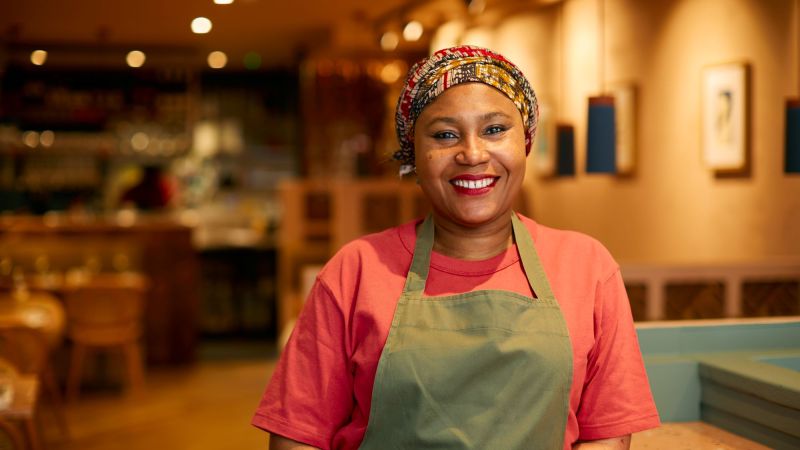
Adejoké Bakare, the UK's first Black female Michelin-starred chef
Opinions expressed by Entrepreneur contributors are their own.
You're reading Entrepreneur United Kingdom, an international franchise of Entrepreneur Media.
In an industry obsessed with certainty, Adejoké “Joké” Bakare remains remarkably comfortable with chance. The chef behind Chishuru made history in 2024 when she became the first Black woman in the UK to receive a Michelin star. Later that year, she was named Chef of the Year at the National Restaurant Awards. It was a landmark achievement not only for Bakare but for British hospitality itself: recognition that West African cuisine, long overlooked by mainstream fine dining, belonged firmly at the highest level of the country’s culinary conversation.
Yet listening to Bakare speak about success, there is little triumphalism. Instead, there is a clear-eyed understanding of how fragile restaurant businesses can be, how much luck matters, and how quickly acclaim can become expectation. “What does earning a Michelin star actually change about how you run a restaurant day to day?” she is asked. “It is overwhelmingly positive. Many guests start with ‘I’d like to go to a Michelin-starred restaurant’ and then they search the Michelin Guide website for which one they’ll choose. It’s the world’s best search engine for restaurants. Having a star brings pressure, on the basis that we don’t want to lose it, but also because some guests come in with a certain level of expectation and we’ll upset them if we don’t deliver it.”
The Michelin star remains one of the few accolades capable of transforming a restaurant’s fortunes overnight. Yet for Bakare, the award is less a destination than a responsibility. The challenge is no longer simply creating extraordinary food. It is delivering excellence every day, to every table, under the gaze of diners who arrive expecting perfection. That tension between recognition and reality runs throughout her story. When asked about the biggest lesson from building a restaurant in Britain, Bakare’s answer cuts against the mythology of meritocracy that often surrounds successful chefs. “Luck plays an enormous role. There were a couple of turning points in Chishuru’s history where if things hadn’t gone our way, or if an opportunity hadn’t arrived at a very specific time, we wouldn’t even be trading today. It’s a bit like music or movies – it’s not a rational business at all.”
It is a refreshingly honest assessment. Hospitality is often portrayed as a sector where hard work inevitably rises to the surface. Anyone who has spent time around restaurants knows otherwise. Timing, landlords, investors, economic cycles, and sheer circumstance can be every bit as influential as talent. Perhaps that is why Bakare’s rise feels so unusual. There was no carefully plotted ascent through Michelin kitchens, no apprenticeship under celebrity chefs, no strategic pursuit of accolades. Asked when she realised Chishuru was operating at Michelin level, her answer is disarmingly candid. “It was honestly a huge surprise. When we were doing the fit-out of the Fitzrovia site in 2023, the amount of time we devoted to thinking ‘how will this look when we have a Michelin star’ was exactly zero. Some restaurants open with a clear, naked determination to get accolades; we were very much not one of those. In hindsight I can say that cooking the food of my heritage and cooking from my heart was the secret to it – Michelin do like restaurants that tell a story – but that wasn’t a deliberate choice to get noticed.”
There is a lesson here for an industry increasingly susceptible to trends and branding exercises. Chishuru’s success emerged not from trying to fit into a fine-dining template but from confidently rejecting it. The restaurant’s identity is rooted in Bakare’s own heritage, experiences and instincts rather than an imagined Michelin ideal. Still, authenticity alone does not pay wages. The modern hospitality industry is built on consistency, and Bakare knows how difficult consistency has become in an era of soaring costs and chronic labour shortages. “What do you think UK hospitality most underestimates about delivering consistent excellence?” she is asked. “I think the importance of consistency is well understood in the industry; it’s fundamental. The challenge isn’t knowing its importance, it’s in pulling it off. Retaining great staff is number one; achieving that while also not blowing your entire budget on labour is hard. Similarly we need to deliver delicious creative dishes but at the same time the price of raw materials has never been higher.”
It is a dilemma familiar to operators across the country. Diners want creativity, quality and value. Staff deserve better pay and conditions. Ingredients cost more than ever. Something has to give. And right now, many restaurants fear that what gives may be their survival. Asked about the state of British hospitality, Bakare offers a sobering diagnosis. “I don’t know any operators who aren’t feeling the pain. One of London’s busiest restaurants reports a 40% drop in sales this year compared to 2025. Dining out is a luxury purchase and so our industry feels the changes in consumer sentiment and spending power very keenly.”
The statement captures the precariousness of the current moment. Even acclaimed restaurants are not insulated from economic headwinds. Awards can bring attention, but they cannot reverse broader shifts in consumer confidence. Yet despite the pressures, Bakare remains energised by the work itself. “What’s been your toughest challenge – creative, operational, or financial – in running the restaurant?” “The creative challenge is there of course but I wouldn’t describe it as ’tough’ because it’s what gets me out of bed every day. One of the greatest things about hospitality is that – even with all the difficulties we face – it is an enjoyable, exciting and fulfilling industry to work in. The financial challenge really happens at the beginning: once you’ve got your restaurant open, you’ve cleared the biggest hurdle by far. So it’s operational: labour again. Finding great chefs who work well as a team, who collaborate with me, who look out for each other… I first opened Chishuru in Brixton in September 2020 and only now in 2026 do I finally feel I’ve got the team I want.”
There is something revealing in that final admission. In an age of instant success stories and accelerated timelines, Bakare speaks about building a team as a six-year process. Excellence, she suggests, is not merely about talent. It is about trust, patience and collective effort. That philosophy extends beyond the kitchen. For independent restaurateurs attempting to navigate an increasingly unforgiving market, Bakare’s advice is rooted not in creativity but in restraint. “One of the funny things about restaurants is that we’ve all had hundreds of lunches and dinners in other people’s venues, we can see what their menus are, how they operate, what their design is – so everyone is an expert to some extent. I would advise anyone thinking of opening – especially a chef – to team up with someone who thinks about downsides as well as upsides, who worries about money, who proposes cuts instead of spending. I tease my business partner Matt that he’s my ‘head of dull’ because this is how he thinks.” It is perhaps the most important lesson of all. Restaurants may be built on vision, but they survive through discipline.
Bakare’s own journey has never followed a conventional script. Before Chishuru, she had no traditional career pathway through the industry. Asked whether being a Black woman in British hospitality shaped the opportunities available to her, she reflects on an unconventional route into professional cooking. “I never had a career path in this industry: I started out by winning a competition in a newspaper in 2019 and that was the first time I ever cooked professionally. I’ve only ever worked for myself. We’ve encountered various commercial landlords who didn’t want us or who have been actively unhelpful but I’ve never had someone standing in my way to stop me.”
The answer is characteristic: measured, unsentimental and quietly determined. Bakare’s achievement matters because of what it represents. It broadens the image of who can succeed in British hospitality and what kinds of cuisine can be celebrated at its highest levels. Yet she remains resistant to simple narratives of inevitability or destiny. Her story is not one of a chef following a prescribed route to Michelin glory. It is the story of someone who trusted her own voice, cooked from her heritage, survived the industry’s brutal economics, and benefited from moments of fortune when they mattered most. In a business where success is often attributed entirely to genius, Bakare offers a more truthful formula: talent, persistence, teamwork and luck. Not necessarily in that order.
In an industry obsessed with certainty, Adejoké “Joké” Bakare remains remarkably comfortable with chance. The chef behind Chishuru made history in 2024 when she became the first Black woman in the UK to receive a Michelin star. Later that year, she was named Chef of the Year at the National Restaurant Awards. It was a landmark achievement not only for Bakare but for British hospitality itself: recognition that West African cuisine, long overlooked by mainstream fine dining, belonged firmly at the highest level of the country’s culinary conversation.
Yet listening to Bakare speak about success, there is little triumphalism. Instead, there is a clear-eyed understanding of how fragile restaurant businesses can be, how much luck matters, and how quickly acclaim can become expectation. “What does earning a Michelin star actually change about how you run a restaurant day to day?” she is asked. “It is overwhelmingly positive. Many guests start with ‘I’d like to go to a Michelin-starred restaurant’ and then they search the Michelin Guide website for which one they’ll choose. It’s the world’s best search engine for restaurants. Having a star brings pressure, on the basis that we don’t want to lose it, but also because some guests come in with a certain level of expectation and we’ll upset them if we don’t deliver it.”
The Michelin star remains one of the few accolades capable of transforming a restaurant’s fortunes overnight. Yet for Bakare, the award is less a destination than a responsibility. The challenge is no longer simply creating extraordinary food. It is delivering excellence every day, to every table, under the gaze of diners who arrive expecting perfection. That tension between recognition and reality runs throughout her story. When asked about the biggest lesson from building a restaurant in Britain, Bakare’s answer cuts against the mythology of meritocracy that often surrounds successful chefs. “Luck plays an enormous role. There were a couple of turning points in Chishuru’s history where if things hadn’t gone our way, or if an opportunity hadn’t arrived at a very specific time, we wouldn’t even be trading today. It’s a bit like music or movies – it’s not a rational business at all.”

Patricia Cullen • Features Writer
Entrepreneur Staff