A Life Well Collected
The designer on antiques, art, family, heritage and creating meaningful interiors.
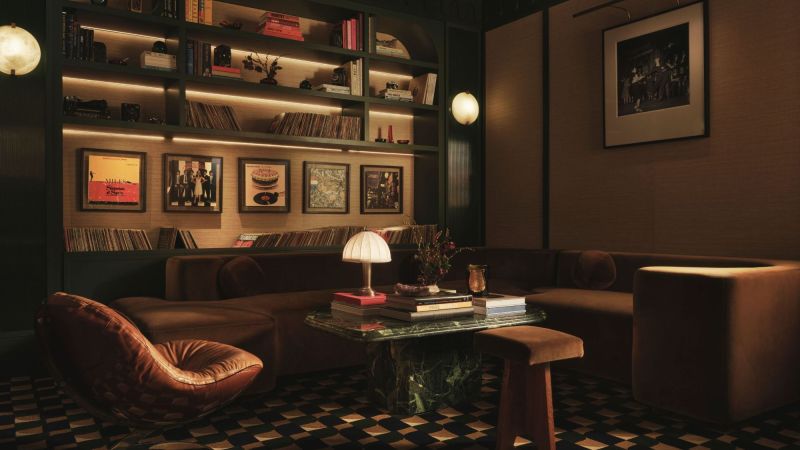
Felix Speller
Spinocchia Freund
Opinions expressed by Entrepreneur contributors are their own.
You're reading Entrepreneur United Kingdom, an international franchise of Entrepreneur Media.
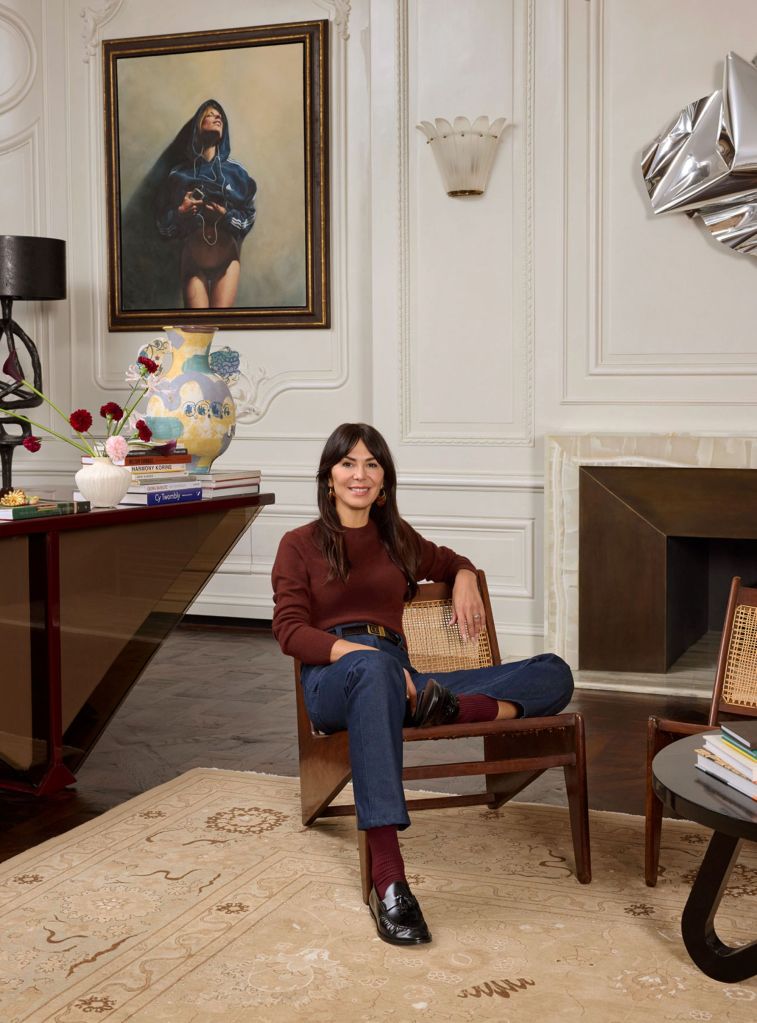
Brigitta Spinocchia Freund is the founder of Spinocchia Freund, the international interior design practice behind richly layered, highly personal spaces. Here, she speaks to Marine Tanguy about growing up surrounded by antiques, the objects she treasures, the artists who continue to inspire her and why the best rooms are ultimately made to be lived in.
Take me back to your parents’ shops. What do you remember about them?
My parents had an antique shop called Bukhara. It began in Turkey and later moved to Dorset. My father also imported and exported Italian furniture, so there were always things arriving from somewhere. I remember the Turkish shop being incredibly full. There were ceramics, textiles, brass, furniture, rugs. You would pick something up and then notice something else behind it. I loved that. There was a real mix of people coming through the shop. Some knew exactly what they were looking for and others would just come in and start looking. My parents were always very welcoming, and there was usually a lot of conversation. I remember the smell of old wood and textiles, and the feeling of being surrounded by things that had already had a life. There was always something being moved, unpacked or looked at. I spent a lot of time there as a child, so I suppose looking at objects became very natural to me.
You’ve said your parents would speak to the makers, ask about techniques, haggle, and dig out the story behind each piece. What did you learn from watching them?
My parents were very hands on with everything they bought. They wanted to know who had made something, how it had been made and what the material was. They would talk to the makers and ask very detailed questions. They would haggle too, of course. I watched all of that. I think I learnt to look at things in the same way. I still pick something up and turn it over in my hands. You notice the weight, the surface, the little irregularities. With a ceramic, it might be the glaze or the shape of the rim. With silver, it might be the way it has been handled over many years. Those are the details I respond to. There was always a story attached to things. My parents would remember where they had found something, who they had bought it from or what had happened on a particular trip. That was part of the pleasure.
You’ve described your childhood home as “curated chaos.” How much of that, and of your Greek heritage, do you think has stayed with you in the way you design?
Our house was definitely full. There were lots of things, lots of books, lots of colour and lots of people coming and going. My Greek heritage has always been a very instinctive part of the way I look at objects. In Greece, ceramics are part of everyday life. You see terracotta pots, painted plates, jugs and bowls being used all the time. They can be incredibly simple, but there is something beautiful about the hand that has made them. The Mediterranean also taught me not to be frightened of colour. Cobalt blue, turquoise, terracotta, chalky white, the colours of old plaster and stone. They are all very much part of my visual memory. My own interiors became much calmer as I got older. I think that came from having grown up with so much around me. I became very interested in space and proportion and in giving particular things room to breathe. But I still love a room that is collected and layered. I like an old Greek pot beside a contemporary ceramic, or an antique rug under something very modern. That mixture feels very natural to me.
What pieces from your childhood do you still live with?
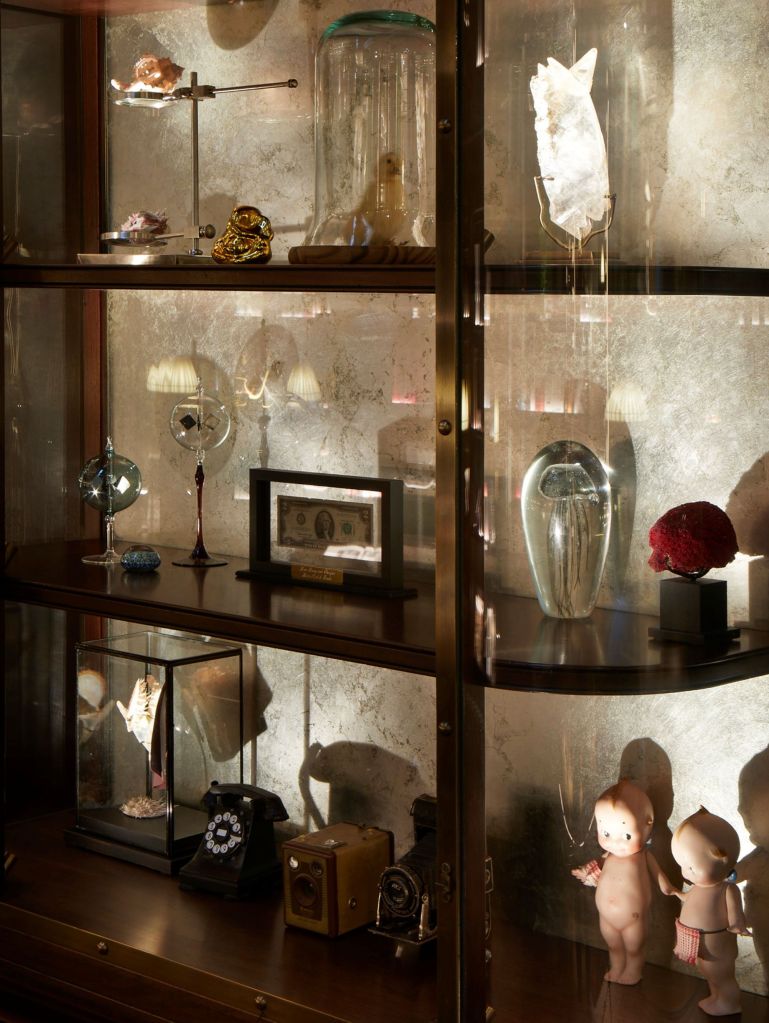
I have lots of my mother’s silver, including pieces that came from the shop. I use it all the time. Silver pots, serving dishes, little bowls, candlesticks. I particularly love setting a table with things that belonged to her. I also have some beautiful antique Turkish silk rugs. They have softened so beautifully with age. The colours change depending on the light and the silk has that wonderful quality of catching the light as you walk across it. Then there are my grandfather’s cameras. He was a photographer for the British Army and was posted in India, so they are incredibly special to me. He also brought things back from India, including some beautiful hand painted tea sets. They have extraordinary colours and tiny details that you can keep looking at. I love having those things around me. They remind me of my family, but they also remind me of the places they came from.
You started your own practice in 2009, just as the financial crisis hit. Who was your first client?
I actually helped start a property development and interior design business in 1999, working with two very successful developers. It became a very international practice and we worked on some exceptional projects. It was what I would describe as on the job training. I was on site every day, utterly committed to every inch of the design process, from the architectural build, working alongside my principal, builders and contractors, through to all the interior finishes. The practice became an international phenomenon, all achieved in under a decade. By 2009, I already had a great deal of experience behind me designing international homes, yachts and planes. I then decided it was time to start my own practice. My first client was a client who suggested I design their chalet in Switzerland. They lived there for two or three months of the year and wanted it to feel meaningful to them, but it also needed to appeal to the luxury rental market. They were something of a dream client because they were incredibly open to ideas and excited by the process. They gave me the freedom to explore the architecture, the art and the furniture, and that was a wonderful way to begin. I’ve now been working in interior design for nearly thirty years, and it has been quite a journey. Starting your own practice is always a big step, but I had already learnt so much from those earlier years and knew very clearly what I wanted my practice to be.
Walk me through a first meeting with a new client. What are you actually looking for?
I’m trying to understand how they live. I want to know what they love, where they travel, what they collect and what they have inherited. I ask about their children, their friends, how they entertain and what they do on the weekend. I’m also listening to the little details. Sometimes somebody will mention a piece of furniture they have had since they were young, or a place they love going to, and that can tell you a great deal. Then I want to understand the architecture. The light, the views, how the rooms connect and where people naturally gather. You are really trying to put all of those things together in your head before you start designing.
You built a domed ceiling around an Abel Macías painting. How did that idea come about?
It was for a London client who was very open to ideas and wanted something exceptional for a room that was used on a sunny day. We often investigate an existing space from the architectural perspective. In this case, parts of the room had been boxed in, so we opened it up and started thinking about the architecture and how we could bring more creativity into the space. I wanted the ceiling to become part of the room, so we created the dome and worked with Abel Macias. I love the warmth and looseness of his work. It has a wonderful sense of movement and imagination. We then carried his designs through other parts of the room. We worked with Hand & Lock to embroider elements of his artwork onto stools and outdoor cushions using UV specific threads. It became a lovely collaboration between the artist, the architecture and the craftsmanship.
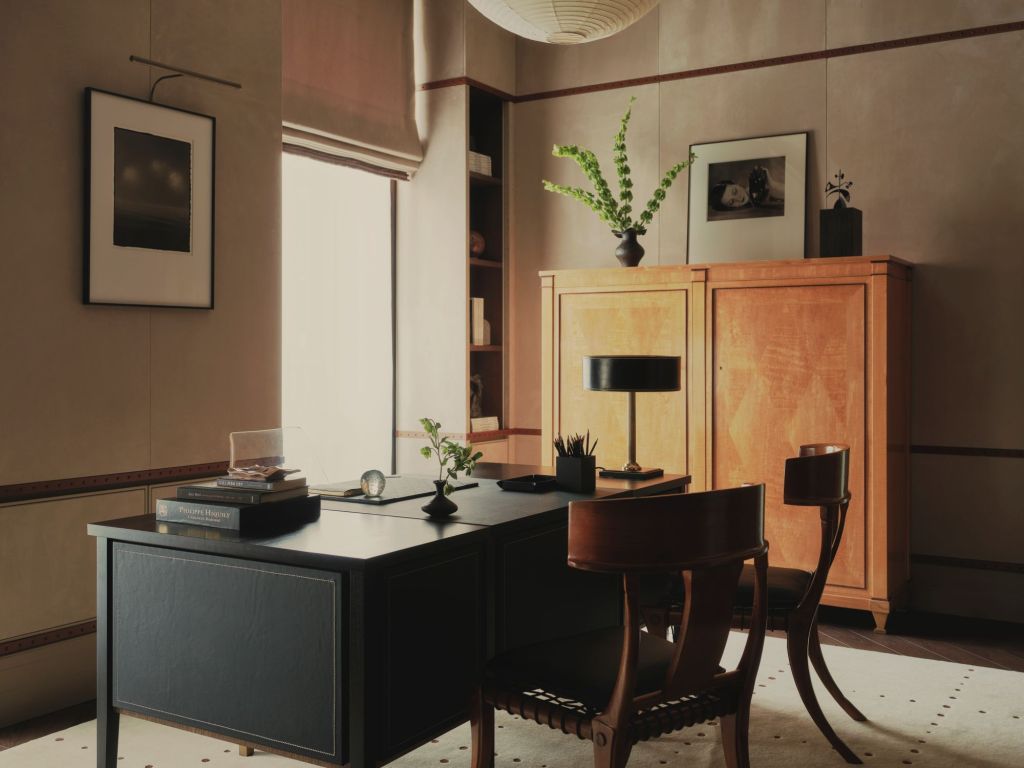
What is it about the things you keep that makes them meaningful to you?
No object is ever just an object. I think that comes from growing up in an antique shop. I can look at a piece of silver and wonder who used it, or pick up a ceramic and think about the person who made it. I have my mother’s silver, my grandfather’s cameras and things he brought back from India. They all have a very strong connection to particular people in my life. Then there are things I have bought myself. A piece you find on a trip can take you straight back to that place years later. I think that is why I love collecting. The things around you gradually become connected to your own life.
You have a Jaume Plensa Hands figure that you and your husband bought when you were pregnant with your first child. Tell me about it.
I had loved Jaume Plensa’s work for years. I had seen his outdoor installations and was always very moved by the figures and the feeling they created within a landscape. My husband and I bought the small bronze Hands when I was pregnant with our first child. It was such a special time. There was so much anticipation and excitement, and that sculpture has remained very connected to that feeling for me. I love that about art. You can buy something because you respond to it, and then your own life becomes part of the meaning of the piece.
Books were your first source of inspiration, and you’ve moved from design anthologies to art and cultural theory. What are you reading now?
I have just finished Peggy Guggenheim’s autobiography, which I loved. Her life was extraordinary and I find her independence fascinating. I’m reading the new Shocking about Elsa Schiaparelli, which I’m really enjoying. I’m halfway through Surreal, and I’m also reading The Extraordinary Life of Gala Dalí by Michèle Gerber Klein. I’m working on a little art project for Wylder at the moment, so I’ve been reading quite a lot around that. Then my evening book is Graydon Carter’s When the Going Was Good, which is about his adventures during the last golden age of magazines. I love moving between completely different subjects. You never quite know where an idea is going to come from.
You’ve mentioned Gio Ponti, Gaetano Pesce and Charlotte Perriand. What do you like about their work?
I love that they are so different. Gio Ponti had this extraordinary elegance, but he also brought art, architecture and everyday life together in a very joyful way. Pesce was much more instinctive. There is colour, humour and so much personality in his work. He allowed things to be irregular and expressive. And Charlotte Perriand had such clarity. Everything feels so natural in her work. She understood materials, proportion and the way people live, and somehow made all of that feel incredibly effortless. I find all three inspiring for different reasons. They each had a very strong visual language, and you can recognise their work immediately.
You said Elsa Schiaparelli’s independence of spirit inspired you. Tell me more…
I love the fact that she followed her own ideas so completely. She was incredibly independent and had a very strong creative instinct. She surrounded herself with artists and writers and brought those influences into fashion in such an extraordinary way. She understood that fashion could be art, sculpture, humour and storytelling all at once. I’m very drawn to people who move between different creative worlds. I think you find some of the most interesting ideas in those connections.
You’ve mentioned James Turrell, Mirosław Bałka and Tadao Ando. What is it about their work that stays with you?
I experienced Turrell in Los Angeles in 2005 at the Sheats Goldstein Residence, John Lautner’s extraordinary house for James Goldstein. The work was Above Horizon. I remember being completely absorbed by the light and by the way it worked with Lautner’s architecture. You became very aware of the sky and the space around you. I also remember Mirosław Bałka’s How It Is at Tate Modern very vividly. You walked into this darkness and suddenly became incredibly aware of your own body, of sound and of the people around you. It was incredibly physical. And then there is Ando at Naoshima, particularly the Chichu Art Museum. The concrete, the light, the landscape and the sea all become part of the experience. I think about those experiences when I am designing. Light can completely change a room. So can a view, a doorway or the relationship between two spaces. Sometimes you walk into a room and immediately feel something. That is the part of architecture and interiors that I find most fascinating
Your country house is full of white and cream, but you have three children and three dogs. How does that work?
The house in Sussex came after the pandemic because I wanted to be close to one of my best friends, and it has become such an important family home for us. I love white and cream because they make a room feel incredibly calm. I bring in lots of texture, though. Linen, wool, old wood, rugs, baskets, ceramics, books and flowers. I also like colours that feel slightly faded. Olive, tobacco, terracotta and old blue all sit beautifully with cream. And then there are the children and the dogs, so the room is constantly being lived in. There are books everywhere, throws, dog beds and all the things that come with family life. I use fabrics that can be washed and furniture that becomes more beautiful with use. I love an old wooden table that already has marks on it and a rug with lots of variation in the colour. For me, the loveliest country rooms have that sense of ease. Everything is there to be used. You can sit down, put your feet up, have a glass of wine, the dogs can curl up beside you and the children can come running through. That is what I want from a family home. It should feel beautiful, but it should also feel completely comfortable.
Brigitta Spinocchia Freund is the founder of Spinocchia Freund, the international interior design practice behind richly layered, highly personal spaces. Here, she speaks to Marine Tanguy about growing up surrounded by antiques, the objects she treasures, the artists who continue to inspire her and why the best rooms are ultimately made to be lived in.
Take me back to your parents’ shops. What do you remember about them?
My parents had an antique shop called Bukhara. It began in Turkey and later moved to Dorset. My father also imported and exported Italian furniture, so there were always things arriving from somewhere. I remember the Turkish shop being incredibly full. There were ceramics, textiles, brass, furniture, rugs. You would pick something up and then notice something else behind it. I loved that. There was a real mix of people coming through the shop. Some knew exactly what they were looking for and others would just come in and start looking. My parents were always very welcoming, and there was usually a lot of conversation. I remember the smell of old wood and textiles, and the feeling of being surrounded by things that had already had a life. There was always something being moved, unpacked or looked at. I spent a lot of time there as a child, so I suppose looking at objects became very natural to me.
You’ve said your parents would speak to the makers, ask about techniques, haggle, and dig out the story behind each piece. What did you learn from watching them?
My parents were very hands on with everything they bought. They wanted to know who had made something, how it had been made and what the material was. They would talk to the makers and ask very detailed questions. They would haggle too, of course. I watched all of that. I think I learnt to look at things in the same way. I still pick something up and turn it over in my hands. You notice the weight, the surface, the little irregularities. With a ceramic, it might be the glaze or the shape of the rim. With silver, it might be the way it has been handled over many years. Those are the details I respond to. There was always a story attached to things. My parents would remember where they had found something, who they had bought it from or what had happened on a particular trip. That was part of the pleasure.

Marine Tanguy is a French-British art entrepreneur, author and speaker, best known as the founder... Read more