Fires Have Changed. Extinguishers Have Not. Inside LifeSafe’s Plan to Modernise Fire Safety
The uncomfortable truth in the data is that the fires of the next decade are already in our pockets, our hallways and our warming landscapes. Fire has modernised. The tools most people rely on have not. LifeSafe’s decade of work is a reminder that the gap between those two facts is not fixed and that closing it begins with accepting the fires we actually face rather than the ones we used to face.
LifeSafe Technologies
You're reading Entrepreneur United Kingdom, an international franchise of Entrepreneur Media.
Somewhere in Britain, a fire crew is dispatched to a lithium ion battery fire once every five hours. Research published this year by the insurer QBE counted 1,760 such fires in 2025, a rise of 147 percent in three years. Nearly half of them started inside homes. The average household now contains between 15 and 25 lithium ion batteries, sitting in phones, laptops, tools and kitchenware, while the equipment defending those homes was designed for a different era of fire.
That mismatch is the problem LifeSafe Technologies has spent a decade working to solve. The conventional extinguisher was built for a familiar menu of threats: wood and paper, flammable liquids, electrical faults. A burning lithium battery follows different rules. Once a cell enters thermal runaway it generates its own heat and feeds on its own chemistry, which means a battery fire can appear extinguished and then reignite minutes later. Water alone often fails to stop it. The person holding the extinguisher is left guessing the type of fire at the worst possible moment.
LifeSafe’s story began before its 2015 founding, with an unlikely collaboration. Dipesh Subba, a veteran of 13 years in the Gurkha regiment, brought his family’s traditional fire extinguishing recipe to Gavin Cornelius, a chemist and green technology entrepreneur. Working with London Fire Brigade Enterprises, the pair reworked that recipe into a patented, nontoxic fire extinguishing fluid designed for modern threats. Chief executive Dominic Berger describes the founding purpose as creating “a fluid capable of extinguishing many fires” in order to save lives.
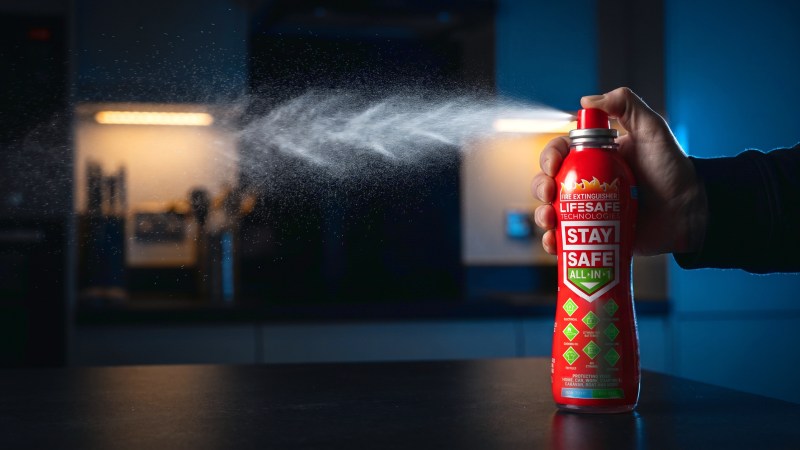
The science rests on one principle: remove the heat. The fluid’s initial reaction is endothermic, meaning it absorbs energy and cools the fire rather than simply smothering it. For a lithium battery that fuels its own combustion, stripping out heat is what stops the fire and what prevents reignition. The company has built nine patent filings around the chemistry. It has certified the fluid across multiple fire classes including cooking oil, tested it for safe use on live electrical equipment and packaged it so that anyone can use it without training.
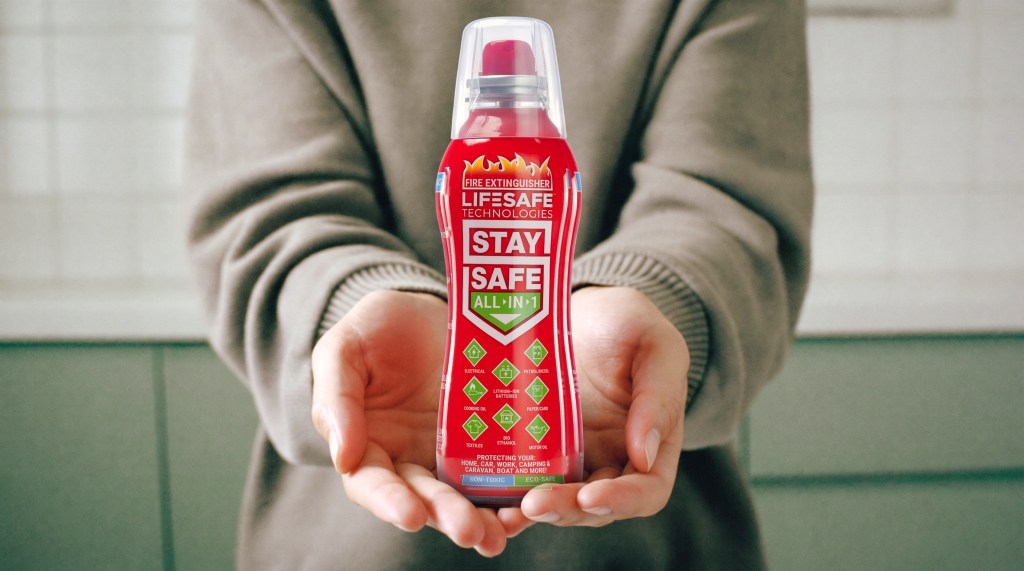
The wider fire industry, built around water, foam and long established certification regimes, was slow to engage. So LifeSafe went directly to the public instead. Its consumer aerosols have now sold more than one million units and its flagship product became the best selling fire extinguisher on Amazon in both the US and the UK. Dominic points to reported cases of university students using the devices to stop fires in student accommodation before they spread. Every large fire starts small and the device within reach in the first thirty seconds matters more than the fire engine ten minutes away.
None of this makes the industry’s caution irrational. Certification regimes exist because lives depend on equipment performing as promised and fire officers are understandably reluctant to endorse products that current standards were never written to assess. LifeSafe’s argument is not that standards should be abandoned but that they should catch up with how fires now start. Regulators are beginning to move, with the Product Regulation and Metrology Act passing into UK law in 2025 to regulate lithium powered devices such as electric bikes.
The most striking use of the chemistry, though, may lie in the largest fires on earth. Tuned for wildfire protection, the same fluid acts as both an extinguishing agent and a retardant. Sprayed in strategic lines across land before a fire arrives, it creates a protective firebreak designed to stop the spread. The company reports that in its trials treated areas have resisted ignition for extended periods, lasting up to 30 days under certain conditions. The thinking mirrors how councils grit roads before frost: treat the ground before the threat arrives rather than fight it afterwards. In a world of longer and more destructive fire seasons, prevention may prove more valuable than response.
The consumer business was the proof. The next phase is scale, supplying the fluid in industrial volumes to fire services, infrastructure operators and manufacturers. LifeSafe is funding the move partly through a live crowdfunding round on Crowdcube, taking its case to the public that first proved the demand. The ambition is for the chemistry, rather than any single product, to become the platform for modern fire safety.
The uncomfortable truth in the data is that the fires of the next decade are already in our pockets, our hallways and our warming landscapes. Fire has modernised. The tools most people rely on have not. LifeSafe’s decade of work is a reminder that the gap between those two facts is not fixed and that closing it begins with accepting the fires we actually face rather than the ones we used to face.
More information about LifeSafe Technologies is available at lifesafetechnologies.co.uk.
Somewhere in Britain, a fire crew is dispatched to a lithium ion battery fire once every five hours. Research published this year by the insurer QBE counted 1,760 such fires in 2025, a rise of 147 percent in three years. Nearly half of them started inside homes. The average household now contains between 15 and 25 lithium ion batteries, sitting in phones, laptops, tools and kitchenware, while the equipment defending those homes was designed for a different era of fire.
That mismatch is the problem LifeSafe Technologies has spent a decade working to solve. The conventional extinguisher was built for a familiar menu of threats: wood and paper, flammable liquids, electrical faults. A burning lithium battery follows different rules. Once a cell enters thermal runaway it generates its own heat and feeds on its own chemistry, which means a battery fire can appear extinguished and then reignite minutes later. Water alone often fails to stop it. The person holding the extinguisher is left guessing the type of fire at the worst possible moment.
LifeSafe’s story began before its 2015 founding, with an unlikely collaboration. Dipesh Subba, a veteran of 13 years in the Gurkha regiment, brought his family’s traditional fire extinguishing recipe to Gavin Cornelius, a chemist and green technology entrepreneur. Working with London Fire Brigade Enterprises, the pair reworked that recipe into a patented, nontoxic fire extinguishing fluid designed for modern threats. Chief executive Dominic Berger describes the founding purpose as creating “a fluid capable of extinguishing many fires” in order to save lives.
Entrepreneur UK
Entrepreneur Staff