Teleperformance and the Next AI Revolution: Why Human Expertise Still Matters
As businesses move from AI experiments to real-world deployment, the competitive advantage may lie less in the algorithms they buy than in how effectively they combine technology, people and processes. Teleperformance offers an instructive case study.
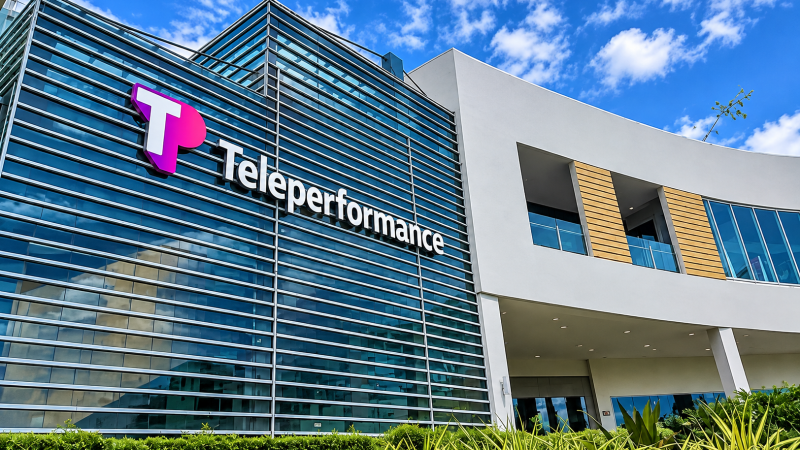
Teleperformance
You're reading Entrepreneur United Kingdom, an international franchise of Entrepreneur Media.
For years, the debate about artificial intelligence in business has revolved around a deceptively simple question: how many human jobs can machines replace?
It is the wrong starting point for entrepreneurs and business leaders. A more useful question is what happens to the entire operating model when machines take on routine work, customers expect faster outcomes and employees are asked to solve more complex problems.
That shift is moving from theory to boardroom reality. In the UK government’s 2026 AI Adoption Survey, 32% of businesses reported using at least one AI technology, double the proportion recorded in 2025. Yet skills shortages, unclear business cases and concerns about accuracy and security remain substantial barriers. The government’s findings capture a tension many founders will recognise: buying technology is becoming easier than changing an organisation around it.
The automation paradox
Few industries illustrate this challenge more clearly than outsourced customer experience and business services. Chatbots can resolve straightforward queries, automated systems can classify content and generative AI can summarise conversations. Those capabilities put pressure on revenue once earned by processing large volumes of repetitive tasks.
But automation does not eliminate every service requirement. It changes the mix. When a customer disputes a financial transaction, an insurance claim involves unusual circumstances or an AI system makes an uncertain decision, organisations still need judgement, accountability and a route to human intervention.
Teleperformance, the French multinational now operating under the TP brand, offers a timely illustration. Its November 5 third-quarter results showed a 1.2% like-for-like revenue decline and prompted the group to lower its 2026 sales outlook to a decline of 1.5% to 2.5%. The shares fell the following day. Content moderation, or Trust & Safety, has been particularly exposed to automation and changing client demand.
Yet the same release reported 2% like-for-like growth across the group excluding Trust & Safety, and 2.9% growth in Core Services on that basis. TP’s results show that disruption and expansion can occur inside the same business at the same time. The exclusion does not make the troubled activity disappear; it reveals where the pressures are concentrated.
From pilot projects to operating infrastructure
One of the clearest mistakes companies make with AI is treating deployment as a software installation. A promising demonstration tells a business little about how an application will perform across thousands of customer interactions, languages and regulatory contexts.
Scaling requires clean data, redesigned workflows, cybersecurity, training, escalation protocols and clarity about who is responsible when a system gets something wrong. Without those foundations, a faster process can simply create errors at greater speed.
TP says it had approximately 1,400 AI projects by the end of September, more than twice the level a year earlier, with over 300 production-grade deployments introduced during the third quarter. More than 35% of its global client portfolio now uses at least one TP.ai solution. These are useful indicators of commercial adoption, although they do not yet establish the revenue or profit generated by AI-enabled services.
For entrepreneurs, that distinction is fundamental. A pilot measures whether technology can work. Adoption measures whether customers will use it. A sustainable business model depends on whether it improves outcomes enough for customers to pay, stay and expand.
The new premium on human expertise
The assumption that smarter systems automatically diminish the value of people misunderstands how complex services work. As routine tasks become automated, the remaining human workload can become more difficult: exceptions, complaints, emotionally sensitive situations, compliance judgements and decisions involving incomplete information.
Human oversight must also be designed, not merely promised. Employees need access to the information behind an automated recommendation, authority to override it and training to recognise failure modes. Otherwise, the phrase “human in the loop” risks becoming a comforting slogan rather than a genuine safeguard.
This is consistent with the World Economic Forum’s Future of Jobs findings, which identify analytical thinking, resilience, leadership and collaboration among the core capabilities employers continue to value, even as AI and big-data skills grow rapidly in importance.
For TP, the proposed hybrid model brings together automation and specialist teams in activities such as financial services, back-office operations and complex customer care. Its scale and multinational client relationships offer a platform for deployment. But scale is not proof of success: the company must still demonstrate that new services can offset pressure on its established operations.
The economics of the next AI economy
The implications extend well beyond outsourcing. As artificial intelligence becomes embedded in business operations, the traditional relationship between labour, productivity and revenue is being fundamentally reconsidered.
For decades, many service industries expanded by adding people to meet growing demand. AI increasingly allows businesses to handle greater volumes of work without a proportional increase in headcount. That shift may improve productivity, but it also challenges pricing models historically linked to the number of employees delivering a service.
The companies best positioned to navigate this transition may not necessarily be those developing the most sophisticated algorithms. They could be those capable of integrating technology into complex operations, managing regulatory requirements and delivering consistent service across multiple markets.
This is where established global operators such as TP possess potentially significant advantages. Their relationships with multinational clients, operational expertise and international delivery networks provide an existing platform for deploying new services at scale. Whether those assets translate into sustained competitive advantage will depend on execution and the economics of the emerging offerings.
TP’s latest financial outlook reflects both the opportunities and the uncertainties of this transition. The company has maintained its profitability and free-cash-flow targets despite revising revenue expectations, giving it financial capacity to pursue its transformation.
Ultimately, the AI revolution in business services may be less about replacing people than redefining the value they create. As automation becomes increasingly accessible, the ability to combine technological efficiency with human judgement, trust and operational reliability could become one of the industry’s most important sources of differentiation.
For years, the debate about artificial intelligence in business has revolved around a deceptively simple question: how many human jobs can machines replace?
It is the wrong starting point for entrepreneurs and business leaders. A more useful question is what happens to the entire operating model when machines take on routine work, customers expect faster outcomes and employees are asked to solve more complex problems.
That shift is moving from theory to boardroom reality. In the UK government’s 2026 AI Adoption Survey, 32% of businesses reported using at least one AI technology, double the proportion recorded in 2025. Yet skills shortages, unclear business cases and concerns about accuracy and security remain substantial barriers. The government’s findings capture a tension many founders will recognise: buying technology is becoming easier than changing an organisation around it.
Entrepreneur UK
Entrepreneur Staff