The Art of Transformation
Qatari artist Shua’a Ali transforms overlooked materials into stories of identity and change.
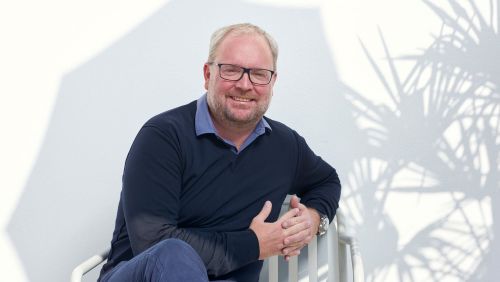
Shua’a Ali
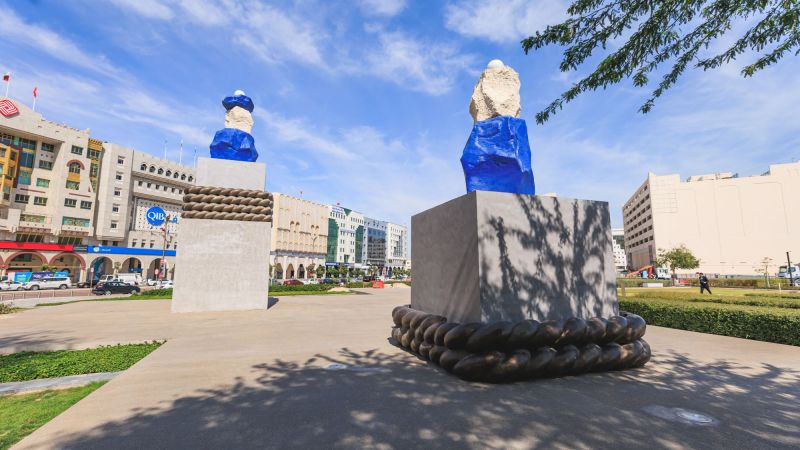
Milestones, 2022
Opinions expressed by Entrepreneur contributors are their own.
You're reading Entrepreneur United Kingdom, an international franchise of Entrepreneur Media.
After 22 years abroad, the self-taught Qatari artist Shua’a Ali returned to a Doha transformed by rapid development. Now she is turning construction debris, desert cairns, stone and paint into a contemporary language for memory, identity and change. There are cities that preserve their past in museums, and there are cities where the past survives in less obvious places: in the materials of old buildings, in paths marked across the desert, in objects that have outlived the purpose for which they were made. For Shua’a Ali, those fragments have become a kind of vocabulary.
The Qatari artist returned to Doha after 22 years abroad to find a city transformed. The skyline had changed, new districts had emerged and the pace of development had accelerated. Yet beneath the physical transformation she recognised the traditions, landscapes and memories that had shaped her childhood. She began to look more closely at what was being overlooked. “I became increasingly aware that many ordinary objects, construction materials, traditional practices, and landscapes were quietly disappearing or being overlooked,” she says. Her response was not to preserve them as museum pieces, or to reproduce the past literally, but to reinterpret them through contemporary art.
That instinct has become central to her practice – and, increasingly, to the way she has built a creative career. Ali did not take the conventional route into art. She studied computer science and developed her artistic practice independently. But she describes creativity as something that was always present in the way she observed the world. “Art became the language through which I could express ideas that couldn’t be communicated through words or numbers alone.” Being self-taught, she says, gave her freedom from established rules and encouraged her to begin with curiosity rather than technique. “Instead of beginning with technique, I began with curiosity and exploration.”
Her early experiences had already given her an unusual perspective on identity. She grew up across Somalia, Iraq, Austria, Tunisia and London, moving between different cultures and ways of seeing the world. Those years taught her to observe how identity is expressed through architecture, traditions, landscapes and everyday objects. Living abroad also gave her a deeper appreciation of Qatar. “Ironically, living abroad gave me a deeper appreciation for my own heritage.” Returning to Doha, she began to see familiar traditions and landscapes with fresh eyes. What might once have seemed ordinary became material for questions about memory, belonging and change. The result is a practice that sits between the personal and the civic. Ali’s work is rooted in Qatar, but its concerns – identity, memory, belonging and transformation – are not confined to one country. That distinction matters. In an increasingly international creative economy, cultural specificity can be a form of creative differentiation. For Ali, looking closely at her own surroundings has become a way of making work that can travel beyond them. “The more deeply I have explored my own heritage, stories, and memories, the more I have found that they give my work a distinctive voice that can connect with audiences beyond Qatar.”
Making a changing city visible
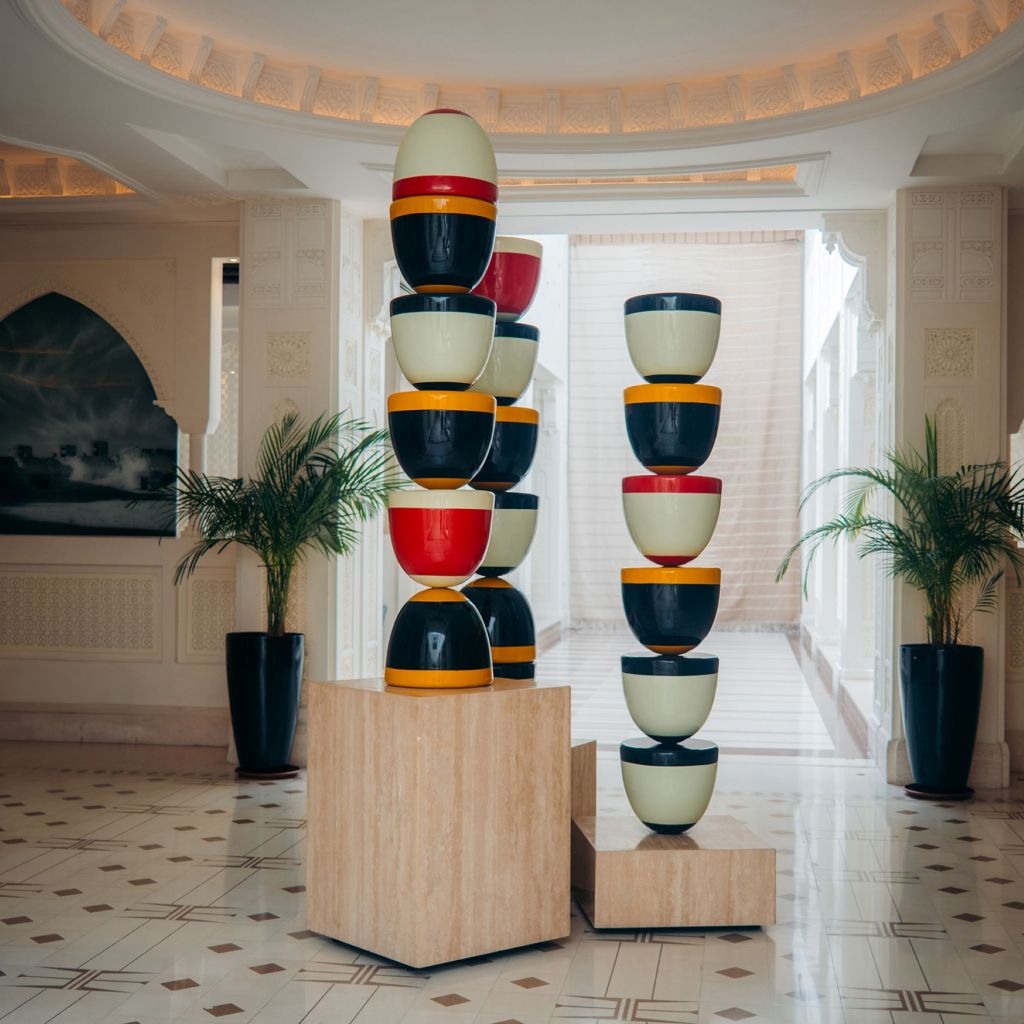
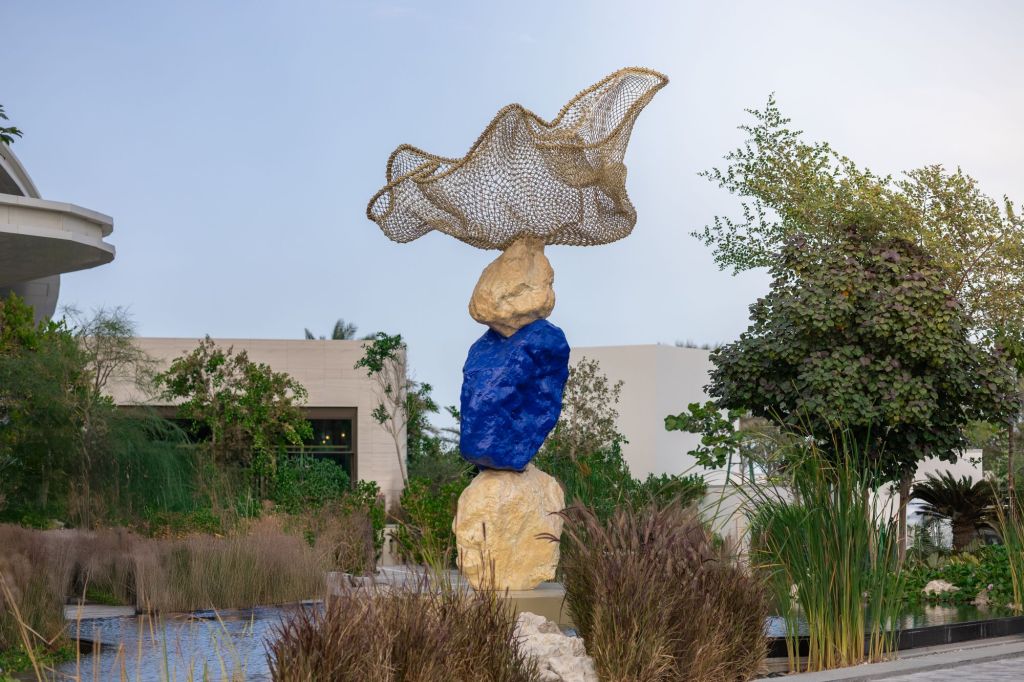
In 2022, Ali’s public sculptures Milestones and Tawazun were installed in Doha as part of Qatar’s expanding public-art landscape. Milestones stands at Grand Hamad Plaza, while Tawazun is located in Msheireb Downtown Doha. The commissions placed her work outside the traditional gallery environment and into the daily life of the city. “Public art becomes part of the daily lives of the people who encounter it,” she says. “For me, Milestones and Tawazun were an opportunity to tell stories about Qatar’s identity through contemporary sculpture.” The two works approach that story differently.
Milestones looks at Qatar’s economic transformation through material. Rope wraps around the sculpture as a reference to the country’s pearl-diving heritage, while gold stone represents wealth and the transformation of Grand Hamad Street into the financial district and gold souq. The symbolism could easily have become literal. Ali instead wanted the materials themselves to carry the history. “For me, every material carries a story, so the process always begins with the concept rather than the form.”
The rope references the rhythm and endurance of pearl diving. Two wraps represent the traditional two-month dive, while four represent the 40-day dive. The gold stone becomes a marker of the country’s economic transformation. The sculpture turns an economic history into something physical. It is also characteristic of Ali’s approach to commissions: rather than treating a site or brief as a constraint, she looks for the story already contained within it. With Tawazun, that story is found in the relationship between construction debris and neshan – location marks or cairns found in both urban and desert environments. “I have always been drawn to materials that carry stories. For me, found and overlooked materials are not simply remnants; they are fragments of memory that reflect human effort, time, and transformation.” The work brings traditional and modern elements into conversation, reflecting the relationship between Qatar’s heritage and its rapidly changing built environment. Its balanced, geometric form also carries a more specific historical resonance, referencing the challenges Qatar faced during the 2017 blockade and the stability that followed. Bringing these materials together creates a conversation between the city and the desert, between progress and heritage. It is a useful description of the wider proposition behind Ali’s work. She is not arguing that Qatar should resist change. Instead, she is interested in what can remain visible within it.
From public art to private collaboration
The ability to move between contexts has become another part of Ali’s practice. A public sculpture, a painting and a collaboration with a luxury brand may appear to demand different approaches. For Ali, however, the starting point remains consistent. “The starting point is always the same for me: an idea, a story, or a feeling that I want to explore.” A commission introduces additional considerations – architecture, environment, institutional identity, audience and scale – she sees these as part of the creative process rather than limitations. “I don’t see these as completely different processes. Even in a commission, I want to find a genuine connection between the brief and my own artistic language.” The balance is important. An artist who works with brands and institutions risks becoming defined by the brief. Ali’s ambition is different: to make work that responds to a client or place while retaining its own identity. “Ultimately, I try not to create something that simply fits a space. I want the work to have its own identity while also feeling as though it belongs there.”
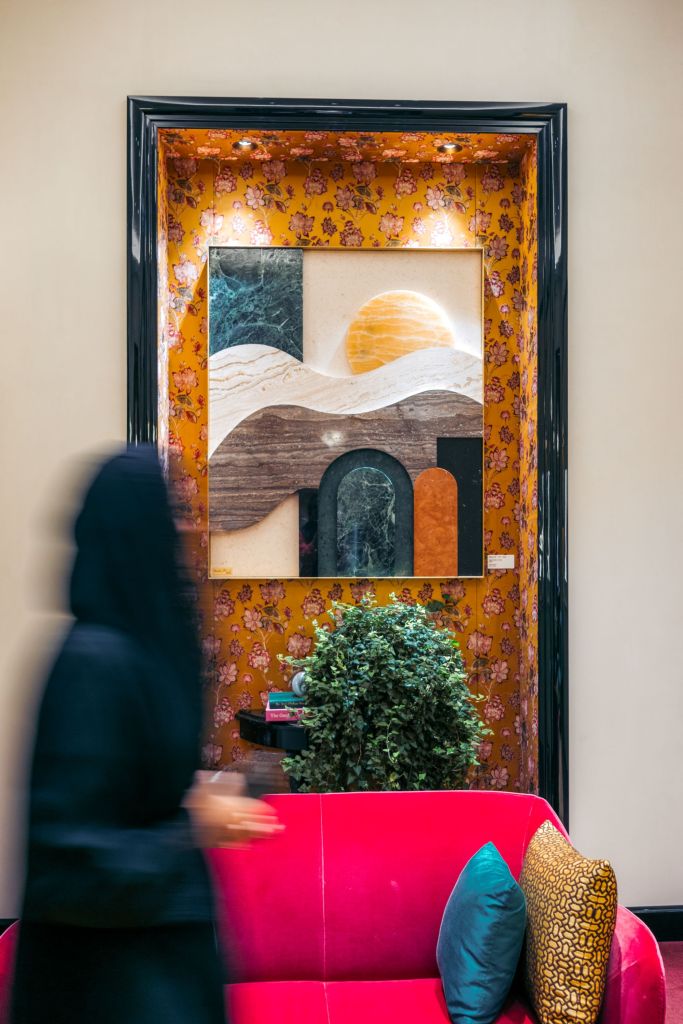
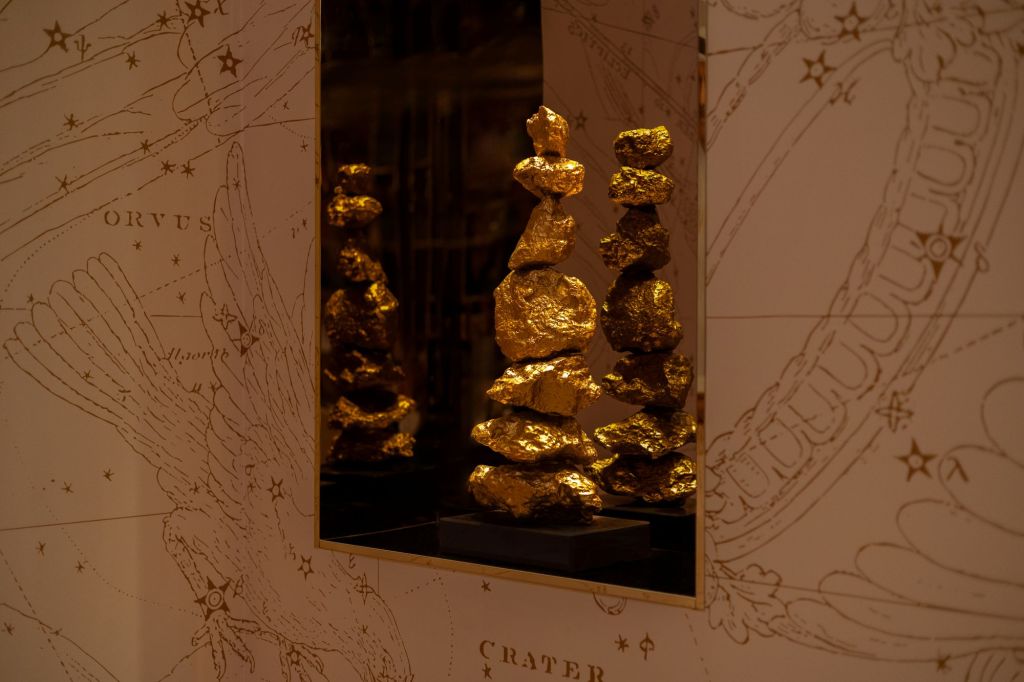
That philosophy is evident in her collaboration with Boucheron at the French jewellery house’s new Lagoona Mall boutique in Doha, where her work is presented alongside that of French artist Myriam Hubert. The starting material was leftover marble from the boutique’s interior-design project. For Ali, the opportunity was less about creating art for a luxury environment than about changing the fate of a material that had already served one purpose. “Rather than allowing the material to become waste, the intention was to transform it into an artwork that would become part of the space and carry a new meaning.” The collaboration neatly overlaps with the concerns that have shaped her independent practice: material memory, sustainability, transformation and the possibility of finding value in what might otherwise be discarded. It also illustrates something increasingly important to contemporary creative careers: the ability to collaborate across disciplines without losing a recognisable point of view. Ali’s practice can move between art, architecture, public space, cultural institutions and luxury, but the underlying question remains the same – what story can this material, place or object tell?
Layers of a life
The idea of accumulation is explicit in Ali’s painting. She has spoken of “overlapping layers and strokes of paint” as a metaphor for the way fragments of experience build an identity. In her work, the metaphor is also a physical process. “The idea of layering is very literal in my practice, both in my paintings and my sculptures.” Paint is built up in layers. Stones are arranged into compositions. Individual elements remain distinct while contributing to something larger. “Each layer carries a trace of what came before it.” It is difficult not to see the same process in Ali’s own career. Computer science. Five countries and cities of childhood. Twenty-two years abroad. A return to Doha. Public sculpture. Museums. Cultural institutions. Luxury collaboration. Each experience has added another layer without erasing the previous one. That may explain why her work is so concerned with balance. “I see this process as a reflection of how we build our own identities. We are shaped by places we have experienced, stories we inherit, and memories we collect over time.” The idea also offers a useful way of understanding creative entrepreneurship. A distinctive practice is rarely built from a single breakthrough. It develops through accumulated experiences, relationships, experiments and opportunities – provided the artist can recognise the thread connecting them. For Ali, that thread is transformation.
Knowledge, memory and permanence
The same concern appears in Sayyidah Al Hurra, a 2023 public-art sculpture at Qatar Foundation. Where Milestones considers economic transformation and Tawazun explores the relationship between heritage and development, Sayyidah Al Hurra turns towards knowledge and the role of women in history. The carved stone book represents education, wisdom and the preservation of knowledge across generations. Stone, for Ali, becomes a material of permanence. The work broadens her definition of heritage. It is not only something found in buildings, landscapes or objects. It can also exist in the ideas and achievements that are passed from one generation to the next. That idea connects the sculpture to her paintings, where accumulated layers become a way of thinking about memory and identity.
Building from Doha
The cultural landscape in which Ali is working is changing almost as quickly as the city itself. She sees that change as an opportunity rather than simply a backdrop. Doha’s expanding network of museums, cultural initiatives and international collaborations is creating new possibilities for artists who can work locally while engaging with a wider audience. “There is a genuine openness to new ideas, and an increasing number of institutions, museums, cultural initiatives, and international collaborations are creating opportunities for artists to contribute to that development.” Her advice to creatives building careers in Doha is strikingly simple: look closer, rather than necessarily looking further. “Understand your own identity, be curious about your surroundings, and don’t overlook the stories and materials that are closest to you.” For an international, entrepreneurially minded audience, there is a larger lesson in that approach. Ali’s career has not been built by separating local identity from international ambition. It has been built by making the two reinforce one another. The more specific the source material becomes – the pearl-diving economy, the desert cairn, the construction fragment, the inherited story – the more distinctive the resulting work can become. Her next ambition is to contribute to one of Doha’s new cultural destinations with a substantial public artwork: something site-specific that responds to its architecture and environment while drawing on local stories, materials and memory. But scale is not the real objective. “I would like the work to feel rooted in Doha, but at the same time be contemporary and open to an international audience.”
Ultimately, she wants to make something that becomes part of the cultural memory of the city. “My dream would not simply be to make a large or prominent sculpture. It would be to create something meaningful enough that people encounter it years later and still feel a connection to the place, the story, and the moment in which it was created.” That ambition brings her practice back to where it began: with attention to what is already there. A piece of rope can carry an economic history. Construction debris can become a record of urban transformation. A desert cairn can become part of a contemporary sculpture. Marble left over from a luxury interior can acquire another life. Ali’s achievement is to recognise that these are not merely materials. They are evidence. Evidence of where a place has been, how it has changed and what it chooses to remember. In a city being transformed at extraordinary speed, perhaps that is the most useful role an artist can play: not to stop change, but to make sure that something of what came before remains visible within it.
After 22 years abroad, the self-taught Qatari artist Shua’a Ali returned to a Doha transformed by rapid development. Now she is turning construction debris, desert cairns, stone and paint into a contemporary language for memory, identity and change. There are cities that preserve their past in museums, and there are cities where the past survives in less obvious places: in the materials of old buildings, in paths marked across the desert, in objects that have outlived the purpose for which they were made. For Shua’a Ali, those fragments have become a kind of vocabulary.
The Qatari artist returned to Doha after 22 years abroad to find a city transformed. The skyline had changed, new districts had emerged and the pace of development had accelerated. Yet beneath the physical transformation she recognised the traditions, landscapes and memories that had shaped her childhood. She began to look more closely at what was being overlooked. “I became increasingly aware that many ordinary objects, construction materials, traditional practices, and landscapes were quietly disappearing or being overlooked,” she says. Her response was not to preserve them as museum pieces, or to reproduce the past literally, but to reinterpret them through contemporary art.
That instinct has become central to her practice – and, increasingly, to the way she has built a creative career. Ali did not take the conventional route into art. She studied computer science and developed her artistic practice independently. But she describes creativity as something that was always present in the way she observed the world. “Art became the language through which I could express ideas that couldn’t be communicated through words or numbers alone.” Being self-taught, she says, gave her freedom from established rules and encouraged her to begin with curiosity rather than technique. “Instead of beginning with technique, I began with curiosity and exploration.”

Patricia Cullen • Features Writer
Entrepreneur Staff