We’re facing a ‘quiet hiring’ freeze: what happens when businesses stop replacing people?
AI eliminates junior roles today, risking the senior talent businesses need tomorrow.
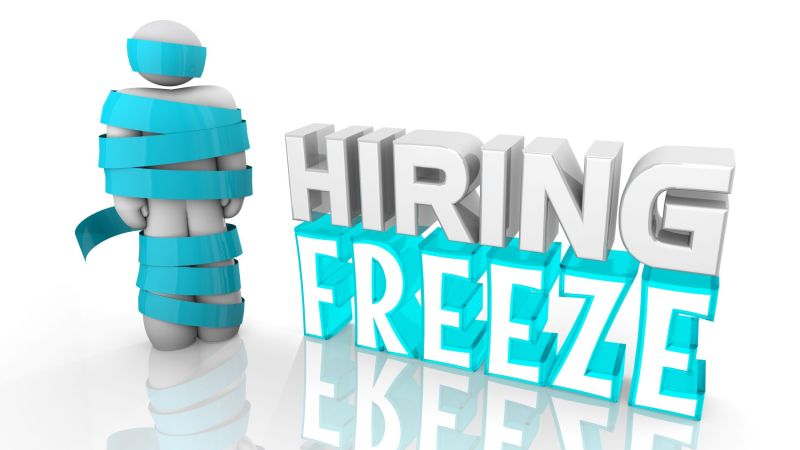
Shuterstock
Opinions expressed by Entrepreneur contributors are their own.
You're reading Entrepreneur United Kingdom, an international franchise of Entrepreneur Media.
Almost four years ago, when ChatGPT launched, agency owners started to tinker with it and run their copywriting and content processes through it, with the likes of Zapier and ClickUp. I even built a few workflows myself. As soon as I started doing it, I realised there were going to be people who weren’t hired in the future because of this (because the work it was doing was the work the junior used to do).
At one agency I was advising, the junior had been promoted to a mid-weight copywriter, and was young and keen enough to start building processes to semi-automate the copywriting they’d previously done themselves. The agency took the role down. They’d been hiring to replace the junior who had moved up.
Then, while I was at Enterprise Skills building the Skills Hub platform from scratch by myself, I saw the other end of it. That platform was built for schools, to support business studies and economics with curriculum-aligned simulation tools. Very quickly, I realised that a lot of the tools were actually bridging a skills-versus-grades gap. I got looking at how schools taught skills and realised it was woefully inadequate, and that these students would come out of school, college and university with grades that wouldn’t be suitable for the skills they needed to get jobs.
So why aren’t we reading about it? Well, we kind of are, passively, throughout the day. If you scroll through LinkedIn, you’ll see an awful lot more green swooshes on profile pictures, and you’ll see posts asking people to let them know about roles. What we aren’t seeing, necessarily, are large-scale redundancies.
We’re seeing people apply for a job, and the job beingremoved once they’ve been accepted. Over the last few weeks, I’ve also seen more and more people saying they’re looking for a job again because the job they left their last one for has been taken back in-house, which means that, technically, they got made redundant.
And as people move through businesses, up or alongside, the roles they held aren’t being backfilled the way they used to be. I used to work with a digital agency that almost always had two junior roles advertised, because as people moved up or out of the agency, they needed replacing. They’ve done zero junior hires in the last 10 months, when it would probably have been five or six. None of those jobs were posted, so you don’t read about it. But they weren’t redundancies either.
So where does the work go? Some of it goes to the AI, which is what they’re using to backfill the orchestration work, and the AI does it well enough. . Some of it goes to the employees that are left, who are now doing a bit more work for the same money.And some of it just stops, which is the interesting bit, because some of it should have stopped years ago.
In some cases, there’s a mathematics to this. If people become more productive and someone leaves the team, that productivity absorbs the loss of the person, which means that a team of 10 could become a team of five over 18 months without anyone being made redundant.
There’s a statement I make an awful lot: you can’t become a senior anything if you’ve never been a junior something.
The junior roles that existed throughout all of knowledge work, and before that even in factories and farms, existed so that people immersed themselves in the monotonous doing that taught them the very basics of how work was done. As those juniors became more knowledgeable and absorbed the things around them, they were given more meaningful work to do. That meaningful work then turns a junior into a mid-level, then a senior.
If AI takes an awful lot of the orchestration away from juniors (the boring monotony in spreadsheets and emails and meetings), those roles don’t need to exist. Therefore, in the future, you end up with a perversion of professional atrophy, which in the short term looks great on the numbers in terms of profitability. In the long term, businesses can’t necessarily survive without the seniors that grow out of juniors.
One thing to note is that it’s not just how to do the work that you learn as a junior. It’s the resilience when the work doesn’t go to plan. If an AI does the work well enough most of the time, it won’t necessarily do it brilliantly all the time. When there’s a client complaining, or an issue that comes up, will that new senior who’s never been a junior be able to cope with it well enough?
Each decision on its own is completely rational for an individual company, but that’s actually the bigger problem, because everyone’s acting individually. They don’t have a collective sense of the impact.
Add up all the entry-level adverts that don’t go out. Add up the collectively large but independently few jobs that get made redundant: the ones that are high, high, high orchestration. Individually, that’s one or two roles in an organisation. Most of the UK’s organisations are SMEs with fewer than 250 staff, but collectively, across the UK and across the rest of the world, that’s huge numbers of people.
So what do you do about it? Make conscious choices, and that’s about all you can do. The next time someone leaves, don’t let things drift into an accidental absorption. Work out whether replacing the role or redesigning it is more important than killing it. If you’re killing a junior role, you need to decide whether that’s going to have an impact in five, 10, 15 years’ time, not just for you but for the industry you work in.
Making an individual choice not to hire a junior is, individually, one single junior. Maybe a few more. But if you make it as a conscious choice, aware that others are probably making the same one, you’ll see that in the long term it gets an awful lot harder to find the seniors you need.
Almost four years ago, when ChatGPT launched, agency owners started to tinker with it and run their copywriting and content processes through it, with the likes of Zapier and ClickUp. I even built a few workflows myself. As soon as I started doing it, I realised there were going to be people who weren’t hired in the future because of this (because the work it was doing was the work the junior used to do).
At one agency I was advising, the junior had been promoted to a mid-weight copywriter, and was young and keen enough to start building processes to semi-automate the copywriting they’d previously done themselves. The agency took the role down. They’d been hiring to replace the junior who had moved up.
Then, while I was at Enterprise Skills building the Skills Hub platform from scratch by myself, I saw the other end of it. That platform was built for schools, to support business studies and economics with curriculum-aligned simulation tools. Very quickly, I realised that a lot of the tools were actually bridging a skills-versus-grades gap. I got looking at how schools taught skills and realised it was woefully inadequate, and that these students would come out of school, college and university with grades that wouldn’t be suitable for the skills they needed to get jobs.

Chris Simmance • Founder of Orca (simmance.ai)
Chris Simmance is the founder of Orca (simmance.ai) and the author of The Next Rung,... Read more