The Business of Belonging:
Connection thrives when local spaces are accessible, visible, and easy
Conveenie
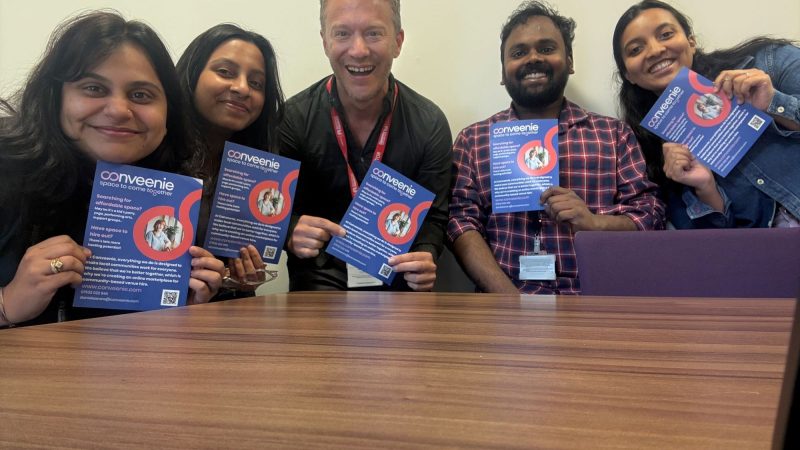
Founder Daniel Aarons and the Conveenie team
Opinions expressed by Entrepreneur contributors are their own.
You're reading Entrepreneur United Kingdom, an international franchise of Entrepreneur Media.
The idea for Conveenie didn’t start with a business plan. It started with a problem that felt personal – finding meaningful connection locally wasn’t as easy as it should be. What followed was a deeper discovery: behind every community group is a constant struggle to secure the right space. Conveenie was built to remove that friction. Entrepreneur UK talks to founder, Daniel Aarons, to find out more…
You’ve spoken about feeling a sense of disconnection – how did that personal experience shape the idea behind Conveenie?
Disconnection, loneliness, a sense that something is missing, hits us all from time to time in our lives. If we retreat further, it compounds. Something needed to change and I took what felt like a leap into unknown territory. I joined the Camberwell Community Choir, found my voice, and realised how good it feels harmonising with a group. Bolstered by that experience, yet having never acted before, I took the scary decision to sign up to the Dulwich Players, a local Amateur Dramatics group. For me it unlocked a level of creativity and confidence I never knew I had. These local groups provided a “natural high” and showed me that community & connection is often right on our doorstep. We need real experiences, with real people, locally, to feel grounded and satisfy the social connection we need as humans to thrive.
However, my curiosity & conversations in the community revealed how difficult it is for local groups and clubs to find suitable venues for whatever their passion is. I also discovered the quiet struggle faced by the people managing local venues (often volunteers). Between 2018 and 2023, London lost more community spaces than it gained. Seeing these vital hubs stretched thin by administrative burdens – at a time when we need connection most – is what led me to start Conveenie. I wanted to strip away the logistical friction so that community leaders can focus on their passion, not their paperwork.
At what point did a personal frustration begin to look like a business idea?
During Covid, I used the time to complete an MBA, where the idea for the platform took shape. But I returned to the world of branding and design and the idea sat on the shelf. Why? The safety of a salary, the structure of employment and being in an environment that you know and derive some meaning and satisfaction from. But importantly the fear of making a big change, trying something completely new, going alone and not knowing if would succeed (also given other competitors that had launched in this space with significant investment). Overcoming that fear and committing was the biggest hurdle. I didn’t want to have a lingering personal frustration and regret at having not even tried. So, I took the leap, left paid employment and got to work building conveenie.
What did you learn early on about how people actually find and use community spaces?
Use of community space spans a lifetime, right from pregnancy groups to exercise clubs for seniors. It crosses every ethnicity, culture, subculture, every passion project, every group. A regular local gathering or a single one-off celebration. The unifying driver is the need for the right space at the right time to come together to collaborate, support, grow and importantly share experiences. After launching conveenie, I heard countless anecdotes from guests explaining they had searched endlessly to find space but hit a wall and wished they had found us sooner.People’s lives are busy and they need transparent/clear information, convenience, responsiveness and in the times we are in, affordability is paramount. To this end, we were intentional in building in the functionality for hosts to self-serve their own discounted rates within the platform. Offering flexible ‘Happy Times’ pricing for off-peak periods, charity & community discounts, and for recurring bookings.
Building something that serves both groups and venues can be complex – where has that tension shown up most?
It’s a constant balancing act between building the supply of venues and capturing the demand from customers who need that space. A greater portfolio of spaces means more choice and variety, and more likelihood of bookings. However, sometimes we receive enquiries from guests in localities where we don’t yet have venues – but this can become an advantage, outreaching to new potential venues with an active opportunity (demand>unlocking supply). The biggest challenge / tension we have faced after launch has been bookings made by guests that could not be accepted by hosts. The main cause being suitability, availability and calendar management. Whilst there are technical solutions such as calendar syncing, until your platform is delivering enough value & time saving to be prioritised, the risk is that other existing bookings take priority.
How do you grow a platform like this without losing the local, human element that inspired it?
Showing up physically, and meeting hosts in person locally as much as possible is vital. It shows a commitment and allows for those informal conversations, understanding the challenges faced on the ground and the insights that can shape further platform development. With growth there is always a risk that the human element can be compromised. One of the ways to mitigate this is having a clear brand purpose, a north star that provides a constant lens for decision making, for us it’s ‘Empowering community to come together more and thrive’. Supported by a set of brand values that guide how we act and behave with all stakeholders, which for us is ‘connection, collaboration, ingenuity, fun.’ Ultimately, it’s the real-life experiences that people have when they come together locally, that’s where the magic happens – keeping this front and centre so that we continually make this as easy and convenient to do so through the platform. As we expand, we’ll need to continue to build those local connections on the ground, with community leaders who can support and advocate for our mission.
What does a sustainable model look like for a business built around community spaces?
For us, a sustainable model means a combination of things;
- Becoming the go-to platform for single and especially regular community bookings, day in day out. Revenue generating for each space on the platform, but also importantly providing demonstrable time saving for our hosts. Alleviating the time and stress associated with administrative burden.
- We’re also encouraging corporates to move ‘from the conference room to the community room’. By doing so, businesses can hold away days and workshops somewhere unexpected, reduce costs, and drive social impact by reinvesting event budgets back into local neighbourhoods.
- This will also feed into and support us being able to continually ‘subsidise’ the discounted rates that are offered to community and charities.
- Having collaborated with the Southwark Climate Collective, we’re able to identify the interventions we can make to be a more sustainable business, but importantly amplify the effect through knowledge sharing and ‘nudges’ to all the venues on conveenie,. You can learn more in our inaugural Impact Report.
- We’re exploring building out an ecosystem of other local event vendors (who are purpose led and have a commitment to sustainability & social value) who can provide the services and products that people need for their events. Whether that’s a florist, caterer, musician etc – there’s so many talented and creative businesses that are needed and can provide their services more often within the local events industry. And guests’ money therefore, as much as possible, is spent and re-invested locally.
You’re using technology to solve a very human problem – how do you strike that balance?
We use tech to handle the less exciting but time consuming elements of the experience – filters, secure payments, calendar syncing, T&C’s, email reminders – because that’s where humans get frustrated. Our UI and experience for hosts and guests is designed to be clean, simple and straightforward. Whether you’re managing the space or booking the space, you get to use your time where it really matters – connecting in person. We’ll continue to embrace rapidly evolving tools at our disposal to automate and be more efficient – but where it’s useful, relevant, and alleviates frustration. This means being very purposeful and considered, and keeping human interaction as the default, especially in a world where trust is more important than ever.
What does a more connected neighbourhood actually look like in practice?
Feeling a part of and having a pride in your community, being involved, having a voice and a sense that you are helping to shape its future. What this means in practice;
- Thriving ‘third spaces’, accessible to all where they can collaborate, feel supported and grow. Whatever their passion, group or project is. And by default, contributing to stemming the closure of vital local spaces.
- Where locals are more connected to one another and aware of what is happening around them. When you’re out and about, the likelihood of bumping in to someone you’ve met at a book club, yoga session, choir rehearsal, support group, parents group is increased.
- People are spending less time scrolling social media, they’re feeling less lonely and isolated.
- Where people are emotionally invested in wanting to support local businesses to thrive.
- Finally, I’ve seen how much further our business has been able to go as a result of collaboration. Partnering on initiatives and projects with other companies and organisations that share common values, objectives and audiences generates a positive multiplier (we worked on this: https://choirfriendlyvenues.org/). There’s a power and momentum to this, especially when it happens at a local level.
The idea for Conveenie didn’t start with a business plan. It started with a problem that felt personal – finding meaningful connection locally wasn’t as easy as it should be. What followed was a deeper discovery: behind every community group is a constant struggle to secure the right space. Conveenie was built to remove that friction. Entrepreneur UK talks to founder, Daniel Aarons, to find out more…
You’ve spoken about feeling a sense of disconnection – how did that personal experience shape the idea behind Conveenie?
Disconnection, loneliness, a sense that something is missing, hits us all from time to time in our lives. If we retreat further, it compounds. Something needed to change and I took what felt like a leap into unknown territory. I joined the Camberwell Community Choir, found my voice, and realised how good it feels harmonising with a group. Bolstered by that experience, yet having never acted before, I took the scary decision to sign up to the Dulwich Players, a local Amateur Dramatics group. For me it unlocked a level of creativity and confidence I never knew I had. These local groups provided a “natural high” and showed me that community & connection is often right on our doorstep. We need real experiences, with real people, locally, to feel grounded and satisfy the social connection we need as humans to thrive.
However, my curiosity & conversations in the community revealed how difficult it is for local groups and clubs to find suitable venues for whatever their passion is. I also discovered the quiet struggle faced by the people managing local venues (often volunteers). Between 2018 and 2023, London lost more community spaces than it gained. Seeing these vital hubs stretched thin by administrative burdens – at a time when we need connection most – is what led me to start Conveenie. I wanted to strip away the logistical friction so that community leaders can focus on their passion, not their paperwork.

Patricia Cullen • Features Writer
Entrepreneur Staff