Crowley & Lacey: The Modern Day Problem Solvers in the World of Tech Consulting
Devoteam
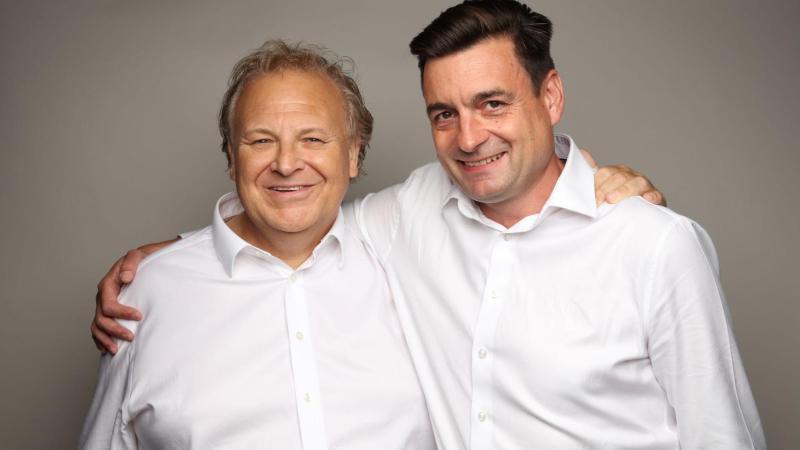
How the contrasting styles of two entrepreneurs saw them team up as partners, taking them from startup risk to leading the UK arm of one of Europe’s top AI-driven consultancies
Some business partnerships are engineered. Others form under pressure and hold because neither side ever gives the other a reason to doubt them.
Steve Crowley and John Lacey sit firmly in the second category.
From first working together in the 1990s to their current roles as Managing Directors at Devoteam UK & Ireland, the two leaders still operate with the kind of alignment most founders spend years trying to manufacture. And it all started nearly 30 years ago.
“1997,” they say. “Our background came from the Unisys Corporation, where we both worked and met,” Lacey added.
It was not a startup environment. It was public-sector technology delivery. High-stakes, prolonged timelines, and little room for error. What emerged during those years was not just familiarity. It was pattern recognition. They approached problems differently but arrived at the same conclusions, a dynamic that would later define their partnership.
Different Strengths, One Direction
Crowley gravitated toward defining what the business should sell and why. Lacey gravitated towards winning, a born salesman.
Lacey is a charming and larger-than-life figure who commands a room by exuding confidence with endearing, no-nonsense humor and direct plain speaking, a trait of his upbringing in Northern England.
It’s easy to see why he has achieved so much in his career. Lacey is known for being a persuasive and personable communicator. Yet it was also his entrepreneurial vision that alerted his junior colleague at the time during their employment at Unisys.
“The reason I got to know John is because I got more interested in developing propositions,” Crowley said. “What does the customer need? What does the market need?” Lacey, he added, was the person you wanted when it was time to close. “John was (and still is) the best guy you want in the room doing the selling bit.”
That early division of instinct would prove foundational. Many founder relationships collapse because both people want control of the same decisions. Crowley and Lacey moved naturally into complementary lanes, then learned enough about each other’s worlds to operate without friction. They also carried forward a shared standard, shaped by their early environment.
“Unisys has shaped the way John and I think,” Crowley said. “They’re an engineering company. They are honest, direct and good.”
Lacey remembers it as something closer to ownership.
“We felt like a team, and we felt that was our company,” he said. “We were absolutely committed. We’d fight for business, we’d fight for delivery.”
The Moment Entrepreneurs Recognize
Yet for both men, the turning point came when corporate momentum stopped matching their own. “If you’re an entrepreneur, you feel like you’re in a traffic jam,” Crowley said. “You want to go faster.”
Crowley is matter-of-fact. No frills, no fluff. Also hailing from ‘The North,’ Crowley projects a calm and reliable presence, particularly when dealing with complex technical challenges. The quiet confidence of a man who knows what he’s doing.
Crowley’s no frills, ‘let’s get it done’ mantra of creating every day is the perfect juxtaposition to Lacey’s confidence in what he is selling, knowing who he is selling to, and his innate ability to close a deal.
Despite the calm exterior surface, a fierce ambition lies within Crowley, which was the impetus for taking the leap into the unknown with Lacey as the pair were finding that during their final months at Unisys: “a lot of people started taking credit for the good stuff we were doing,” Lacey said.
The frustration eventually stopped being temporary, and the pair channeled it to be directional: “Most of us are frustrated to the point where we have to make a change,” Crowley said.
The leap that followed was not polished. “We didn’t really have an amazing business plan. We had a stupid business plan.”
Then came the reality check every first-time founder remembers after leaving a big corporation to launch a startup. The phone does not ring. The inbox is nearly empty. “From one day where you’re getting 400 emails to this one deathly silence,” he said.
What Actually Holds a Partnership Together
Early-stage quiet has the potential to break weak partnerships fast. In their case, it distilled something special.
“From day one, we have always had faith in each other,” Lacey said. “And faith in our partnership.”
Crowley described the daily mindset in simpler terms: “You still have to create every day, and that’s what John and I constantly do.”
The mindset changed from reactive to proactive.
That ability to keep moving without external validation became a defining trend in their working relationship. Interestingly, neither describes the decision to start a company together as dramatic. It was gradual and slightly awkward.“It’s like a dating thing,” Crowley said. “You don’t want to be the first to say, ‘Should we start a business together?’”
Instead, the idea surfaced repeatedly as opportunities appeared within Unisys that they both believed should have been pursued but were not. “At that time, Unisys weren’t organised enough to go and put the bids together,” Crowley said. Eventually, the question stopped being hypothetical, and Crowley asked what was stopping them from going and doing it. Lacey responded that nothing should stop them, and despite being more senior and with more to lose than Crowley on the gamble, their journey together began in the early 2000s.
Why the Roles Still Work
Two decades later, their responsibilities remain distinct but fluid.
“John is a sales guy,” Crowley said. “John closed a deal on Monday that probably nobody else could have closed.”
His own focus sits upstream. “I’m more interested in what we’re going to sell and building teams,” added Crowley.
Lacey remembers the early days differently, less structure, more survival. “At the beginning, it was just mobilize, do everything.”
The durability comes from something less tactical: self-awareness. “You’ve got to be humble enough to understand where your gaps are,” Crowley said.
Lacey never considered doing it alone: “I wouldn’t have wanted to do it without Steve. The journey’s been a journey of excitement because of working with Steve.”
In fact, conflict has been rare: “You could probably count any disagreement on one hand,” they both agreed.
The Real ‘Secret Sauce’ Is Not Complicated
When asked directly what keeps a long-term business partnership intact, Lacey does not hesitate.
“We trust each other implicitly,” he said. “We communicate everything and everything—the foundation is trust.”
But trust alone is passive. What makes it productive is shared drive.
“We share that tenacity and fight, that passion to win.”
And it never switches off.
“Always pushing. Nothing’s ever good enough.”
For founders looking for a formula, there is none hidden here. The traits are basic, but they are enforced daily.
They Don’t Pretend the Journey Was Smooth
One reason the partnership reads as credible is their willingness to talk about mistakes without reframing them as strategy.
“We’ve messed a lot of things up,” Crowley said plainly.
Lacey described an early stretch even more bluntly: “We found the wrong people and ended up getting rid of all of them.”
Moments like that are where partnerships either fracture or deepen. Theirs held.
“It’s like looking into the abyss and eating glass,” Lacey said.
Not a metaphor most executives would choose casually, which is exactly why it lands.
Rebuilding Is Part of the Pattern
Their first business eventually hit a wall. Instead of stretching a declining model, they reset, pivoted, and found Amazon Web Services (AWS), which signaled a turning point.
The pivot forced them into another uncomfortable position: selling something skeptical customers were not yet sure they trusted, mainly due to handing data over to external providers.
Talent proved just as volatile. Early hires trained in emerging cloud skills left within six months, seeking better pay elsewhere with their newfound expertise.
Crowley and Lacey adapted again, building around high-caliber talent rather than temporary capacity: “If we can make our brand the place to work, then we’ll attract the right talent,” Crowley said. It is a philosophy that mirrors their partnership—invest in the right people, align expectations, and let performance compound.
When the Partnership Was Tested at Scale
That focus on talent and delivery ultimately positioned the business for its next phase. Around eighteen months ago, Crowley and Lacey sold their cloud consultancy to one of Europe’s leading AI-driven technology consultancies, Devoteam, shifting their partnership from founder-led execution to enterprise-scale leadership.
Soon after the deal closed, Devoteam founder Stanislas de Bentzmann reportedly tasked them with building a leading AWS practice in the United Kingdom before later expanding their remit to the UK & Ireland business, placing the same operating partnership that had navigated startup uncertainty in charge of a far larger business.
Crowley and Lacey say they have already delivered as Amazon Web Services has named Devoteam its Consulting Partner of the Year for the United Kingdom and Ireland, with the announcement made at the AWS Partner Summit in London in April. The recognition comes through the 2026 Regional AWS Partner Awards program, which singles out firms across the globe for their role in helping organizations adopt and build on AWS infrastructure.
Devoteam recognises that the award acknowledges its performance in AWS Migration and Modernization projects over the past year, alongside its ability to deliver complex, large-scale programs and its growing pool of AWS-certified specialists across its UK and Ireland operations. Canalys audited the underlying data used to evaluate all nominees, ensuring the selection process was grounded in objective performance metrics.
Lacey said. “This award reflects the quality and impact of the work our people do every single day, particularly in AI and cloud migration and modernisation, where we are consistently setting new standards across the UK and Ireland.”
After 20 Years, It Still Works
Strip away the history, and one advantage becomes clear: shared processing speed.
“So what I’m thinking, he’s thinking,” Crowley said. “Six steps down, we’re already there. You don’t meet many people like this.”
Fewer explanations. Lesser analysis. Faster decisions.
Lacey still sounds energized by the unpredictability that comes with building: “I’ve been in business for years, and it still comes at you as something. Can you believe what we’ve got here today?” he says.
The pair does not frame the partnership as friendship, though there is respect. They frame it as alignment.
“Trust, humility, respect,” Lacey said, summarizing it in three words before adding a final note of self-awareness. “We’ve got a bit of ego. I’m a sales guy after all.” Lacey is often described as approachable and down-to-earth despite his background in sales.
After more than two decades, their partnership does not run on personality. It runs on standards, clarity of role, and the confidence that when one pushes forward, the other is already moving.
For founders chasing the idea of the perfect co-founder, their story suggests something simpler. Find someone who sees the road the same way you do and is willing to keep building when it goes quiet.
Then show up on Monday, and create.
How the contrasting styles of two entrepreneurs saw them team up as partners, taking them from startup risk to leading the UK arm of one of Europe’s top AI-driven consultancies
Some business partnerships are engineered. Others form under pressure and hold because neither side ever gives the other a reason to doubt them.
Steve Crowley and John Lacey sit firmly in the second category.
From first working together in the 1990s to their current roles as Managing Directors at Devoteam UK & Ireland, the two leaders still operate with the kind of alignment most founders spend years trying to manufacture. And it all started nearly 30 years ago.