WHEN EVERYTHING CAN BE RECREATED, WHAT BECOMES RARE?
Massimo Moretti believes AI will make human creativity more valuable.
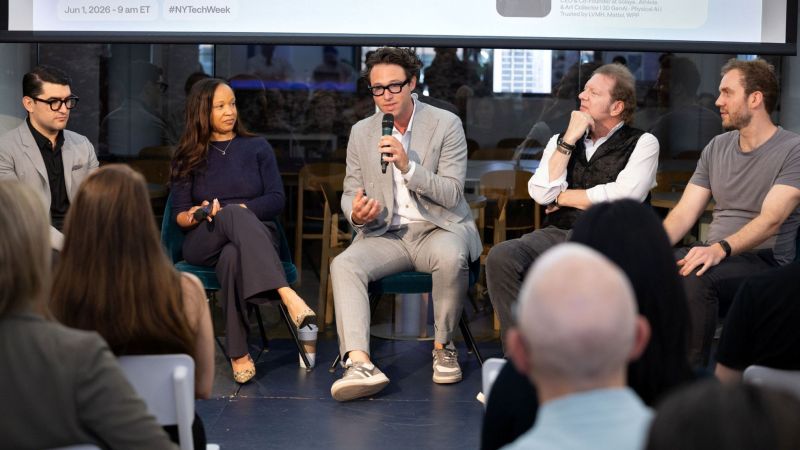
Massimo Moretti
Massimo Moretti, NYC, TechWeek at Betaworks office
Opinions expressed by Entrepreneur contributors are their own.
You're reading Entrepreneur United Kingdom, an international franchise of Entrepreneur Media.
Massimo Moretti is betting that the future of 3D creation fits in the palm of your hand. As AI makes sophisticated production faster and more accessible, the Solaya co-founder believes the technology will make human creativity more valuable. Pick up a handbag, a chair, a pair of trainers, almost anything around you, and imagine turning it into a detailed 3D model with your smartphone. That is the idea behind Solaya. The French deeptech company, founded by Massimo Moretti and Mariem Farhat, is building technology that turns physical products into high fidelity 3D assets. The pitch is simple : “We want to make high quality 3D as simple as taking a photo.” For Moretti, the idea came from seeing how much work goes into creating content for major brands. Before Solaya, he and Farhat worked on strategy, technology and content projects for global names including LVMH, Richemont, Calvin Klein, L’Oréal and Mercedes Benz. They saw brands spending heavily on photography, video, campaigns and 3D assets, and saw an opportunity to rethink how that content was created. Around three years ago, they were asked to explore what AI might mean for content production in the world of high-end brands. Image generation tools were advancing rapidly, but high quality 3D remained expensive, technically demanding and slow. Their response was to build a different kind of tool.
WHEN EVERYONE HAS THE SAME TOOLS, WHAT WINS?
This is where the conversation moves beyond 3D. If AI and new creative tools become available to everyone, simply having access to them won’t make a brand distinctive. For Moretti, the answer is creativity. “Creators, artists & designers are more important than ever,” he says. “Quality, « savoir-faire », ArtThinking, Culture & creativity” will be the differentiators, alongside the experience and judgement of the person using the technology. Since Ai is very generalistic and not really trained on top quality content. That has a practical implication for creative teams. A 3D designer working across hundreds or thousands of products may spend a huge amount of time doing repetitive work. Automating some of it leaves more room for the decisions that actually require a creative eye. As Moretti puts it: “If you have hundreds or thousands of products, it’s sometimes boring.” That is the opportunity he sees in AI and 3D: not replacing the creative process, but giving people more time to do the part that matters.
ONE SCAN. MORE POSSIBILITIES
3D isn’t new. It has been used for years across fashion, film, gaming, architecture, manufacturing and product design. What is changing is access. Solaya allows a physical product to be scanned with a smartphone and turned into a digital asset that can be reused across different applications. Moretti calls it “one scan, unlimited use cases.” For a luxury brand, a digital version of a handbag, watch or shoe could be used across e-commerce, social media, campaigns and interactive experiences. For an artist or designer, a physical creation can become something that can be explored and adapted digitally. Then there are the applications that consumers may not see yet. Moretti points to digital twins, 3D printing and robotics as areas where accurate digital representations of physical objects could become increasingly important. Major clients include LVMH, Mattel, and Karl Lagerfeld. Products such as handbags and toys that once required days of studio work can now be scanned in minutes, generating a high-quality visual digital twin ready for content creation. A digital twin is more than a photograph. It is a detailed digital representation of an object that can carry information about its form and characteristics. For a business, that means one digital asset could potentially be used to create different forms of content without repeatedly starting with the physical product. The result is less about making another image and more about giving a product a digital life.
THE POWER OF IMPERFECTION
Moretti’s view becomes particularly interesting when the conversation turns to luxury. With French and Italian influences shaping his outlook, he sees craftsmanship as something technology should support rather than erase. “Craftsmanship will never disappear,” he says. Then comes the line that says a lot about his approach: “Perfection is boring.” For Moretti, the point of better technology isn’t to make every product look flawless or every creative process identical. It is to give designers more freedom to experiment and push an idea further. That distinction matters as AI makes polished imagery increasingly easy to produce. When everyone can create something technically impressive, technical ability becomes less of a differentiator. Taste matters. So does originality.
THE NEXT SCREEN COULD BE ON YOUR FACE
Moretti is already looking beyond smartphones. Today, the smartphone is the main interface between people and digital content. Tomorrow, much of that interaction could happen through smart glasses, AR headsets, and other wearable devices. But these devices need to understand and display the physical world in 3D. Imagine seeing additional information about a piece of art while standing in front of it. Or viewing a dish in 3D before ordering it. Or speaking to someone in another language while technology translates the conversation in real time. The possibilities are exciting, but Moretti acknowledges that some of the technology can also feel unsettling. “The glasses are scary,” he says. He is quick to acknowledge the other side of the conversation, particularly around how people will adapt to increasingly immersive technology and how much of it they will ultimately want in their everyday lives. That leads the conversation somewhere unexpected: to the value of switching off.
THE VALUE OF SWITCHING OFF
Ask Moretti about some of his favourite experiences and the answer isn’t necessarily futuristic. He talks about a hotel in Salina, Sicily, where the appeal is its natural, old-school atmosphere. He mentions Azulik in Tulum, an experience designed around stepping away from many of the conveniences of modern life. For someone building a company around digitising physical objects, it might sound like a contradiction. It isn’t. Moretti’s argument is that technology should make life and work more capable, not make every moment more digital. In cities such as London, Paris, Milan, and New York, convenience has become almost invisible. Food can arrive at your door. A car is a few taps away. Almost anything can be ordered online. But when everything is available instantly, availability itself becomes less interesting. “Sometimes people need challenges,” Moretti says. One of the reasons he decided to build a deeptech company. He sees that as part of the enduring appeal of luxury. “The fact that something or someone is not accessible makes this unique.” A handmade object. A remote hotel. A restaurant you have to wait for. Somewhere without a phone signal. The less effort something requires to access, the more valuable an experience can become when it asks something of you. And that is where Moretti’s view of technology becomes particularly interesting. He isn’t trying to replace the physical world. He is trying to give people more ways to experience it.
THE REALITY OF BUILDING SOMETHING NEW
Of course, none of this makes building a technology company easy. Funding was one of Solaya’s first challenges. Early business angels from NVIDIA, Adobe invested €10,000, €20,000 and €30,000 while the company was still largely an idea. Moretti remembers how much those early believers mattered. Then came the setbacks. One major project fell through at the last minute after months of work. Moretti and Farhat were understandably frustrated, but the reaction was short lived. They carried on. “Building a company is the art of turning uncertainty into momentum.” Moretti says. An employee receives an offer from a bigger company. A client changes direction. Cash flow becomes difficult. A project that looked certain suddenly isn’t. It is not the glamorous side of entrepreneurship, but it is the reality of it. And resilience, Moretti says, is essential.
THE HUMAN ADVANTAGE
Moretti expects 3D to become increasingly accessible, with applications extending into manufacturing, robotics and the way we interact with products. He is particularly interested in physical AI, where robots need vast amounts of data to understand and interact with the objects around them. Before being digital the world is physical and we need a high fidelity representation of the world both for objects and spaces. But his argument ultimately goes beyond the technology itself. Use the tools. Automate the repetitive work. Experiment faster. Give creators more room to think. Then keep the human part. “The challenge is how you keep the human touch at the centre of any experience,” Moretti says. It is perhaps the most important point he makes. Because the future he describes isn’t one where technology replaces creativity. It is one where technology takes care of more of the work around creativity, leaving people to make the decisions machines still struggle to make: what is beautiful, what is original, what is worth seeing and what is worth remembering. The opportunity isn’t to make everything virtual. It’s to make technology powerful enough to give us more freedom to be human.
Massimo Moretti is betting that the future of 3D creation fits in the palm of your hand. As AI makes sophisticated production faster and more accessible, the Solaya co-founder believes the technology will make human creativity more valuable. Pick up a handbag, a chair, a pair of trainers, almost anything around you, and imagine turning it into a detailed 3D model with your smartphone. That is the idea behind Solaya. The French deeptech company, founded by Massimo Moretti and Mariem Farhat, is building technology that turns physical products into high fidelity 3D assets. The pitch is simple : “We want to make high quality 3D as simple as taking a photo.” For Moretti, the idea came from seeing how much work goes into creating content for major brands. Before Solaya, he and Farhat worked on strategy, technology and content projects for global names including LVMH, Richemont, Calvin Klein, L’Oréal and Mercedes Benz. They saw brands spending heavily on photography, video, campaigns and 3D assets, and saw an opportunity to rethink how that content was created. Around three years ago, they were asked to explore what AI might mean for content production in the world of high-end brands. Image generation tools were advancing rapidly, but high quality 3D remained expensive, technically demanding and slow. Their response was to build a different kind of tool.
WHEN EVERYONE HAS THE SAME TOOLS, WHAT WINS?
This is where the conversation moves beyond 3D. If AI and new creative tools become available to everyone, simply having access to them won’t make a brand distinctive. For Moretti, the answer is creativity. “Creators, artists & designers are more important than ever,” he says. “Quality, « savoir-faire », ArtThinking, Culture & creativity” will be the differentiators, alongside the experience and judgement of the person using the technology. Since Ai is very generalistic and not really trained on top quality content. That has a practical implication for creative teams. A 3D designer working across hundreds or thousands of products may spend a huge amount of time doing repetitive work. Automating some of it leaves more room for the decisions that actually require a creative eye. As Moretti puts it: “If you have hundreds or thousands of products, it’s sometimes boring.” That is the opportunity he sees in AI and 3D: not replacing the creative process, but giving people more time to do the part that matters.
ONE SCAN. MORE POSSIBILITIES
3D isn’t new. It has been used for years across fashion, film, gaming, architecture, manufacturing and product design. What is changing is access. Solaya allows a physical product to be scanned with a smartphone and turned into a digital asset that can be reused across different applications. Moretti calls it “one scan, unlimited use cases.” For a luxury brand, a digital version of a handbag, watch or shoe could be used across e-commerce, social media, campaigns and interactive experiences. For an artist or designer, a physical creation can become something that can be explored and adapted digitally. Then there are the applications that consumers may not see yet. Moretti points to digital twins, 3D printing and robotics as areas where accurate digital representations of physical objects could become increasingly important. Major clients include LVMH, Mattel, and Karl Lagerfeld. Products such as handbags and toys that once required days of studio work can now be scanned in minutes, generating a high-quality visual digital twin ready for content creation. A digital twin is more than a photograph. It is a detailed digital representation of an object that can carry information about its form and characteristics. For a business, that means one digital asset could potentially be used to create different forms of content without repeatedly starting with the physical product. The result is less about making another image and more about giving a product a digital life.

Viktoria Walkowiak • Communications and Content professional
Viktoria Walkowiak is a Communications and Content professional at Entrepreneur UK, working across editorial, storytelling... Read more