How to assess the evidence behind a broker comparison score
Noam Korbl, co-founder and COO of Compare Forex Brokers, writes in his published author profile, “My approach is to ignore the headline and rebuild the cost from the parts.” That mindset encourages readers to assemble the components themselves rather than trust a single number.
CompareForexBrokers
You're reading Entrepreneur United Kingdom, an international franchise of Entrepreneur Media.
What a score actually represent
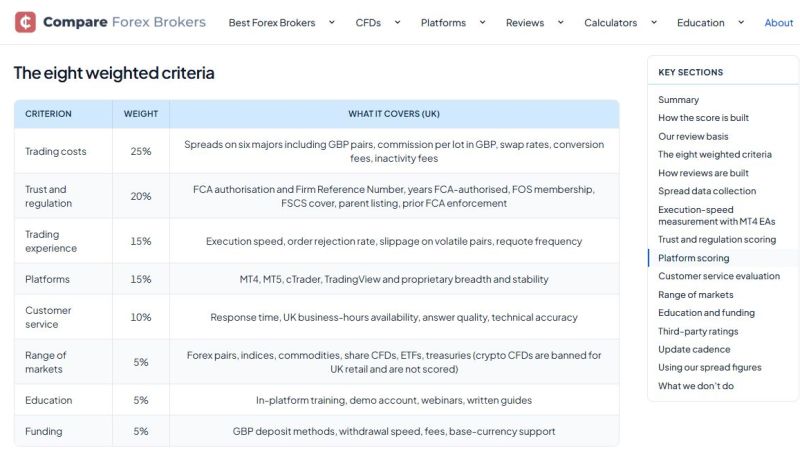
A comparison score is not a prediction of how any individual account will perform. It is an aggregation of evidence shaped by editorial decisions about what to measure and how heavily to weight each element. Two reviewers with the same raw data can produce different scores because the weighting reflects judgement, not arithmetic alone. That is why a single speed figure or headline rating should never be treated as the whole answer. A reader who cares about execution quality may weigh captured prices differently from someone focused on support, and the underlying components matter more than the final number. The published methodology at compareforexbrokers.co.uk distinguishes prices the site captured itself from advertised rates for tiers it did not measure, and explains how the weighted scoring works. It is the site’s own published method, not an independent audit or certification. The same explicit judgement runs through the customer service evaluation, where accuracy is scored alongside responsiveness. Justin Grossbard, co-founder of Compare Forex Brokers, writes in the published methodology, “A fast reply that gets the regulation or the fees wrong scores worse than a slower, correct one.” The scoring appears to favor accuracy over speed, which is a choice a reader should see rather than a fact to accept. Looking behind the rating means asking what was measured, what was weighted and what was left out for the account and service you would actually use.
Authorisation checks come first
A comparison cannot establish that the firm you would deal with is authorised for the activity you intend. The FCA Firm Checker lets you check whether a firm is authorised and has permission for the intended service, though authorisation does not remove all risk, and the tool cannot confirm whether Financial Services Compensation Scheme or Financial Ombudsman Service protection will definitely apply. The Financial Services Register gives further details about firms and their permissions. The FCA advises matching the firm’s permissions to the activity and using the register’s contact details to verify you are dealing with the genuine firm. Do not assume that a shared trading brand identifies the entity named on a client agreement, since the brand you recognise and the entity you would contract with are not always the same thing.
Pricing evidence needs context
An advertised minimum spread tells you only the best case a broker is willing to publish. An observed sample, gathered from live quotes at particular times, shows what actually appeared during a limited window. Neither figure equals the complete cost of trading, because the full picture depends on the currency pair, the account tier, the platform used, the observation period, the size of each trade, any commission charged on top of the spread, and overnight financing applied to positions held past a certain hour.
Noam Korbl, co-founder and COO of Compare Forex Brokers, writes in his published author profile, “My approach is to ignore the headline and rebuild the cost from the parts.” That mindset encourages readers to assemble the components themselves rather than trust a single number.
Consider a hypothetical trader who opens and closes positions within the same day. This trader mainly faces the spread and any commission. A second hypothetical trader who holds identical positions overnight adds financing charges to that bill. Whether financing becomes the larger component for the second trader depends on the rates and duration involved, so it should be checked rather than assumed.
Rebuilding costs this way helps readers compare brokers fairly, though actual results will always vary with conditions.
The evidence checklist
| Comparison claim | Evidence to request | Remaining limitation |
|---|---|---|
| Authorisation | Permission status and entity name via official registers | Does not confirm scheme eligibility or remove all risk |
| Pricing | Pair, account tier, platform, observation period and trade size | A sample may not match your activity or holding period |
| Execution | How requests and fills were measured, and on which account and platform | A single speed number cannot establish overall execution quality |
| Overall score | Criteria, weightings and whether each item is measured or judged | Weightings are editorial choices, not predictions of your outcome |
Record what you find
When reviewing any comparison, note the source URL, the exact entity and account referenced, the observation period and whether each claim is measured, advertised or an editorial judgement. This habit distinguishes missing evidence from a negative product finding. If a site cannot show its pricing basis or explain a weighting, the available evidence does not yet confirm the claim, not that something improper has occurred. Ask for the explanation or simply leave the item marked unknown.
Commercial relationships deserve scrutiny
Affiliate relationships and sponsored articles should be disclosed. Payment itself does not make a statement false, and the absence of payment does not make it true. What you should inspect is both the supporting evidence and how any commercial relationship affects inclusion, scoring or placement within the comparison. A disclosed arrangement with clear methodology is easier to assess than an undisclosed one, but disclosure alone is not verification.
Keep the activity in view
There is also a distinction worth holding onto between a business paying overseas invoices and speculative leveraged trading. A firm converting currency to settle supplier bills has a practical treasury need. Leveraged retail forex and CFD trading is a different activity, with a different risk profile, and a business should not treat spare operational cash as trading capital. The FCA describes CFDs as high-risk products that are unsuitable for some retail consumers, and its CFD information is worth reading directly. A comparison score does not predict returns or establish suitability for anyone.
Your next step
Before treating any comparison as relevant, verify the entity on the Financial Services Register, confirm it holds permission for the service you intend, and retrieve the pricing and methodology records behind the claims you are relying on. Mark each item as measured, advertised or editorial judgement as you go. That file of evidence, rather than the headline score, is what will tell you whether a comparison deserves a place in your decision.
Investing involves risk and your investment may lose value. Past performance gives no indication of future results. These statements do not constitute and cannot replace investment advice.
Sponsored content supplied by Compare Forex Brokers. This is educational material, not an independent publisher endorsement, and does not constitute personalised advice.
What a score actually represent
A comparison score is not a prediction of how any individual account will perform. It is an aggregation of evidence shaped by editorial decisions about what to measure and how heavily to weight each element. Two reviewers with the same raw data can produce different scores because the weighting reflects judgement, not arithmetic alone. That is why a single speed figure or headline rating should never be treated as the whole answer. A reader who cares about execution quality may weigh captured prices differently from someone focused on support, and the underlying components matter more than the final number. The published methodology at compareforexbrokers.co.uk distinguishes prices the site captured itself from advertised rates for tiers it did not measure, and explains how the weighted scoring works. It is the site’s own published method, not an independent audit or certification. The same explicit judgement runs through the customer service evaluation, where accuracy is scored alongside responsiveness. Justin Grossbard, co-founder of Compare Forex Brokers, writes in the published methodology, “A fast reply that gets the regulation or the fees wrong scores worse than a slower, correct one.” The scoring appears to favor accuracy over speed, which is a choice a reader should see rather than a fact to accept. Looking behind the rating means asking what was measured, what was weighted and what was left out for the account and service you would actually use.
Authorisation checks come first
A comparison cannot establish that the firm you would deal with is authorised for the activity you intend. The FCA Firm Checker lets you check whether a firm is authorised and has permission for the intended service, though authorisation does not remove all risk, and the tool cannot confirm whether Financial Services Compensation Scheme or Financial Ombudsman Service protection will definitely apply. The Financial Services Register gives further details about firms and their permissions. The FCA advises matching the firm’s permissions to the activity and using the register’s contact details to verify you are dealing with the genuine firm. Do not assume that a shared trading brand identifies the entity named on a client agreement, since the brand you recognise and the entity you would contract with are not always the same thing.
Entrepreneur UK
Entrepreneur Staff