Entrepreneur UK Business Breakfast: Business Before Brunch
Four entrepreneurs share lessons on ambition, growth, purpose and success.
Snezhana Yarovaya
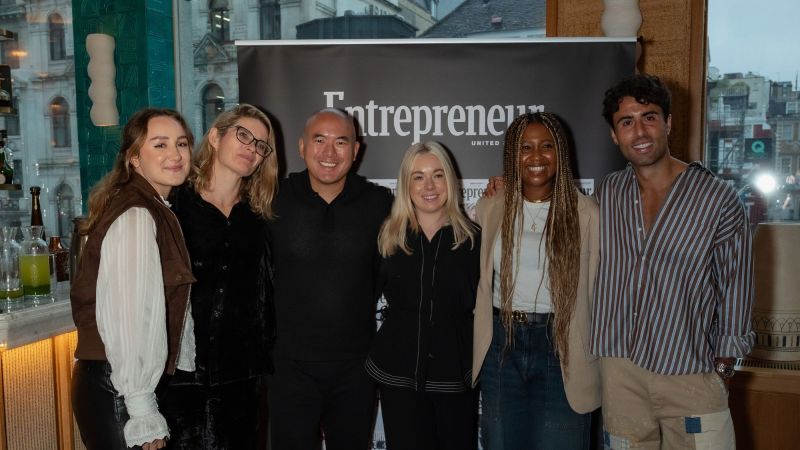
Viktoria Walkowiak and Patricia Cullen with the Business Breakfast speakers Simon Alexander Ong, Lauren Templeton, June Angelides MBE and Alberto Zandi
Opinions expressed by Entrepreneur contributors are their own.
You're reading Entrepreneur United Kingdom, an international franchise of Entrepreneur Media.
What does a former Silicon Valley banker, a performing arts entrepreneur, an executive coach and a young hospitality millionaire have in common? They were all at Riviera yesterday morning for Entrepreneur UK’s Business Breakfast. Simon Alexander Ong, June Angelides MBE, Lauren Templeton and Alberto Zandi arrived from very different corners of the business world, but each has built a career around spotting an opportunity and then figuring out what to do with it.
Ong, the executive coach, keynote speaker, business adviser and bestselling author of Energize, has built his career around helping people think differently about performance, leadership and the way they use their energy. His work is particularly relevant to entrepreneurs, whose businesses can quickly become all-consuming. There is always another meeting, another decision and another problem waiting to be dealt with. As a company grows, so does the responsibility that comes with it. The challenge for a founder is often no longer simply how to make the business work, but how to keep themselves working well alongside it.
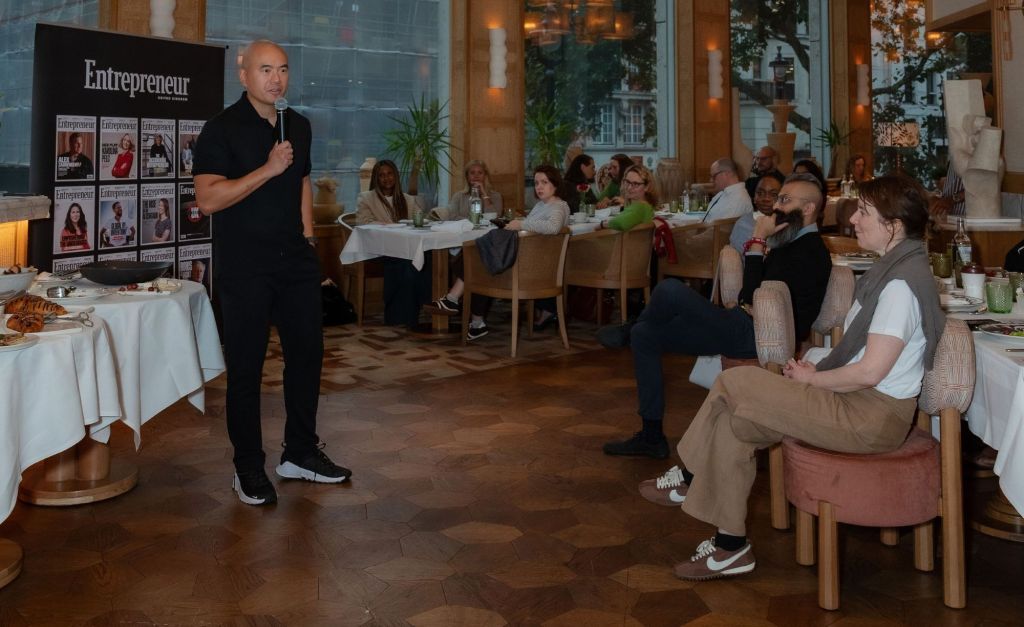
That is where much of Ong’s thinking sits. His bestselling book Energize explores the relationship between energy and performance, and the importance of being more conscious about where that energy goes. It is a subject that can easily be overlooked in a business culture which tends to celebrate long hours and constant momentum. For Ong, that way of thinking also extends to how entrepreneurs approach the business itself. “Thinking strategically in business is about thinking creatively, but it’s also about having the courage to follow through,” he said. The ability to challenge your own thinking is just as important, particularly when a founder becomes surrounded by the same people and ideas. “If you spend time around the same people all the time, you’ll never think differently. Start diversifying and surround yourself with people who think differently.”
June Angelides MBE came to the breakfast with a very different perspective. Her career has taken her from Silicon Valley Bank into entrepreneurship and venture capital, and she is now the founder and CEO of MyPholyo. The company is building financial infrastructure for people whose careers and income extend beyond a single job – something that is becoming increasingly relevant as working lives become less straightforward.

The traditional picture of employment was relatively simple: one employer, one salary and a fairly predictable career path. That is no longer the reality for a growing number of people. Someone might run a business while consulting, have freelance income alongside employment or move between different types of work throughout their career. Entrepreneurs, in particular, rarely have a single source of income for very long. The financial systems built around them have not always kept pace. That is the gap Angelides is looking to address with MyPholyo. Her own career, moving between banking, entrepreneurship and venture capital, gives her a useful perspective on the changes taking place. That experience has also shaped how Angelides thinks about building a career and creating a sense of worth on your own terms. “Eventually, I recognised that no one was coming to save me. If I was going to come from a place of worth, I was going to have to design it myself.” It is an idea that sits naturally alongside her thinking about the changing world of work, where traditional career structures are becoming less fixed. That change is also opening up new possibilities around fractional working. “With the rise of fractional working, don’t be apprehensive. These people understand your customers and they understand your business. The question is, what happens next? Do you think they aren’t committed enough? That decision could cost you the exact expertise your business needs,” she warns.
For businesses trying to scale, the question is increasingly not simply who to employ, but what expertise they need and how best to bring it into the organisation. For Lauren Templeton, another speaker at Entrepreneur UK’s Business Breakfast, the route into business began somewhere quite different: the performing arts. Templeton has spent 30 years in dance and a decade teaching. Over the past seven years she has built Select School of Performing Arts into the UK’s largest independent performing arts provider. It is a significant achievement, particularly in an industry that is not usually discussed in the same breath as venture capital or high-growth technology businesses. But the challenges of scaling are familiar.

There comes a point when a founder cannot do everything themselves. The skills that help someone become successful in their profession are not necessarily the same skills required to run a growing organisation. Templeton has had to make that transition – from dancer and teacher to entrepreneur and business leader, building a company around the expertise she developed over three decades. “What was your starting point? There comes a point where the passion that started it and gave us the idea can also end up holding us back.” It is a recognition that the thing which gets a business started is not always the thing that allows it to grow. “When I started, I did everything myself – teaching, admin, sales and marketing. I was drained of all my creative ideas because I was stuck doing everything.” Her experience captures one of the less glamorous realities of entrepreneurship: the founder can become the bottleneck in the very business they are trying to build. Select is now much bigger than the original business. There are people to manage, systems to put in place and standards to maintain as the organisation grows. It is a reminder that businesses are often built around skills and experience that existed long before anyone started using the word “entrepreneur”.
Then there is Alberto Zandi. Together with his twin brother, Arian, Zandi has built Emerald Hospitality Group into a major hospitality business, with more than 400 employees, eight-figure revenues and a growing portfolio of concepts. He became a millionaire at just 25, but reaching that milestone did not necessarily feel the way he had expected. “I was achieving, but it wasn’t feeling like I thought it would feel,” Zandi said. “So instead of looking outwards, I started looking inwards, and this has been the most transformative year of my whole life.” That shift in perspective has changed the way Zandi thinks about success. Having achieved the kind of financial milestones that many entrepreneurs spend their careers chasing, he began to question whether material success was actually what mattered to him. “I realised that what matters to me is not something material,” he said. “There is a difference between having fun and happiness. There’s a disconnect.”

It is a particularly interesting perspective given how young Zandi was when he achieved financial success. There is plenty of attention paid to the moment an entrepreneur makes their first million, sells a business or reaches a particular financial milestone. Less attention is given to what happens afterwards, when the achievement itself no longer provides the satisfaction that was expected. That realisation has also shaped how Zandi thinks about the next generation of entrepreneurs and the lessons he can pass on from his own experience. “I can help the younger version of myself, that young entrepreneur that was getting into entrepreneurship for the wrong reasons, to become an entrepreneur for the right reasons — to show youngsters that ordinary beginnings can lead to extraordinary endings.”
That idea sits alongside Zandi’s work as the host of Thriving Minds, where conversations extend beyond business performance into personal development and what it means to live well while building a successful career. At the same time, Emerald Hospitality Group has continued to grow. Building a hospitality business brings a very different set of pressures from those involved in getting a company off the ground. The business has to work every day, not just when the founders are in the room. People need to be recruited and managed, customers need to keep coming back and new concepts have to work in practice. There is no hiding from the detail in hospitality. That makes Zandi’s story about more than the number in his bank account at 25. It is also about what happens when early success forces you to reconsider what success actually means.
The four speakers brought very different experiences to Riviera. Ong’s focus is on people and performance. Angelides is looking at the financial infrastructure required by a changing workforce. Templeton has grown a business from a lifetime in the performing arts. Zandi has built a hospitality group with his brother while considering what success means beyond financial achievement. There was no single entrepreneurial formula running through the morning, and perhaps that was the point. The routes into business are rarely as straightforward as they appear afterwards. A career can move from banking to investment to entrepreneurship. A teacher can become the founder of a large organisation. A young entrepreneur can reach financial success and then find themselves asking what they want from it.
For anyone in the room building a business of their own, those are familiar complications. Starting is one thing. Working out how to grow, when to step back, how to manage people and what you actually want from the business once it becomes successful are rather different questions. That was the territory covered over breakfast at Riviera this morning – alongside the coffee, conversations and inevitable exchange of business cards.
The four stories were very different, but the questions around them were familiar to anyone building a business: when to grow, when to change, how to bring people with you and what you want from the business once it starts to succeed.
Stay tuned for details of upcoming Business Breakfast dates, as well as a fuller, more comprehensive feature in the next issue of Entrepreneur UK magazine.
What does a former Silicon Valley banker, a performing arts entrepreneur, an executive coach and a young hospitality millionaire have in common? They were all at Riviera yesterday morning for Entrepreneur UK’s Business Breakfast. Simon Alexander Ong, June Angelides MBE, Lauren Templeton and Alberto Zandi arrived from very different corners of the business world, but each has built a career around spotting an opportunity and then figuring out what to do with it.
Ong, the executive coach, keynote speaker, business adviser and bestselling author of Energize, has built his career around helping people think differently about performance, leadership and the way they use their energy. His work is particularly relevant to entrepreneurs, whose businesses can quickly become all-consuming. There is always another meeting, another decision and another problem waiting to be dealt with. As a company grows, so does the responsibility that comes with it. The challenge for a founder is often no longer simply how to make the business work, but how to keep themselves working well alongside it.
That is where much of Ong’s thinking sits. His bestselling book Energize explores the relationship between energy and performance, and the importance of being more conscious about where that energy goes. It is a subject that can easily be overlooked in a business culture which tends to celebrate long hours and constant momentum. For Ong, that way of thinking also extends to how entrepreneurs approach the business itself. “Thinking strategically in business is about thinking creatively, but it’s also about having the courage to follow through,” he said. The ability to challenge your own thinking is just as important, particularly when a founder becomes surrounded by the same people and ideas. “If you spend time around the same people all the time, you’ll never think differently. Start diversifying and surround yourself with people who think differently.”

Patricia Cullen • Features Writer
Entrepreneur Staff