We Don’t Need AI to Ship Products Faster, We Need it to Shape More Useful Ones
Why businesses need to resist AI hype and choose technology wisely.
Shutterstock
Opinions expressed by Entrepreneur contributors are their own.
You're reading Entrepreneur United Kingdom, an international franchise of Entrepreneur Media.
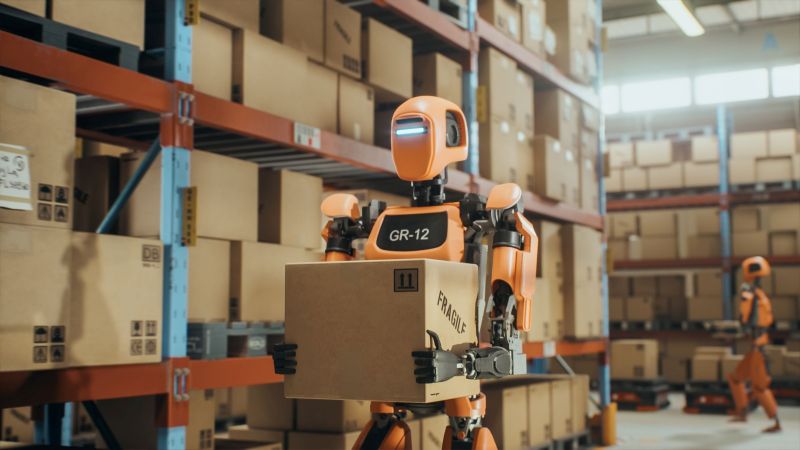
Hit the streets of Milton Keynes, Stevenage or Bristol and it won’t be long before you encounter a delivery robot. Often resembling a mini fridge on wheels, these “robo-couriers”, once solely the stuff of science fiction, now share pavements with pedestrians. They’re being marketed to businesses as a quick, affordable way to put products in customers’ hands and they’re another example of a tech-shaped rabbit hole businesses seem all too keen to burrow down.
Rewind to 2021 and Virtual Reality (VR) was being lauded as the next great tech frontier, with Facebook rebranding to Meta in anticipation. But VR never hit the mainstream. Meta recently dialled back its VR programme and VR headset sales are falling, joining 3D TVs on the list of innovations that didn’t survive contact with the real world.
More recently, customer-facing AI agents were tipped to redefine customer service, but the hype came before the tech was ready. Customer support bots have been rolled back by three-quarters of the enterprises that deployed them, according to a recent Sinch survey.
Time and again, businesses have rushed to adopt tech’s latest flavour of the month in the name of speed, experience and efficiency, without stopping to assess whether it will truly serve their needs. But in seeking out the next big thing to avoid FOMO and stay ahead of the curve, businesses risk over-investing in a sprawling mass of software that overwhelms teams, drains the coffers and creates new, bigger problems.
As the AI gold rush stretches on and vibe-coding makes it easier than ever to ship, it’s all the more important that leaders break the habit of shiny object syndrome. When everything is available to us and anything is possible, wisdom becomes vital. We need to discern when choosing what to buy into and build in order to reach our goals.
This means thinking more deeply about whether new tools are genuinely going to save teams time. Are the models you’ve been experimenting with delivering genuine value in relation to cost? Do the tools your team has built enhance customer satisfaction and ultimately increase sales? The answer may be a resounding yes: at Electric Twin we’ve built significant AI capability in-house, and it’s a big enabler. But in evaluating your strategy it’s useful to remember that every business is different, and what one team finds game-changing might not necessarily service your needs. We are an AI company, after all.
Leaders should also recognise that there’s more to great innovation than enabling speed. Pace is important, but we don’t only need AI to help us build, ship and sell faster. We should also be using it to bring even better products and services into the world.
From fashion and food to healthtech and horticulture, markets are becoming ever more crowded and competitive as consumers spend less. This means having exceptional products that resonate with target audiences is critical for success. The right technology can help make this a reality through smarter testing and prediction.
Some companies are investing in AI tools which can now run thousands of design variations in the time it used to take to test one, so R&D teams can see what works before they build. AI-assisted simulation tools can predict how customers will interact with those designs once they’re out in the world.
Brands like The Times are using synthetic audience technology to create synthetic customers who can be engaged again and again, without experiencing survey fatigue. These tools enable companies to build a rich picture of what matters to target audiences, drawing on this vast, accurate pool of intelligence to stress-test messaging, positioning and new product concepts, before bringing them to market.
AI can also help companies ensure they’re not over-indexing on the wrong ideas. AI-assisted demand forecasting tools allow organisations to predict demand better by analysing data on everything from weather and social media trends to past buying behaviour. This allows businesses to build and buy the right number of products, creating less waste and improving profit margins.
None of this is to say businesses shouldn’t experiment. Some of the best product decisions I’ve seen came from teams who were willing to try something new before they were certain it would work. But experimentation works best inside structure. Before signing off on a new tool, ask what specific problem it solves and how you’ll test – within weeks, not months – whether it’s working.
At Electric Twin we run lots of small experimental pilots and set the criteria for success or failure before we start. We get the people who’ll actually use the thing we’re testing in the room during procurement – so decisions aren’t solely being driven by the people paying the bill. None of this slows innovation down: if anything, it has enabled us to say yes to more ideas and build even better solutions, because we’re always experimenting without placing too big a bet on any individual outcome.
In the AI era, tool-fatigue is real. We have so many solutions at our fingertips, and businesses risk drowning in technology that promises everything and clarifies nothing. So the next time something new is brought up in the boardroom, take the time to see past the halo effect and assess whether it genuinely serves an unmet need.
As for robo-couriers: if the products themselves aren’t up to par, does it matter when they arrive?
Hit the streets of Milton Keynes, Stevenage or Bristol and it won’t be long before you encounter a delivery robot. Often resembling a mini fridge on wheels, these “robo-couriers”, once solely the stuff of science fiction, now share pavements with pedestrians. They’re being marketed to businesses as a quick, affordable way to put products in customers’ hands and they’re another example of a tech-shaped rabbit hole businesses seem all too keen to burrow down.
Rewind to 2021 and Virtual Reality (VR) was being lauded as the next great tech frontier, with Facebook rebranding to Meta in anticipation. But VR never hit the mainstream. Meta recently dialled back its VR programme and VR headset sales are falling, joining 3D TVs on the list of innovations that didn’t survive contact with the real world.
More recently, customer-facing AI agents were tipped to redefine customer service, but the hype came before the tech was ready. Customer support bots have been rolled back by three-quarters of the enterprises that deployed them, according to a recent Sinch survey.