AI Needs a New Monetization Layer. Velocity Is Building It
Subscriptions can remain the primary revenue engine for users who want premium capabilities, higher usage limits, or advanced features. Advertising can monetize the much larger population that prefers free access and may never become a paying customer.
Velocity
You're reading Entrepreneur United Kingdom, an international franchise of Entrepreneur Media.
The AI industry has spent the past several years optimizing for adoption. Now, as AI applications reach increasingly large audiences, a harder question is emerging: how do these products become durable businesses?
The challenge is particularly pronounced in consumer AI. Menlo Ventures estimates that nearly 2 billion people use consumer AI, yet only about 3% pay for premium services. That leaves a massive audience generating usage without generating subscription revenue.
Velocity is building a monetization and distribution platform designed to address that gap. Its premise is that AI applications should not have to choose between putting users behind a subscription and absorbing the cost of serving free users. Advertising can provide another economic layer, built specifically around AI conversations, user intent, and the way people interact with generative applications.
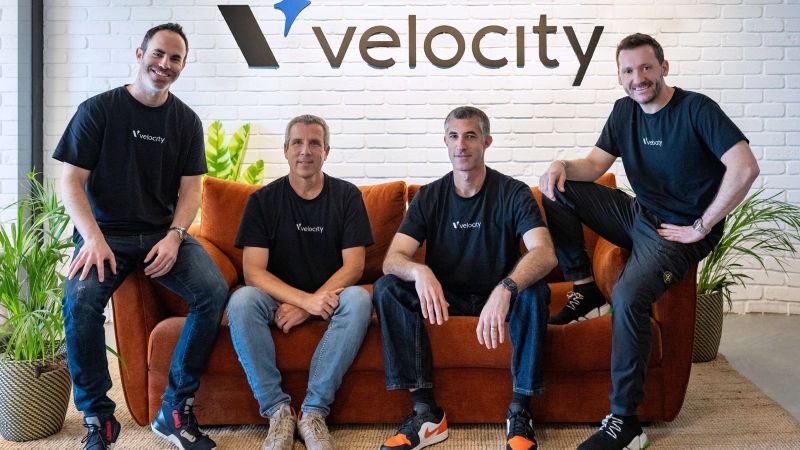
Velocity has raised $27 million from investors including NFX, Red Dot, and AppLovin. Founded by executives who have helped build mobile advertising and monetization businesses at ironSource and Unity, the company notes they have already worked with dozens of publishers and advertisers, bringing practical experience in monetizing free audiences to the AI market.
The Free-User Problem
Subscriptions can work well for highly engaged users willing to pay for recurring access. But AI applications can attract millions of people who use them occasionally, experiment with free features, or simply never become subscribers.
Those users still consume infrastructure and inference resources. Monetizing them therefore becomes an important part of building sustainable AI businesses.
Mobile applications faced a similar challenge as developers looked for ways to monetize users who would not purchase an app or subscription. Advertising created a second revenue stream that could operate alongside paid products. AI may be approaching a similar moment, but its advertising infrastructure needs to account for a fundamentally different interface.
AI Has a New Advertising Signal: Intent
Traditional digital advertising relies heavily on behavioral and contextual signals. AI applications introduce another: users can explicitly state what they want.
A person asking an AI application to compare accounting software, recommend a laptop, or find a hotel is providing a direct signal about their intent. That context can potentially make advertising more relevant while allowing the ad experience to become part of the interaction.
Velocity is built around this idea. It turns each user message into what it describes as a “creative brief.” The platform is designed to analyze the conversation, identifies relevant intent and context, matches the interaction with advertiser demand, and generates a tailored ad experience in real time.
Rather than placing conventional advertising around an AI experience, Velocity is building infrastructure designed for advertising within the conversation itself.
An Infrastructure Layer for AI Monetization
Velocity’s platform brings together three components: an AI Ad Network, mediation and a Conversation Manager.
The AI Ad Network connects AI applications with advertisers and demand sources, matching ads to user intent and generating moment-specific creative. The company says its mediation layer runs real-time auctions, optimizes yield and performance, and gives developers control over placements, pacing, frequency capping, and testing.
The Conversation Manager provides the context layer underneath it. It’s meant to extract real-time intent and conversation signals while filtering personally identifiable and sensitive information and routes anonymized signals to demand sources.
Together, these components give AI developers a system to move from user interaction to monetization without building an advertising infrastructure from scratch.
For advertisers, Velocity opens a new channel for acquiring users and customers across AI applications. By connecting advertiser demand with real-time intent, the platform helps brands and advertisers reach people when their offering is relevant and turn those interactions into measurable business outcomes.
This makes Velocity both a monetization platform for publishers and a growth platform for advertisers, bringing a broader mix of demand into AI applications.
Advertising Can Work Alongside Subscriptions
The opportunity is not necessarily to replace subscriptions. The two models can monetize different parts of the same audience.
Subscriptions can remain the primary revenue engine for users who want premium capabilities, higher usage limits, or advanced features. Advertising can monetize the much larger population that prefers free access and may never become a paying customer.
Velocity’s approach is designed to make the two models complementary. By matching advertising to real-time intent and integrating it into the conversation, the platform aims to create an additional revenue stream without forcing developers to turn their AI products into traditional ad-supported applications.
That can give developers more flexibility: subscriptions monetize willingness to pay, while intent-driven advertising helps monetize reach.
Building for AI’s Next Economic Phase
Bain & Company estimates that annual AI infrastructure spending could reach $1.5 trillion by 2031. The firm estimates that the industry could need roughly $6 trillion in annual revenue to support that level of investment, highlighting the need for new sources of economic value.
For AI developers, monetization is therefore becoming part of the product architecture rather than simply a growth consideration.
Velocity is positioning its platform as that missing layer. It takes the signal already being generated inside AI conversations and connects it to advertiser demand, creative generation, real-time auctions, and native delivery.
The broader idea is simple: AI applications can continue using subscriptions to monetize their most valuable customers while creating a sustainable economic model for everyone else. If AI is going to reach billions of users, the ability to monetize those interactions without restricting access could become as important as the technology powering the interactions themselves.
The information provided in this article is for general informational and educational purposes only. It is not intended as financial or professional advice. Readers should not rely solely on the content of this article and are encouraged to seek professional advice tailored to their specific circumstances. We disclaim any liability for any loss or damage arising directly or indirectly from the use of, or reliance on, the information presented.
The AI industry has spent the past several years optimizing for adoption. Now, as AI applications reach increasingly large audiences, a harder question is emerging: how do these products become durable businesses?
The challenge is particularly pronounced in consumer AI. Menlo Ventures estimates that nearly 2 billion people use consumer AI, yet only about 3% pay for premium services. That leaves a massive audience generating usage without generating subscription revenue.
Velocity is building a monetization and distribution platform designed to address that gap. Its premise is that AI applications should not have to choose between putting users behind a subscription and absorbing the cost of serving free users. Advertising can provide another economic layer, built specifically around AI conversations, user intent, and the way people interact with generative applications.
Entrepreneur UK
Entrepreneur Staff