Why This 24-Year-Old Marketing Columnist Believes Your Personal Brand Matters More Than Your Job Title
AI is cutting into the entry-level jobs that used to start most careers. Kamya Marwah, a 24-year-old columnist with 30,000 LinkedIn followers and a new base in San Francisco, thinks young professionals should stop relying on a job title to carry them.
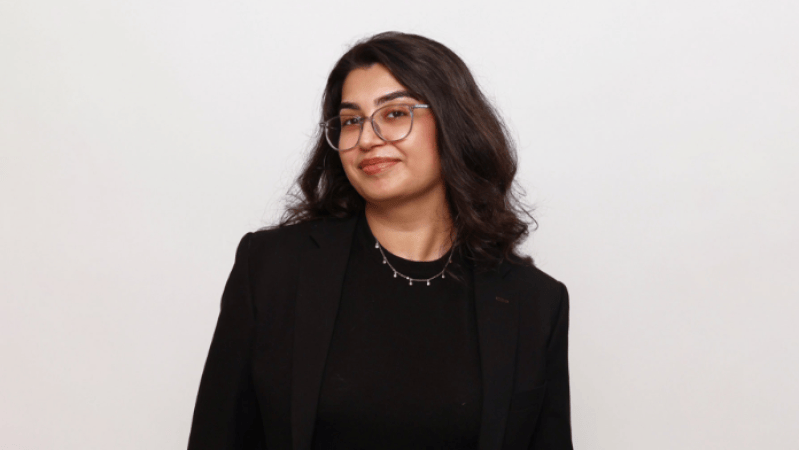
Kamya Marwah
You're reading Entrepreneur United Kingdom, an international franchise of Entrepreneur Media.
When Kamya Marwah walked into SF Tech Week this year, she had only recently moved to the city. She expected a week of introductions. What she got instead was a series of reunions with people she had never met in person: contacts she had known online for months or years, and strangers who recognised her from their LinkedIn feeds before she had said a word.
“Your content enters the room before you do,” she says.
It is a neat line, but for Marwah, a startup marketer turned LinkedIn creator and columnist, it is also a thesis about where work is heading. The traditional career playbook told you to pick a lane, earn a title and let the title vouch for you. Marwah believes that bargain is breaking down, and that the reputation, audience and network you build around your job are starting to matter more than the job title itself.
The ladder is losing its bottom rungs
Her timing is pointed. Since ChatGPT launched in late 2022, UK vacancies for graduate roles, apprenticeships, internships and junior positions have fallen by around 32%, according to Adzuna. In the US, Stanford’s Digital Economy Lab found that employment among 22 to 25-year-olds in the most AI-exposed occupations fell by roughly 13% relative to other jobs.
The roles that once taught young professionals their trade, and gave them a title to put on a CV, are thinning out just as AI makes polished output cheap for everyone. In that market, a job title tells an employer less than it used to. A visible record of how you think and what you have built tells them more.
“Personal branding is becoming career infrastructure, not just a marketing tactic,” Marwah says.
A career that started with a paintbrush
Marwah’s own path is hardly a straight line. In 2020, before she knew much about marketing, she started an art business that went on to produce more than 800 custom artworks. The painting mattered less to her than the customers. “I became fascinated by why people bought, shared and returned,” she says.
That curiosity took her into marketing. After graduating from UCL with First Class Honours, she worked across luxury brands, startups and community-led businesses in London, eventually becoming employee number one and the first go-to-market hire at an early-stage B2B startup.
She started posting on LinkedIn a month before landing her first marketing job, initially to get hired. Once she was, she kept going alongside the day job, writing up what she was learning in the role rather than presenting herself as an expert. That habit has since grown into a community of more than 30,000 people, creator partnerships with brands including Notion and Apollo.io, and a #21 ranking in Technology for Marketing’s Marketing Influencer of the Year list for 2026.
“The thing I was building alongside my career eventually became an important part of the career itself,” she says.
“I am the niche”
The standard creator advice would have told her to narrow down: pick one topic, own it, repeat. Marwah’s content instead spans startup marketing, personal branding, creators, entrepreneurship and culture, a spread most growth coaches would call unfocused.
For a while, she felt that pressure too. “Was I a marketer? A creator? A founder? A writer?” she says. “Eventually I realised that trying to make my career legible to everyone else was actually limiting what I could build.”
Her answer became a phrase she now treats as a philosophy: I am the niche. The connecting thread is not a subject or a title but a point of view. “People don’t necessarily need you to discuss one subject forever,” she says. “They need to understand the lens through which you see the world.”
It is a direct challenge to the idea that credibility comes from specialising in one thing for decades. Marwah’s bet is that careers are becoming portfolio-shaped, particularly for her generation, and that operator, creator, writer and founder can sit on the same CV without cancelling each other out.
The asset that moves with you
That bet was tested in 2026, when she left London, where she had real professional momentum, for San Francisco to pursue entrepreneurship. On paper, it was a restart. In practice, her network had arrived before she did.
“Your career becomes much more resilient when your identity isn’t entirely attached to one employer, role or geography,” she says.
She sees the same shift reshaping business more broadly. For most of modern commercial history, brands controlled the channels and individuals borrowed them. “Historically, companies owned distribution and individuals borrowed it,” she says. “Increasingly, individuals are building meaningful distribution themselves.”
Her own career is a working example. She has been the startup marketer chasing growth on a thin budget, the creator receiving brand briefs, the columnist deciding whether a pitch actually contains a story, and now the founder trying to make people care about something new. From that vantage point, the lines between PR, creator marketing, founder branding and editorial look increasingly artificial.
Isn’t this just influencer culture?
The obvious objection is that this is influencer culture in a smarter outfit. Not everyone wants to post online, not everyone can build 30,000 followers, and for every creator whose audience became a career, plenty more posted into silence.
Marwah rejects the premise that scale is the point. “There is still a perception that building a personal brand means wanting to become an influencer. I disagree,” she says. “The biggest value isn’t follower count. It’s having a body of work and a community that travels with you, even when your job title, company or country changes.”
Framed that way, a personal brand looks less like fame and more like a portable reputation: visible proof of how you think, sitting in front of the people who might hire you, back you or work with you next.
Noticing, not documenting
AI, she argues, raises the stakes. The same tools squeezing entry-level jobs have made content almost free to produce, so simply showing up online is no longer a differentiator. What stays scarce is judgement.
“Everyone can post what happened at an event,” she says. “The value is noticing the thing everyone else missed and having an interesting interpretation of it.”
She calls it competing on noticing, not documenting, and believes it applies to companies as much as individuals. Her advice to leaders is to build distribution long before there is anything to launch, and to stop treating employees with a public voice as a risk to be managed. “Some of the strongest brand advocates are already sitting inside the company,” she says.
Looking further ahead, she expects the strongest personal brands to operate like small media companies, combining owned audiences, journalism, events, communities, products and, eventually, businesses of their own.
More than one thing
For all the talk of distribution and AI, the person Marwah most wants to reach is someone at the start of their career: the same person now facing a thinner graduate jobs market and growing pressure to choose a box and stay in it.
Her message to them is simple. “You can take your career seriously while building things outside your job,” she says. “And you can be ambitious about several things that don’t initially appear to fit neatly together.”
When Kamya Marwah walked into SF Tech Week this year, she had only recently moved to the city. She expected a week of introductions. What she got instead was a series of reunions with people she had never met in person: contacts she had known online for months or years, and strangers who recognised her from their LinkedIn feeds before she had said a word.
“Your content enters the room before you do,” she says.
It is a neat line, but for Marwah, a startup marketer turned LinkedIn creator and columnist, it is also a thesis about where work is heading. The traditional career playbook told you to pick a lane, earn a title and let the title vouch for you. Marwah believes that bargain is breaking down, and that the reputation, audience and network you build around your job are starting to matter more than the job title itself.
Entrepreneur UK
Entrepreneur Staff