How Steve Reinharz Is Quietly Rebuilding Security With AI
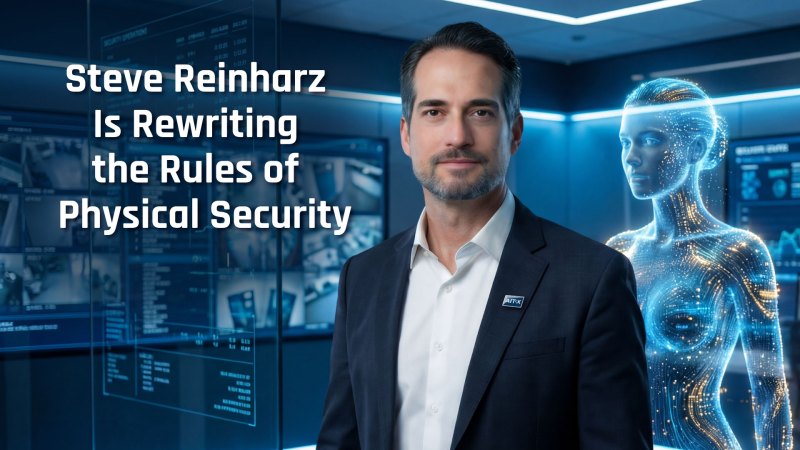
Steve Reinharz
Steve Reinharz has been thinking about artificial intelligence since before it was widely discussed outside academic circles. Reinharz grew up in Toronto, and in his final year of high school in the 1980s, wrote an essay on AI — an obscure subject at the time that most students would have avoided. He turned it into a self-published book and spent the summer after his freshman year at the University of Western Ontario selling 400 copies to local high schools. It was an early signal of where his interests were heading.
Decades later, Reinharz is the CEO and CTO of Artificial Intelligence Technology Solutions, Inc., the company behind one of the most ambitious bets in the security industry today. While bigger competitors often command the spotlight at industry events, AITX has been steadily rolling out AI-enabled security tools for commercial customers. The company says it works with more than 200 clients, has deployed over 1,000 systems, and is in discussions with dozens of large enterprises, including Fortune 500 firms. For a business that nearly didn’t make it through its early years, the pace is notable.
The Long Road to a Big Idea
The journey was anything but smooth. After graduating from college, Reinharz moved to California and built a security services company from the ground up, one that helped advance the merging of technology with physical security. He grew it to 35 employees over eight years. Then a major contract went unpaid, and he lost everything. What followed was a decade of restlessness. He consulted, hustled, and searched.
Then, working as a freelance business development consultant in the San Francisco Bay Area, he came across a computer processor capable of detecting human presence. The technology stopped him cold. He saw immediately what it could become — AI-powered devices that would replace expensive, fallible human security personnel. “I knew someone was going to create this business, and I could not let it go,” he said. “It was going to be us.”
The road to building AITX tested him in ways few entrepreneurs ever face. He burned through his savings, then his 401(k). He turned to family and friends. He went without a paycheck for extended periods while calling employees regularly to ask how much they needed to get by. He sold his house and drained his wife’s retirement savings. Cars were repossessed. “I risked everything,” Reinharz has said. “The sacrifices went far beyond finances. They were personal and constant. The only option was to keep moving forward.”
The pandemic in 2020 became an unexpected lifeline. An unpaid programmer on the team pitched an AI-powered face-mask detection system—an idea that captured media attention and helped the company regain traction. The momentum that followed allowed Reinharz to pay his team, expand the staff, and recalibrate. AITX relocated its manufacturing facility, the RAD Excellence Center (REX), to Ferndale, Michigan, in 2021. The company never looked back.
When AI Meets the Security Guard
The core product at AITX is SARA — Speaking Autonomous Responsive Agent — an agentic AI platform that monitors live security camera feeds, detects relevant events, and responds without waiting for a human operator to act. SARA verifies alerts, triggers deterrence protocols, initiates outbound calls to first responders, and escalates incidents — all in real time. According to the company, over a recent 30-day period SARA autonomously initiated thousands of outbound security calls across live deployments, triggered by RAD devices including ROSA and RIO.
That level of activity reflects how frequently the system is already being used in live environments. Traditional security monitoring relies on human operators reviewing events one at a time in a queue, a model that’s slow, expensive, and inconsistent. SARA processes events in parallel, at any hour, without the fatigue-related variability seen in human-only monitoring, regardless of staffing levels or incident volume. At ISC West 2026, SARA Alive Operating Inside Immix, a version of SARA that executes monitoring workflows directly within the Immix central station platform, won the Security Industry Association’s New Product Showcase Award in the Commercial Monitoring Solutions category. “Our industry has spent years talking about automation inside the monitoring center,” Reinharz said at the event. “SARA Alive Operating Inside Immix demonstrates that this is no longer theoretical.”
The Camera That Talks Back
Beyond SARA, AITX has also pushed AI deeper into the everyday spaces where people live. RADCam, developed through AITX’s residential subsidiary RAD-R, is what the company calls the first AI-powered talking security camera. Rather than simply recording what happens in front of it, RADCam actively engages. It uses large language model technology to hold real-time, contextual conversations with anyone approaching a home entryway. It greets expected visitors, challenges strangers, monitors packages, and offers concierge-level interactions — all without a human on the other end.
RADCam reveals an important aspect of Reinharz’s thinking about AI. Reinharz’s goal was never just to automate surveillance. The goal was to build systems that can actually communicate, reason about what they’re seeing, and act. AITX’s technology is built around conversation and autonomous response, making the system an active participant rather than a passive observer.
Rewriting the Rules of an Entire Industry
Reinharz now sits on the Security Industry Association’s Board of Directors and chairs its Autonomous Solutions Working Group — the body that helps guide the industry on the use of robotics and AI in security. He speaks regularly at major industry events, reflecting growing recognition within the security sector. They reflect a level of respect from peers that takes years to earn in an industry built on caution and process.
AITX argues that its approach can make security operations more efficient. The company says RAD’s offerings are designed to reduce costs versus traditional, fully staffed security models—especially for organizations managing multiple sites. Its subscription pricing is intended to lower the barrier to adoption while supporting ongoing service and product development. AITX also says it’s expanding beyond the US, including into the UK and other international markets.
There is something worth noticing about how Reinharz built all of this. He didn’t come from a well-funded startup accelerator. He didn’t raise a large Series A. He wrote an essay about AI as a teenager, lost a company, rebuilt himself, and then refused to quit when every rational signal said he should. “I feel that my entire life and upbringing were to support this venture,” he once said. That kind of conviction is rare. In a field crowded with well-capitalized players, AITX is doing something more interesting — it’s building momentum through continued deployment and adoption. And Reinharz, the man who has been thinking about this since before the internet existed, is only getting started.
Steve Reinharz has been thinking about artificial intelligence since before it was widely discussed outside academic circles. Reinharz grew up in Toronto, and in his final year of high school in the 1980s, wrote an essay on AI — an obscure subject at the time that most students would have avoided. He turned it into a self-published book and spent the summer after his freshman year at the University of Western Ontario selling 400 copies to local high schools. It was an early signal of where his interests were heading.
Decades later, Reinharz is the CEO and CTO of Artificial Intelligence Technology Solutions, Inc., the company behind one of the most ambitious bets in the security industry today. While bigger competitors often command the spotlight at industry events, AITX has been steadily rolling out AI-enabled security tools for commercial customers. The company says it works with more than 200 clients, has deployed over 1,000 systems, and is in discussions with dozens of large enterprises, including Fortune 500 firms. For a business that nearly didn’t make it through its early years, the pace is notable.
The Long Road to a Big Idea
The journey was anything but smooth. After graduating from college, Reinharz moved to California and built a security services company from the ground up, one that helped advance the merging of technology with physical security. He grew it to 35 employees over eight years. Then a major contract went unpaid, and he lost everything. What followed was a decade of restlessness. He consulted, hustled, and searched.