BIS Safety Software on How AI Is Transforming Training and Compliance Systems Across Safety‑Critical Industries
BIS Safety Software
Dan MacDonald, founder and CEO of BIS Safety Software, observes how technology reshapes safety and compliance in high‑risk industries. He believes artificial intelligence has reached a point where long‑imagined possibilities are now usable within everyday operations, especially in sectors such as mining and construction. Within this changing environment, BIS Safety Software positions its platform as a coordinated system that aims to bring these advancements together while preserving the rigor required in regulated settings.
A report on digitalization and workplace safety notes that AI‑enabled tools are already improving monitoring, reducing exposure to hazards, and streamlining work processes. MacDonald says, “We’re seeing organizations step back and rethink systems that have relied on manual work, spreadsheets, and scattered tools for far too long.” Amid this landscape, BIS Safety Software intends to bring training, compliance tracking, and field execution into a shared environment, creating opportunities for AI to support existing safety practices without disrupting them.
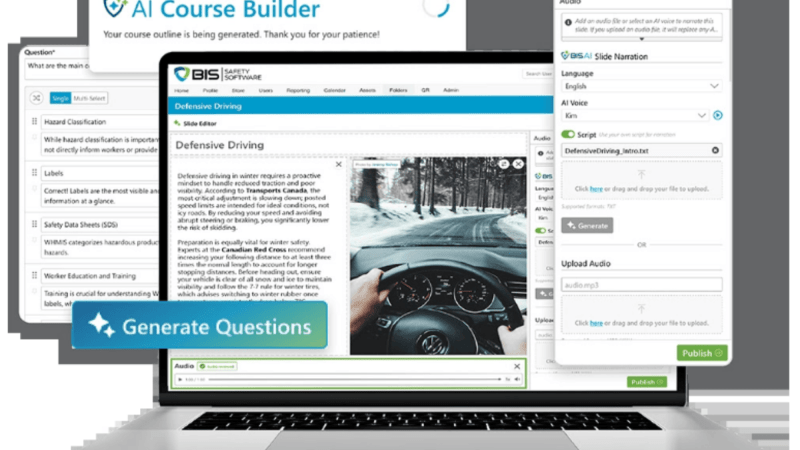
A key part of this transformation, MacDonald notes, involves resolving a longstanding challenge. He points out that adaptive learning tools have been available for some time, offering the promise of training tailored to individual needs, yet adoption stayed limited because building multiple learning pathways demanded considerable time and resources. In his view, AI is beginning to ease those pressures. “Development cycles that once stretched out can now be completed far more efficiently. In one example, a course that was budgeted to be completed over 3 months was finished in less than 6 hours, and when reviewed by an SME, they were shocked at the quality and could not believe it was done through AI,” he says.
MacDonald also observes that as these barriers lessen, the door opens to a level of customization that was previously difficult to sustain. “Training can now adjust to a worker’s existing knowledge, job requirements, and regional regulations. This creates learning experiences that are more relevant and more likely to support safe performance,” he explains. From his perspective, especially in industries where compliance directly influences operational safety, this shift introduces new possibilities for strengthening workforce readiness.
Industry insights about advancements in occupational health and safety reinforce this direction, showing that AI can identify specific skill gaps and align training with the needs of individual workers. MacDonald believes that this creates a more continuous form of learning, where development is woven into daily work rather than limited to scheduled sessions.
These ideas are already being explored within organizations that operate at scale, according to MacDonald. Through its work with mining companies such as BHP, BIS Safety Software supports environments where training, compliance, and operational execution must remain closely aligned across multiple sites and teams.
Insights from Vincent Galati, a Training and Development Specialist at BHP with nearly two decades of experience, illustrate how these ideas are being applied in real settings. He notes how AI can support the creation of learning objectives, improve content quality, and introduce new ways to engage workers through elements such as gamification. His experience reflects a broader movement toward treating learners as active participants, supported by digital instructors and contextual guidance throughout their tasks.
“We’re creating environments where learning is always available, not confined to a single event,” Galati explains. “This contributes to stronger preparedness and more consistent performance across teams.”

Building on this shift toward more dynamic learning, MacDonald acknowledges that organizations are also re-examining the administrative processes that surround training and field work. He argues that paperwork remains essential for compliance, yet it may consume a significant amount of time on large worksites.
“AI tools are starting to make administrative work easier by using conversational interfaces that let workers document tasks in a more natural way,” MacDonald says. “With earpieces or smart glasses, they can talk through what’s happening while the system organizes the information in the background. It helps reduce the time spent on paperwork, as much as 70% (based on internal assessment) and gives people more room to stay focused on the work in front of them.”
These efficiencies bring important questions about data management to the forefront. Safety systems, MacDonald emphasizes, often contain sensitive information related to personnel, operations, and compliance. As AI capabilities expand, maintaining control over how data is accessed and processed remains essential. MacDonald stresses that innovation and data protection must advance together within BIS Safety Software’s development strategy. “Advancement in AI comes with a responsibility to ensure that every interaction respects the boundaries of privacy and consent,” he says.
As organizations strengthen their approach to data governance, attention is also turning to what the next generation of AI‑driven tools may enable. According to MacDonald, new capabilities suggest that the next stage of development will involve more autonomous functions. “Real‑time multilingual forms, near‑instant training modules, and systems capable of completing tasks such as building dashboards or transferring data between platforms with user authorization are becoming more and more realistic,” he states. These agentic workflows may introduce a different type of interaction, where users express intent, and the system completes structured tasks on their behalf.
Overall, the trajectory of AI in safety-critical industries continues to evolve, shaped by both technological capability and the principles guiding its use. For organizations navigating this landscape, the opportunity lies in integrating these tools in a way that enhances existing systems while maintaining a clear focus on safety, trust, and operational integrity.
MacDonald remarks, “Progress in technology becomes meaningful when it aligns with the realities of the people using it, supporting their work while respecting the complexity of the environments they operate in.”
Dan MacDonald, founder and CEO of BIS Safety Software, observes how technology reshapes safety and compliance in high‑risk industries. He believes artificial intelligence has reached a point where long‑imagined possibilities are now usable within everyday operations, especially in sectors such as mining and construction. Within this changing environment, BIS Safety Software positions its platform as a coordinated system that aims to bring these advancements together while preserving the rigor required in regulated settings.
A report on digitalization and workplace safety notes that AI‑enabled tools are already improving monitoring, reducing exposure to hazards, and streamlining work processes. MacDonald says, “We’re seeing organizations step back and rethink systems that have relied on manual work, spreadsheets, and scattered tools for far too long.” Amid this landscape, BIS Safety Software intends to bring training, compliance tracking, and field execution into a shared environment, creating opportunities for AI to support existing safety practices without disrupting them.
A key part of this transformation, MacDonald notes, involves resolving a longstanding challenge. He points out that adaptive learning tools have been available for some time, offering the promise of training tailored to individual needs, yet adoption stayed limited because building multiple learning pathways demanded considerable time and resources. In his view, AI is beginning to ease those pressures. “Development cycles that once stretched out can now be completed far more efficiently. In one example, a course that was budgeted to be completed over 3 months was finished in less than 6 hours, and when reviewed by an SME, they were shocked at the quality and could not believe it was done through AI,” he says.