Joseph Schwarzmann on Why Founders Ignore Trades And How AI Is Reshaping Them
Joseph Schwarzmann
Opinions expressed by Entrepreneur contributors are their own.
You're reading Entrepreneur United Kingdom, an international franchise of Entrepreneur Media.
The founders and venture capitalists racing to build the next generation of AI companies remain overwhelmingly fixated on software, fintech, and consumer applications. Meanwhile, the HVAC sector, despite being one of the largest and most labour-constrained in the American economy, has drawn a fraction of the technological attention its scale warrants. The workers who keep homes and commercial buildings running are ageing out, and replacements are not arriving fast enough to close the gap.
Joseph Schwarzmann, the 28-year-old COO and co-founder of Robby, a Y Combinator–backed startup building AI tools for home services technicians, argues that this blind spot represents one of the largest unclaimed opportunities in technology. His case rests not on speculation but on months spent riding in the passenger seats of technicians’ trucks, watching the gap between back-office digitisation and field-level reality widen with every service call.
A Perfect Storm Hitting an Unprepared Industry
Diagnosing a failing residential HVAC system or rerouting plumbing in a decades-old building requires serious technical skill, meaning years of active practice and a system that can back up new and old technicians. What has historically not been available is the kind of sustained outside investment and technological attention that software, finance, and healthcare have attracted over the past two decades.
That disparity is now closing fast, and it is closing on multiple fronts at once. AI is being deployed across call centres, dispatching and diagnostics, each representing a layer of the business that previously needed manual coordination and institutional memory to track.
At the same time, private equity firms have been aggressively consolidating fragmented local operators into platform companies, organisations that suddenly need scalable technology and standardised processes to justify their acquisitions. And a surge in data centre construction is generating massive new demand for HVAC installation and maintenance, adding volume pressure to a workforce that was already stretched thin.
No single new company, Schwarzmann contends, can absorb all of these shifts at once. “There’s just so much disruption happening in the trades, whether from AI at every part of the value chain, new hardware, or changing customer demands,” he says. “That’s just too much disruption for any one company to completely navigate efficiently.”
For founders willing to focus on a specific, high-value problem within this chaos, the opening is considerable. But it also means finding the right angle.
The Technician Problem Robby Aims To Solve
The first wave of AI investment in home services, Schwarzmann argues, has targeted the office. These are useful products, but they share a common orientation: they serve the people sitting at desks, not the ones generating revenue in the field.
The technician, responsible for driving to a customer’s home, diagnosing a product issue, and getting the repair done, hasn’t typically been a primary focus for many AI companies in the space. The office was getting digitised while the technician’s workflow remained almost entirely analogue. “There was a ton of AI in the back office, but not much helping technicians do their jobs,” he says. “And if you think about it, they’re the assets of the business, because they’re the ones that are actually generating all the revenue.”
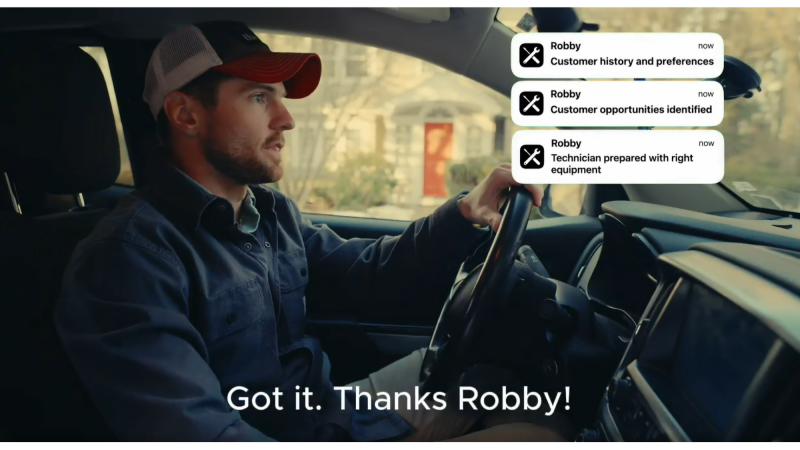
Robby was built to invert that priority. The product centres on the technician as its primary user, providing real-time equipment guidance, automating ordering and documentation, and handling communication with the office. In practice, that means a technician arriving at a job can pull up a unit’s full service history, get diagnostic suggestions for unfamiliar equipment, and have parts ordered from a supply house, all without calling back to dispatch or filling out paperwork in the driveway.
The goal is to consolidate everything a technician needs to complete a service call into a single AI-powered assistant that travels with them from job to job.
A Labour Shortage That Technology Can’t Ignore
Unlike software or most consumer markets, the trades can’t scale by hiring faster. Demand for HVAC, plumbing, and electrical work is expected to continue increasing, fuelled by residential construction, commercial buildout, and the explosion of data centre infrastructure. But the other side of the coin is that experienced technicians risk ageing out of the workforce faster than apprentices can replace them, and each retirement takes decades of accumulated knowledge out the door.
This means AI that can meaningfully support technicians in the field is a direct response to a structural constraint. Tools that remove administrative burden from veteran technicians can help free up time for an already stretched workforce, while tools that support faster learning for newer technicians may shorten parts of the traditional training curve.
Robby is designed to address both sides of that shortage at once. For experienced technicians, it automates ordering, documentation, and office communication, and for those earlier in their careers, it acts as a real-time AI companion, surfacing diagnostic suggestions and equipment history that might otherwise take extensive field experience to internalise. “If you can speed up the path to learning, then that can help create the next generation of technicians,” Schwarzmann points out. “We believe technicians should focus on what they do best: equipment and customers. That focus is especially important now given the number of experienced technicians ageing out of the workforce.”
The distinction matters for founders and investors evaluating where to build next. In markets where talent supply is elastic, technology is a convenience. In the trades, where labour can’t be manufactured on demand, it becomes increasingly important, and companies that address that constraint may be positioned to meet more consistent long-term demand.
A Platform That Prioritizes The Technicians
The Robby team’s approach to product development began not with code but with fieldwork. The platform’s founders worked directly with technicians, following them through a regular workday to identify the biggest pain points in their routine. “We didn’t come to this problem by thinking about it with a pen, whiteboard, and some data analysis,” Schwarzmann says. “We learned first-hand from technicians, during ride-alongs, in basements, in attics, and hours in the truck.”
That ground-level immersion gave Robby an advantage that office-based customer interviews or market research alone could not replicate. The product roadmap continues to be shaped by ongoing ride-alongs rather than top-down feature planning, which means every new capability maps directly to a problem technicians face in the field. Schwarzmann argues that willingness to follow that kind of unglamorous work is itself a competitive moat that few founders are prepared to build.
Looking ahead, Joseph Schwarzmann sees the trades entering a period where the pace of change will only accelerate, and where the winners will be companies focused enough to go deep rather than broad. Until then, he and the Robby team plan to keep building the way they started: close to the technicians, close to the problems, and far from the assumption that the best opportunities in tech have already been claimed.
The founders and venture capitalists racing to build the next generation of AI companies remain overwhelmingly fixated on software, fintech, and consumer applications. Meanwhile, the HVAC sector, despite being one of the largest and most labour-constrained in the American economy, has drawn a fraction of the technological attention its scale warrants. The workers who keep homes and commercial buildings running are ageing out, and replacements are not arriving fast enough to close the gap.
Joseph Schwarzmann, the 28-year-old COO and co-founder of Robby, a Y Combinator–backed startup building AI tools for home services technicians, argues that this blind spot represents one of the largest unclaimed opportunities in technology. His case rests not on speculation but on months spent riding in the passenger seats of technicians’ trucks, watching the gap between back-office digitisation and field-level reality widen with every service call.
A Perfect Storm Hitting an Unprepared Industry
Diagnosing a failing residential HVAC system or rerouting plumbing in a decades-old building requires serious technical skill, meaning years of active practice and a system that can back up new and old technicians. What has historically not been available is the kind of sustained outside investment and technological attention that software, finance, and healthcare have attracted over the past two decades.

Patricia Cullen • Features Writer
Entrepreneur Staff