What the Boardroom Can Learn from the World’s Best Chefs
How culinary creativity inspires innovation, sharper thinking and better business leadership today.

Shutterstock
Opinions expressed by Entrepreneur contributors are their own.
You're reading Entrepreneur United Kingdom, an international franchise of Entrepreneur Media.
What can we learn about creativity from the world of hospitality, one of the most difficult industries in which to succeed, where sixty percent of restaurants will fail in the first year and eighty percent in the first five? At the same time, restaurants are big business. The average American consumer in 2018 spent $660 a month eating out, representing 13% of all household spending. Overall, U.S. restaurant sales climbed to $863 billion in 2019. To put those figures in perspective, U.S. Steel earned $12.9 billion in 2019, and all Broadway theatre ticket sales that same year totalled just $1.43 billion. If a well-executed dish is an art form, then culinary art is the highest-earning medium of all forms. It is therefore a great avenue for senior executives to consider when exploring the synergy between creative exploration and commercial reward.
When asked how they invent their recipes, some chefs subscribe to the ‘combinatorial’ view. In other words, they combine existing ideas, techniques, or ingredients in new or less familiar ways. There are many historical examples of this, which culminated in what we today regard as iconic foods. One classic story is that of Antoine Feuchtwanger at the St. Louis World’s Fair in 1904. Antoine sold sausages, which he called ‘frankfurters’ after his native Frankfurt. He despaired that he was losing money because plates and tableware were too expensive, and when he provided gloves to his customers to hold the hot frankfurters, he often wouldn’t get the gloves back. Turning to his brother, a baker, the Feuchtwangers created a bread roll that was the right length and height to hold the sausage, and voila – the hot dog was born!
Another iconic dish sprang to life through combinatorial creativity at that same fair. Syrian concessionaire Ernest Hamwi sold waffles. One day, he noticed the ice cream vendor next door had run out of dishes. A quick conference with this seller, an adjustment to the thickness of the waffle to be able to wrap it around the ice cream, and the world was introduced to the ice cream cone.
Cooking is a wonderful way to discover or rediscover your creativity. One simple technique is to combine ideas that you hadn’t brought together before. Surprise yourself with unusual but complementary matchmaking, such as our recipe for popcorn ice cream. We learn from the realm of neuroscience that the more we exercise the creative ‘muscles’ in our brains, no matter the context, the more our brain is receptive to new ideas and to conceiving creative ideas in other disciplines. In other words, by practicing creativity in the kitchen, we can also train our brains to be more innovative at work.
As you develop this mindset of allowing yourself to be surprised, you can utilise this technique in your work environment. One exercise that you can do on your own or with your team is to draw two lines down a large sheet of paper, creating three equally sized columns. At the top of the left-hand column, write ‘From Our World’. On the top of the second column, write ‘From Other Worlds’, and on the top of the third column, write ‘Innovations’. In the first column, list the themes, products, services, features, business models, or processes that you want to refresh or reinvent. It’s best to have a focus and just cover one genre, such as ‘features’. In the second column, write completely unrelated things, people, ideas or influences. The more seemingly random, the better. In the last column, brainstorm what would happen if you combined each item in column one with the influence from column two. Virtuous habits of creativity that you develop in the kitchen can eventually manifest in your creative outputs in your professional life.
Fuel and Spark
While creativity isn’t a single ingredient you can add to a dish, you can cultivate a mental state that is more open, flexible, and receptive to new ideas. You can help foster that state through two distinct pathways: providing the right neurochemical fuel for your brain and creating a spark of sensory surprise to jolt it out of familiar patterns.
First, the fuel. Creative thought, particularly the generation of new ideas, is closely linked to the neurotransmitter dopamine, which governs our response to reward and novelty. The essential building block for dopamine is an amino acid called tyrosine. Supplying your brain with this raw material can support the very circuits involved in originality and insight, and while the research suggests it might not help with brainstorming, it can promote convergent, deep thinking. Aged cheeses, for example, happen to be one of the richest dietary sources of tyrosine, which may help to prime the brain for its next great idea.
While fuel equips the machinery, spark is what jolts it out of autopilot. Creativity is, at heart, about forging connections between distant or nonobvious domains, and that is much easier when the mind is nudged, however gently, out of habitual loops.
Just as an excellent meal is multisensory, a great conversation in a business context is often stimulated with new catalysts, be it walking outside or changing the environment to an inspirational space. Context, ambiance, and expectation can make a difference, from the lighting, soundscape, air quality or temperature. For instance, chatting on a scenic balcony or with softly textured music may amplify openness to new ideas.
Perhaps the most valuable lesson the boardroom can learn from the world’s best kitchens is to embrace a mindset that is open, adaptable, and creative.
What can we learn about creativity from the world of hospitality, one of the most difficult industries in which to succeed, where sixty percent of restaurants will fail in the first year and eighty percent in the first five? At the same time, restaurants are big business. The average American consumer in 2018 spent $660 a month eating out, representing 13% of all household spending. Overall, U.S. restaurant sales climbed to $863 billion in 2019. To put those figures in perspective, U.S. Steel earned $12.9 billion in 2019, and all Broadway theatre ticket sales that same year totalled just $1.43 billion. If a well-executed dish is an art form, then culinary art is the highest-earning medium of all forms. It is therefore a great avenue for senior executives to consider when exploring the synergy between creative exploration and commercial reward.
When asked how they invent their recipes, some chefs subscribe to the ‘combinatorial’ view. In other words, they combine existing ideas, techniques, or ingredients in new or less familiar ways. There are many historical examples of this, which culminated in what we today regard as iconic foods. One classic story is that of Antoine Feuchtwanger at the St. Louis World’s Fair in 1904. Antoine sold sausages, which he called ‘frankfurters’ after his native Frankfurt. He despaired that he was losing money because plates and tableware were too expensive, and when he provided gloves to his customers to hold the hot frankfurters, he often wouldn’t get the gloves back. Turning to his brother, a baker, the Feuchtwangers created a bread roll that was the right length and height to hold the sausage, and voila – the hot dog was born!
Another iconic dish sprang to life through combinatorial creativity at that same fair. Syrian concessionaire Ernest Hamwi sold waffles. One day, he noticed the ice cream vendor next door had run out of dishes. A quick conference with this seller, an adjustment to the thickness of the waffle to be able to wrap it around the ice cream, and the world was introduced to the ice cream cone.

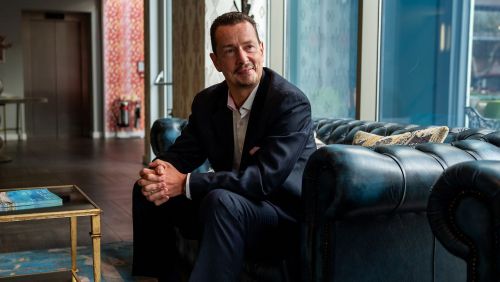
Adam Kingl • C-author of Executive Eats
Adam Kingl is an executive educator and co-author of Executive Eats with Jakub Radzikowski.