Culture: It’s not what you say, it’s what you tolerate
What thermodynamics teaches us about effective leadership and organisational success.

Shutterstock
Opinions expressed by Entrepreneur contributors are their own.
You're reading Entrepreneur United Kingdom, an international franchise of Entrepreneur Media.
Every organisation is an entropy machine. Left alone, standards decay and what gets tolerated quietly becomes what gets accepted. The question is not whether this force is acting on your business. It is. The question is whether you are doing anything about it.
Educators Gruenert & Whitaker put it well: ‘The culture of any organisation is shaped by the worst behaviour the leader is willing to tolerate.’ You can plaster mission statements on walls, but real culture gets built through what leaders allow to happen every day. The gap between stated values and tolerated behaviour is the difference between a genuine and a performative culture. Allow small tolerances to compound over time, and dysfunction becomes the business norm. As someone with a background in physics, I see this playing out like the behaviour of gases. Let me explain.
The gas law of culture
Think of a company as a gas. Many particles, each moving on its own path, colliding, bouncing. It looks like chaos, yet a gas obeys a handful of simple physical laws: temperature, pressure, volume. Individual trajectories are unpredictable but the aggregate behaviour follows clear patterns. Culture works the same way. Tens or hundreds of people making thousands of micro-decisions every day looks like noise, but underneath, a few simple rules govern the whole system. Your job as a founder is not to choreograph every particle but to define and embed the handful of rules that everyone operates by. Without that clarity, the company drifts. Entropy wins. You lose focus on what matters: how the business runs and how it serves customers.
Culture diffuses like heat
Heat doesn’t move by decree but slowly, molecule by molecule, from warm to cold. Culture behaves the same way. You cannot shout culture into existence at an all-hands meeting. It has to diffuse through the organisation via example, repetition and the cumulative soft power of small unobserved interactions. This takes time: if you have ‘embed new culture’ as a target for Q1, you’re fighting thermodynamics. Leaders who build powerful cultures put years into the task.
I saw this firsthand years ago when I worked briefly at Novartis, formed from the merger of Ciba-Geigy and Sandoz in 1996. Fifteen years after the merger, I still met people who identified as Ciba-Geigy, not Novartis. The legacy cultures had never fully diffused into one. They were still different entities, with different reflexes and different unspoken ways of working. Business performance and customer value inevitably suffered.
Tolerance as entropy
In physics, entropy is the quiet tax the universe charges on every closed system. Left alone, order decays into disorder and heat leaks. Nothing stays organised for free. So too with tolerance. Every small thing you let slide increases cultural entropy. A missed deadline excused. A sexist comment ignored. A brilliant jerk protected because their numbers look good. Individually, each event is negligible. Collectively, they move the whole system towards disorder.
When mediocrity gets tolerated, it becomes the standard. High performers either lower their standards or leave. Toxic behaviour accelerates this by giving everyone permission to follow suit. The trap is that tolerance feels cheap in the moment and expensive only in aggregate. By the time the cost shows up, you’re paying for a curve that’s been bending for years.
When the boundary conditions change
Every physical system has boundary conditions. Change them, and the behaviour inside changes too. A company of five people is a small container with informal rules and visible faces. What counts as tolerance then is often just pragmatism. At 50 people, however, the container is bigger and the same informal rules produce different outcomes. The patterns persist but the conditions that kept them harmless do not.
I have seen this pattern repeatedly. At five people, the founder who answers every customer complaint personally is heroic. At fifty, that same behaviour becomes a bottleneck that signals to the team that no one else’s judgement is trusted. The behaviour did not change. The boundary conditions did. Confronting that drift means confronting your own earlier choices. New leaders often hesitate because it feels like betraying the startup spirit. You’re not – you’re just updating the rules to match new boundary conditions.
Standards as the restoring force
In mechanics, a restoring force pulls a system back towards equilibrium when disturbed. Think of a spring returning to its natural length, or gravity pulling a pendulum back to centre. Standards are the restoring force of a company. When behaviour drifts from your philosophy, clear standards pull it back. So start by auditing what you currently tolerate. Ask trusted team members what behaviours get excused or ignored. Define three to five non-negotiable behaviours that directly enable your strategy and communicate them through clear expectations and visible examples. Address misalignment in the moment, not months later. Hire and promote based on behaviour alignment, not just technical skill. Remember that who you let in and who you elevate defines the walls of your container. Celebrate desired behaviour publicly. Build systems that make high standards the path of least resistance. Follow through consistently. If some people leave, so be it; that’s the system finding its new, healthier state.
The physics of a culture worth inheriting
Tolerance becomes powerful when it’s deliberate, not passive. Strong cultures deliberately tolerate behaviours that drive success: effort over excuses, respectful disagreement, learning-curve mistakes, space for difficult conversations. Such businesses outperform over time because they attract talented people and compound competitive advantages that flawed cultures cannot replicate. And maintaining clear boundaries from the beginning is easier than resetting them later. In physics as in business, it’s always cheaper to set the initial conditions correctly than to reverse a trajectory in flight. What you tolerate today defines the culture you live with tomorrow. In physics, systems respond to the forces actually applied, not the theories written down. Your team responds to the standards you live by, not the values you display.
Every organisation is an entropy machine. Left alone, standards decay and what gets tolerated quietly becomes what gets accepted. The question is not whether this force is acting on your business. It is. The question is whether you are doing anything about it.
Educators Gruenert & Whitaker put it well: ‘The culture of any organisation is shaped by the worst behaviour the leader is willing to tolerate.’ You can plaster mission statements on walls, but real culture gets built through what leaders allow to happen every day. The gap between stated values and tolerated behaviour is the difference between a genuine and a performative culture. Allow small tolerances to compound over time, and dysfunction becomes the business norm. As someone with a background in physics, I see this playing out like the behaviour of gases. Let me explain.
The gas law of culture
Think of a company as a gas. Many particles, each moving on its own path, colliding, bouncing. It looks like chaos, yet a gas obeys a handful of simple physical laws: temperature, pressure, volume. Individual trajectories are unpredictable but the aggregate behaviour follows clear patterns. Culture works the same way. Tens or hundreds of people making thousands of micro-decisions every day looks like noise, but underneath, a few simple rules govern the whole system. Your job as a founder is not to choreograph every particle but to define and embed the handful of rules that everyone operates by. Without that clarity, the company drifts. Entropy wins. You lose focus on what matters: how the business runs and how it serves customers.

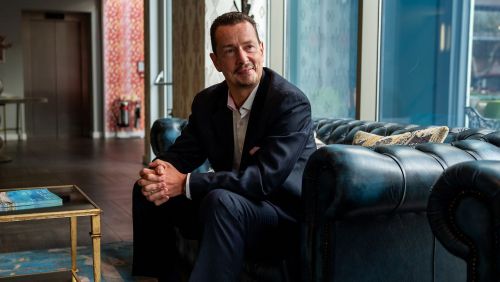
Serge Santos • Founder and CEO of Funding Alternative Group
Dr. Serge Santos, The Business Physicist