Efficiency, Equity, and the Algorithm
FabricShift founder Johanna Beresford is upending how organisations tackle culture change — with data, not dogma, and with a team that proves smaller can mean stronger.
FabricShift
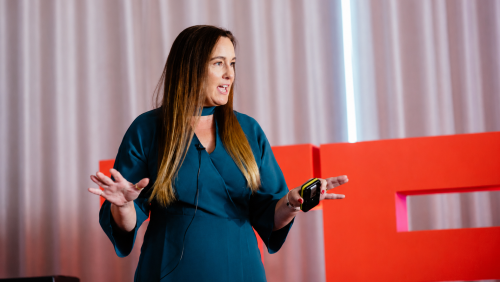
Johanna Beresford, CEO of FabricShift
Opinions expressed by Entrepreneur contributors are their own.
You're reading Entrepreneur United Kingdom, an international franchise of Entrepreneur Media.
In a tech landscape still riddled with bloated teams, nebulous buzzwords, and far too many panels on “women in STEM,” Johanna Beresford is building something different. As CEO and co-founder of FabricShift, a Warwickshire based platform designed to enable measurable, scalable culture change, she says “you don’t need a perfect product to start. In fact, your technology will change and develop, again and again. What matters most is solving a real, specific problem. Build from that, and refine as you go.” At its core, FabricShift is designed to do what many promise but few actually deliver: help companies change for the better – and prove it. Unlike traditional culture consultancy or static HR tools, FabricShift is product-first, data-led, and behaviour-focused. Its goal isn’t just to improve workplace culture – it’s to show that improvement clearly, and help it stick.
Beresford is clear-eyed about the challenge. Culture change is notoriously hard to measure, let alone scale. But her answer has been to lean harder into metrics – not to dilute them. “Committing to data,” she says, “has been the decision that most moved the needle for our growth. Every aspect of our platform is backed by behavioural data and measurable outcomes. In a space like culture change, where impact is often hard to quantify, this has been critical in proving value and earning trust.” Trust, after all, is hard-won – particularly in the world of digital transformation and HR tech, where fatigue and scepticism are common. FabricShift’s response is disarmingly simple: keep it lean, and make it work.
One of the company’s most notable characteristics is its team structure. In contrast to fast-scaling startups that balloon headcount in the name of momentum, FabricShift has stayed deliberately small – and all the more effective for it. “The idea that you need a big team to scale a tech business is completely wrong,” Beresford says. “We’ve built a high-performing, scalable platform with a small, agile team. With the right people, aligned around purpose and capability, lean teams can do incredible things.”
That clarity of purpose has proven powerful. With fewer layers and more direct input, the company is able to respond rapidly to client needs while remaining firmly grounded in its values. And that starts, as Beresford explains, with the hiring process.
“We’ve built a culture where every voice counts,” she says. “Rather than hiring for one type of background, we hire smart, curious people who challenge each other. The result is an environment where women and underrepresented groups naturally thrive.”
This inclusive ethos extends beyond the company’s internal culture and into its product design. FabricShift works closely with a broad base of HR leaders – many of them women – which makes listening to different voices not just good ethics, but good business. “Our product is also used by a broad, gender-balanced HR leadership audience,” Beresford adds. “So understanding and reflecting diverse perspectives is embedded in everything we design.”
For Beresford, that balance between technology and human insight is not just a feature – it’s the future. Her vision for leadership is refreshingly grounded: empower people, hire for mindset, and focus on solving real-world problems. But if there’s a thread that runs through her story – and FabricShift’s rise – it’s a resistance to the illusion of perfection.
“I wish more women knew that you don’t need a perfect product to start,” she says. “Too many founders – especially women – delay launching until they’ve got everything in place. But your technology will evolve. What matters is having a deep understanding of the problem and committing to solving it.”
That iterative, real-world approach has earned the company recognition in a sector where impact is difficult to quantify. While many culture-focused platforms default to vague sentiment analysis or checkbox training, FabricShift has anchored its proposition in clarity, accountability, and continuous improvement. It’s not just a software company. It’s a belief system – one that insists that better business culture can and should be measurable.
As the world of work continues to evolve – from hybrid models to AI-enabled decision-making – the need for that kind of clarity is only increasing. In that context, Beresford’s calm, deliberate leadership stands out. There’s no grandstanding, no jargon, and no assumption that progress needs to be loud to be effective.
Instead, there is quiet intent, careful innovation, and a willingness to question industry norms – not for disruption’s sake, but to actually deliver something better.
“Sometimes the best ideas come from being closer to the problem,” she says. “You don’t have to start with scale. You just have to start.”
In a tech landscape still riddled with bloated teams, nebulous buzzwords, and far too many panels on “women in STEM,” Johanna Beresford is building something different. As CEO and co-founder of FabricShift, a Warwickshire based platform designed to enable measurable, scalable culture change, she says “you don’t need a perfect product to start. In fact, your technology will change and develop, again and again. What matters most is solving a real, specific problem. Build from that, and refine as you go.” At its core, FabricShift is designed to do what many promise but few actually deliver: help companies change for the better – and prove it. Unlike traditional culture consultancy or static HR tools, FabricShift is product-first, data-led, and behaviour-focused. Its goal isn’t just to improve workplace culture – it’s to show that improvement clearly, and help it stick.
Beresford is clear-eyed about the challenge. Culture change is notoriously hard to measure, let alone scale. But her answer has been to lean harder into metrics – not to dilute them. “Committing to data,” she says, “has been the decision that most moved the needle for our growth. Every aspect of our platform is backed by behavioural data and measurable outcomes. In a space like culture change, where impact is often hard to quantify, this has been critical in proving value and earning trust.” Trust, after all, is hard-won – particularly in the world of digital transformation and HR tech, where fatigue and scepticism are common. FabricShift’s response is disarmingly simple: keep it lean, and make it work.
One of the company’s most notable characteristics is its team structure. In contrast to fast-scaling startups that balloon headcount in the name of momentum, FabricShift has stayed deliberately small – and all the more effective for it. “The idea that you need a big team to scale a tech business is completely wrong,” Beresford says. “We’ve built a high-performing, scalable platform with a small, agile team. With the right people, aligned around purpose and capability, lean teams can do incredible things.”

Patricia Cullen • Features Writer
Entrepreneur Staff