Connecting the Dots
Naomi Timperley champions inclusive, resilient growth across UK tech.
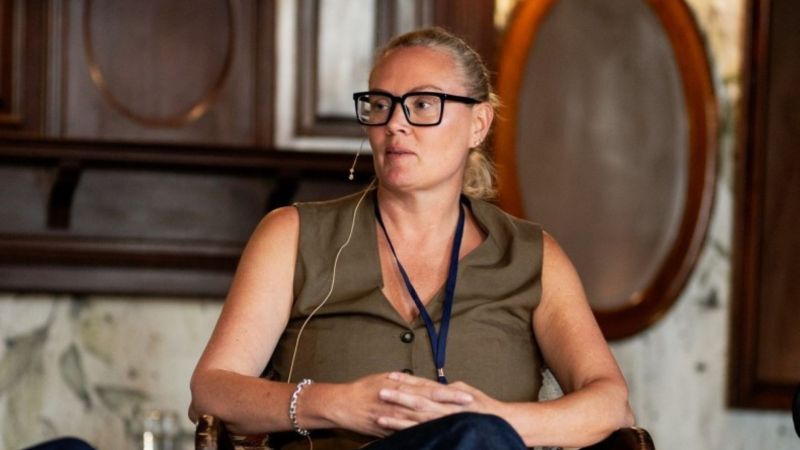
Naomi Timperley, founder, Tech North Advocates
Opinions expressed by Entrepreneur contributors are their own.
You're reading Entrepreneur United Kingdom, an international franchise of Entrepreneur Media.
Naomi Timperley didn’t take the conventional path into tech. She never studied computer science, never launched directly into a venture-backed start-up, nor followed the corporate ladder. Her journey began in the travel sector, a far cry from the boardrooms and accelerator rooms she now inhabits. “My route into tech wasn’t linear. I didn’t study computer science or start in a venture-backed start-up or go down the corporate route. My first career was actually in the travel sector,” she recalls.
Her first real foray into the tech world came almost by accident, in the late 1990s, when she worked for a tech recruitment company in Manchester. “One of the accounts I worked on was one called Vertex. I still remember the first guy that I ever placed, which was a C++ programmer called Rajeev Patel at Vertex on a contract,” she remembers. These early experiences, connecting talent with opportunity, would foreshadow the work she would dedicate herself to: building ecosystems where talent could thrive.
After a detour raising her daughters, Timperley co-launched the UK arm of an American events company, which she ran across nine cities within two years. She recounts the experience with both pride and the kind of candid realism that permeates her reflections on entrepreneurship: “We got offered investment. We turned it down. Usual story, they wanted 40%. I had an American business partner. We would have both been minority shareholders. It wasn’t the right thing to do.” These early ventures also led Timperley to work with youth and women entrepreneurs. She founded Enterprise Lab, a programme bridging education, employment, and enterprise, and a space where young people could test ideas in real markets. One of her favourite projects involved a dozen under-25s bringing products to life through Portobello Road Market. “It was really helping people that had an idea for something. And over the course of about 12 weeks, bringing that product, even if it was really early stage, to market. Very different to the world of working now,” she reflects.
This focus on bridging gaps – whether between talent and opportunity, education and enterprise, or founders and the complex tech ecosystem – has become a central thread in her work. She notes a persistent truth she encounters in her mentoring: “Talent is everywhere, but access isn’t.” That insight underpins much of her career, from her work with Enterprise Lab to founding Tech North Advocates, her leadership role with Global Tech Advocates, and her most recent initiative, Endgame.
At Endgame, Timperley works alongside founders to ensure they’re not just building products, but sustainable businesses. Her insights? “The biggest thing is confusing product processes with business progress. Founders can get deeply attached to building tech features, tech roadmap around that, but then actually delay the hard conversations around product market fit, who their customers actually are, the commercial model around that, and then the leadership capability.”
She sees another common misstep: scaling too early. “Growth amplifies whatever you’ve got that is already fragile. So if you haven’t got the right governance in place, you’ve not got the right team structure, or your cash discipline isn’t strong, scale just accelerates that problem.” At Endgame, Timperley and her team focus on clarity: of value proposition, of the customer, of unit economics, and even of potential exit strategies. “Once that’s in place, the execution that they might want, which might be in three, five, or ten years, becomes far more powerful,” she says.
A key component of her work is her dedication to regional innovation. She points to the North of England as a case study in untapped potential, highlighting a project called Northern Arc. The initiative treats cities such as Manchester, Liverpool, Leeds, and Sheffield not as isolated hubs but as a connected innovation ecosystem, aiming to rival global clusters like Silicon Valley or the Ruhr in Germany. “Northern Arc is about looking at how we can bring Liverpool, Greater Manchester, West Yorkshire, South Yorkshire, Cheshire, and Warrington, and then Lancashire as a conurbation. And how, if we did and enabled that, northern innovation would be much more powerful.”
Timperley highlights the fragmentation that currently hinders investment and growth in the North: “Investors only sort of see fragmented snapshots rather than the full picture… With each city having its own inward investment agency, the businesses are not getting the best fit for their needs. Whereas with a connected approach, you can leverage talent, research, and resources across the entire region.” She frames the Northern Arc project as a model for strategic, co-ordinated regional innovation – one that puts the North firmly on the global tech map.
Mentorship and connection remain central to Timperley’s philosophy. As she reflects on the ripple effects of guidance, she shares a story from the Liverpool Tech Climbers panel: “An individual on the panel, Jay Ascroft, wrote on LinkedIn: ‘Great mentors make all the difference in start-ups. I was introduced to Naomi Tindley and she invited me and my provisional co-founder over to her house for a cup of tea. 45 minutes later, we walked out full of confidence. Gone was the fear, replaced with excitement. I quit that job the very next week. It started my journey into entrepreneurship, and I’ve never looked back.’” These stories reveal mentorship’s impact, reflecting Timperley’s belief that influence exists to create opportunity. “For me, influence only matters if it’s used to open doors, especially for other people.” She is equally passionate about diversity and inclusion in tech. “Innovation thrives on diversity of thought. If ecosystems are not diverse, they stagnate. The rooms that I’m going into and that other people are going into need to reflect the society that we live in,” she stresses, linking inclusive practice directly to sustainable innovation.
Timperley also has a strong perspective on technology trends, particularly AI. But she approaches it with pragmatism. “AI will continue to transform every sector. But the most interesting developments will be sector-specific applications: climate, advanced manufacturing, health, and the creative industries.” She cites the AI Empower Programme she co-created for the Turing Innovation Catalyst as a pilot for the Department of Science and Industry Technology as a practical example: “We worked with businesses that weren’t AI-first… and actually using it to solve a problem, not because it’s a nice shiny thing. And the impact on that was phenomenal.”
For founders shaping the next wave of UK tech, she offers hard-earned advice: “Don’t just build a product. Build a business that has got choices – choices around capital, growth, pace, and exit. Remember that resilience is a strategy, not just a personality trait.” Timperley emphasises preparation and understanding the problem deeply: “A lot of people say, ‘I’ve got a great idea for this,’ but they don’t really think about the problem. Researching, having real conversations, and understanding if people would actually pay to use your product – that’s the foundation of a strong business.”
Despite the challenges facing UK tech – from fragmented regional ecosystems to constrained IPO markets – Timperley remains optimistic. “We’re still a major global player. We’ve still got one of the largest and most valuable tech ecosystems in Europe. The labour market is still resilient and dynamic. And even though you’ve got AI-related roles, there’s still demand for cyber security, infrastructure specialists, data, cloud, hybrid technical roles, and developers with commercial as well as technical skills.” She celebrates the opportunity the current moment provides: “It’s a really interesting and exciting time for people to create things. You can take an idea, test it, get customers, and just go for it without too much money to start. That’s really powerful.”
Her commitment to practical mentorship extends beyond advice into action. Programmes such as Freelancer 100, designed for female freelancers in tech, digital, and creative sectors, have lasting impact: “Three months later, we have 108 people engaged in it, some of these women are still working together, still talking to each other, still connected.” For Timperley, it’s about confidence and creating a safe space for founders to speak honestly. “Most of it has been around confidence. Founders specifically need a safe space to speak honestly. That’s often when they get their biggest breakthroughs.”
Timperley reflects on the cumulative purpose of her career: nurturing talent, bridging gaps, and connecting people. Whether it’s through Endgame, Northern Arc, Tech North Advocates, or Global Tech Advocates, her mission is clear: “It’s about building confidence around UK businesses, connecting tech founders to a global community, and making sure the pipeline of founders from different backgrounds, regions, and routes into tech are seen, introduced, and supported.”
Timperley’s journey – from tech recruitment in Manchester to influencing thousands of founders across the UK – demonstrates that leadership in tech is not only about code, capital, or innovation, but about human connection, mentorship, and a relentless focus on bridging gaps. In her world, the future of UK tech is not just about creating products; it’s about creating opportunities, confidence, and ecosystems that allow creativity and entrepreneurship to flourish.
Naomi Timperley didn’t take the conventional path into tech. She never studied computer science, never launched directly into a venture-backed start-up, nor followed the corporate ladder. Her journey began in the travel sector, a far cry from the boardrooms and accelerator rooms she now inhabits. “My route into tech wasn’t linear. I didn’t study computer science or start in a venture-backed start-up or go down the corporate route. My first career was actually in the travel sector,” she recalls.
Her first real foray into the tech world came almost by accident, in the late 1990s, when she worked for a tech recruitment company in Manchester. “One of the accounts I worked on was one called Vertex. I still remember the first guy that I ever placed, which was a C++ programmer called Rajeev Patel at Vertex on a contract,” she remembers. These early experiences, connecting talent with opportunity, would foreshadow the work she would dedicate herself to: building ecosystems where talent could thrive.
After a detour raising her daughters, Timperley co-launched the UK arm of an American events company, which she ran across nine cities within two years. She recounts the experience with both pride and the kind of candid realism that permeates her reflections on entrepreneurship: “We got offered investment. We turned it down. Usual story, they wanted 40%. I had an American business partner. We would have both been minority shareholders. It wasn’t the right thing to do.” These early ventures also led Timperley to work with youth and women entrepreneurs. She founded Enterprise Lab, a programme bridging education, employment, and enterprise, and a space where young people could test ideas in real markets. One of her favourite projects involved a dozen under-25s bringing products to life through Portobello Road Market. “It was really helping people that had an idea for something. And over the course of about 12 weeks, bringing that product, even if it was really early stage, to market. Very different to the world of working now,” she reflects.

Patricia Cullen • Features Writer
Entrepreneur Staff