Why This London Art Firm Built Its Entire Model Around One Artist
Some businesses spend their first five years trying to serve more customers. Aurum Fox has spent its trying to serve fewer, more slowly.
Aurum Fox
Opinions expressed by Entrepreneur contributors are their own.
You're reading Entrepreneur United Kingdom, an international franchise of Entrepreneur Media.
Aurum Fox represents a single artist, releases his work in controlled stages and would rather keep a waiting list than saturate the market. Founder Kazi Hoque argues that discipline, not scale, is the business.
Some businesses spend their first five years trying to serve more customers. Aurum Fox has spent its trying to serve fewer, more slowly.
The Chelsea brokerage says it has a waiting list for the work it sells. It has chosen not to clear it. It could ask the studio for more paintings and turn that list into revenue this quarter. It doesn’t, because the moment it does, the thing its existing clients bought becomes a slightly more common thing.
That is an uncomfortable position for any founder who has ever watched demand outstrip stock. It is also, in this case, the entire operating model.
One artist is the whole business
Aurum Fox represents one artist: Greg Deda, a Canadian painter born in 1965 who works between Toronto and New York. Not a roster with a lead name. One.
Most art advisers spread across styles, price bands and dozens of artists, for the obvious reason that any business teacher would give you. Aurum Fox concentrated instead. It runs a gallery on Fulham Road in Chelsea, viewings by appointment only, and says it holds a fifty per cent stake in it. According to Aurum Fox, the firm brings decades of combined market experience and has placed a significant volume of works with collectors.
“Great collections are not bought. They are built — with patience, knowledge and an eye for the exceptional,” says Hoque, who founded the firm.
The trade-off is real and the firm states it in its own disclosures: a single-artist model concentrates risk in a way a diversified one does not. What it may offer in return is greater depth. Every exhibition, every placement, every decision about what goes to market and when is made about one body of work rather than forty.
Why Greg Deda
A single-artist strategy is only as strong as the artist, and Deda’s training is unusually classical for a contemporary painter. In 1996 he studied at the Scuola dei Beni Culturali in Italy, now part of the University of Salento, where he worked on restoring icon panels and frescos. His biography credits the fresco painters of the Renaissance, Michelangelo, Botticelli and Mantegna among them, as the formative influence on his work.
He then moved to Germany in the years after the fall of the Berlin Wall, studying at a Kunstschule where he met artists including Gerhard Richter and Jörg Immendorff. Old-master technique on one side and post-reunification German painting on the other became the foundation for his two main bodies of work.
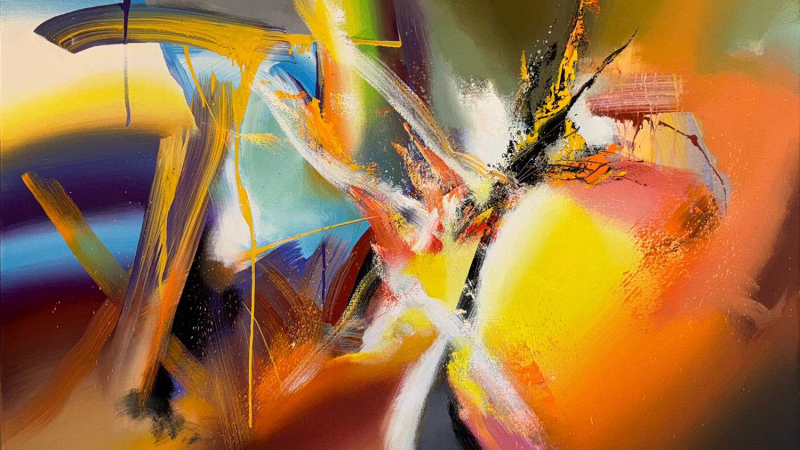
The first is magic realism: dreamlike, symbol-heavy scenes built around Roman mythology, architecture, illusion and shifting societies, deliberately ambiguous in mood. The second is abstract and semi-abstract painting concerned with nature, architecture and the subconscious. His work has been shown in Turin, Düsseldorf, Munich, New York, Toronto and, more recently, London.
For a firm that plans to release work slowly over many years, that range matters. Deda’s output runs from his Early Magic Realism series of the late 1990s, through canvases such as Afternoon Tea in 2012, to abstract works such as Abstract Awakening II. A long and varied catalogue lets Aurum Fox bring work to market in considered stages without leaning on a single style or period. The approach treats Deda as a career to be managed over decades rather than a stock of paintings to be sold down.
Why it controls the pace of release
Supply discipline is easy to talk about and hard to hold. It means saying no to buyers who are ready now.
Aurum Fox says it paces the rate at which new work reaches the market and declines to raise that rate when interest rises, on the view that over-saturating the market would undermine the value of work already in collectors’ hands. Its calendar stays deliberately thin. Last November, it hosted an invitation evening called Fox’s Journey at Foxhills Country Club & Resort, a collectors’ event rather than a public show, and its published programme since has remained limited to a handful of dates.
Founders who have run limited releases will recognize the mechanic. What is unusual here is applying it as a permanent policy rather than a launch tactic, in a category where increasing output can be tempting and the marginal cost of doing so may be relatively low.
Putting the model in public
Here is what sets the model apart from a typical scarcity claim: the firm sends the work to open auction, where it does not control the final price.
Almost everything that happens in private art sales stays private. A gallery names a figure, a collector agrees, and nobody outside the room learns anything. An auction inverts that. The estimate is set by the auction house, the bidding is open to anyone registered, and the result goes on the public record whether it flatters the seller or not.
In September 2025, Lot 156a at Tate Ward’s Urban & Contemporary Art sale in east London was Abstract Awakening II, a unique mixed media work on canvas. It sold for £50,000 against a published estimate of £40,000 to £60,000. Inside expectation rather than beyond it, and set by a third party.
On 12 August this year the firm went further afield, entering a 2013 canvas called Afternoon Tea into Lyon & Turnbull’s Contemporary Art sale in Edinburgh. The house has traded since 1826, making this its bicentenary year, and sells from the former Broughton Place Church, a Greek Revival building that opened in 1821. Its buyers include Scottish and international fine art collectors, a different setting from Tate Ward’s Brick Lane urban and contemporary art sales. Afternoon Tea sold for £35,480 including buyer’s premium, against an estimate of £2,000 to £3,000, nearly twelve times the top of the range.
Two different rooms, two different bidder pools. That is how a business finds out whether its demand is real or local. Both results are now on the public record. A single sale that beats its estimate by that margin does not set a price level on its own, but it does show demand for Deda’s work beyond the firm’s own client list.
The exposure has also moved beyond the saleroom. On 19 September, Aurum Fox was the official art partner of This Is Icon, a runway show and gala held at The Brewery on Chiswell Street during London Fashion Week, and used the evening to introduce Deda’s work to an audience from fashion and luxury rather than the art trade.
The risk nobody puts in the pitch deck
Concentration cuts both ways, and it would be dishonest to write this up as a clean win.
If interest in one artist cools, there is no second product line to carry the firm. If releases stay slow and a rival moves faster on a comparable name, the waiting list becomes a queue of people who found something else. And a business whose value proposition is scarcity has to keep proving the scarcity is genuine rather than manufactured, which is exactly why the auction results matter more to Aurum Fox than to a conventional gallery.
What founders can take from this
Constraint only works when it is checked externally. Any company can claim limited supply. Few submit to a process where an independent party sets the price and publishes the outcome. If a scarcity story cannot hold up under that kind of external test, it may be more about positioning than strategy.
Controlled release costs revenue now to help protect the integrity of the market later, and that only pays if your customers are buying durability rather than access. Aurum Fox says its clients are buying assets they expect to hold. A business selling something consumable might not benefit from the same approach.
And concentration is a decision, not an accident. Aurum Fox chose one artist knowingly and says so out loud, including the downside. That leaves Aurum Fox with a clear position: it knows where it believes its advantage lies and has built the business around it.
Art carries risk and values can fall as well as rise. Past results give no indication of future performance. Nothing in this article constitutes financial advice.
Aurum Fox represents a single artist, releases his work in controlled stages and would rather keep a waiting list than saturate the market. Founder Kazi Hoque argues that discipline, not scale, is the business.
Some businesses spend their first five years trying to serve more customers. Aurum Fox has spent its trying to serve fewer, more slowly.
The Chelsea brokerage says it has a waiting list for the work it sells. It has chosen not to clear it. It could ask the studio for more paintings and turn that list into revenue this quarter. It doesn’t, because the moment it does, the thing its existing clients bought becomes a slightly more common thing.

Patricia Cullen • Features Writer
Entrepreneur Staff