Cutting Out the Noise
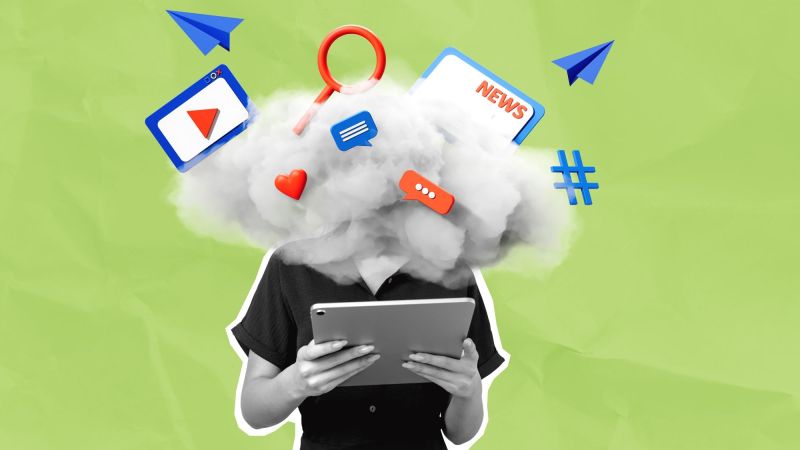
Entrepreneurs risk shallow thinking as AI and digital distractions intensify overload.
Shutterstock
Opinions expressed by Entrepreneur contributors are their own.
You're reading Entrepreneur United Kingdom, an international franchise of Entrepreneur Media.
The Man Who Looks In Control
Frederic runs the European operations of a mid-sized fintech. If you met him at a conference, you’d think he had it together. He’s articulate, well-presented, clearly across his numbers. He can speak fluently about regulatory strategy, product roadmaps, and his team’s quarterly targets. But Frederic has a problem he doesn’t yet have the language to describe. He hasn’t finished reading a long document in months. He starts a report, gets pinged, switches to Slack, checks email, glances at his dashboard – and forty minutes later, can’t recall what he was doing. His thinking feels shallower than it used to. He’s always doing something – but increasingly, he’s not actually thinking. Frederic is not an outlier. He is, in many ways, the portrait of a modern entrepreneur: highly capable, digitally fluent, genuinely committed – and quietly overwhelmed by the very tools designed to help him.
The Data Behind the Distraction
The scale of digital interruption in modern workplaces is not a matter of opinion. Gloria Mark, professor of informatics at the University of California Irvine and arguably the world’s leading researcher on attention and digital distraction, has tracked this phenomenon across two decades. Her findings are sobering. In the early 2000s, Mark found that knowledge workers switched tasks, on average, every two and a half minutes. By 2020, that had dropped to 47 seconds. Today, the average screen attention span in an office context sits at around 40 seconds before something – an alert, a notification, an impulse to check – pulls a worker away from what they were doing. Mark’s more recent work shows something equally troubling: we are now frequently interrupting ourselves. External pings account for roughly 44% of interruptions. The rest are self-generated – we have been conditioned, by the architecture of our devices, to seek novelty compulsively, even when nothing external demands it. The average knowledge worker is interrupted every six minutes in a typical work environment. Add video calls, push notifications, and the ambient pressure of always-on digital culture, and what emerges is an information environment that is fundamentally hostile to sustained thought.
The True Cost of Task Switching
Every time we switch tasks, we pay a cognitive toll. Researchers call this ‘attention residue’: even after moving on, part of the brain stays with the previous task. It takes around 23 minutes to regain deep focus after an interruption – but when interruptions arrive between every 40 seconds and 6 minutes, that recovery never happens. We spend our days in a state of perpetual shallowness. There is a physiological dimension to this too. Constant context switching is not merely mentally tiring; it places the nervous system under sustained stress. Each interruption triggers a mild stress response: a cortisol spike, a shift toward sympathetic activation, preparing the body for something that never quite arrives. Over time, this cumulative load builds. Heart rate variability, a key measure of physiological stress, declines under high levels of digital interruption. The nervous system does not distinguish between a threat and a Slack notification. Both demand a response. This is a twofold problem. Digital interruption fragments attention AND dysregulates the nervous system that underpins sustained thought. The two reinforce each other. As stress rises, focus drops; as focus drops, we reach for more stimulation — and the more we stimulate ourselves (news, videos, messages etc) the more stressed we become. The impact is clear – interrupted surgeons make more errors, air traffic controllers lose situational awareness, and lawyers make more analytical mistakes. The cost is significant, with digital interruption estimated to cost the US economy over $650bn annually. Productivity is arguably the metric we most often focus on when talking about distraction, but it’s the least interesting one. More consequential is what fragmented attention does to how we perceive the world, shaping our decision quality, creativity, and emotional regulation. Attention is our gateway to the world: what we don’t attend to, we don’t perceive. When attention is constantly pulled across superficial topics, our view of the world becomes fragmented, consequentially impacting our thinking. We become more impulsive, less able to hold complexity or weigh up pros and cons. We become more drawn to simple, easily graspable ideas, even when reality is not so simple.
AI Is Pouring Fuel on the Fire
Into this already-challenged landscape, AI has arrived – marketed as a solution to overload, increasingly functioning as an accelerant. An eight-month ethnographic study at a US tech company, published in Harvard Business Review in 2026, identified what researchers called the ‘AI intensification effect.’ Rather than reducing workload, AI quietly expanded it. Task boundaries blurred, workers took on more responsibilities, and the sense of an always-available AI partner pushed work into evenings and weekends. Prompting felt like chatting – until recovery time disappeared. A 2026 BCG/HBR survey of nearly 1,500 US workers identified a distinct phenomenon called ‘AI Brain Fry’: mental fatigue from excessive AI oversight. 14% of regular users reported it, with those affected showing higher decision fatigue, more major errors and a greater likelihood of wanting to quit. The average worker now juggles three to five AI tools, each with its own interface and logic. Research in the International Journal of Information Management identifies ‘AI technostress’ — the strain of constant adaptation to new tools — with 75% of workers reporting low confidence despite rising expectations. And unlike notifications from earlier decades, AI tools create conditions for the worker to generate distractions: more threads, more outputs, more cognitive loops to close.
The Particular Danger for Entrepreneurs
All of the above applies to knowledge workers broadly. For entrepreneurs specifically, the risks are compounded by several factors that rarely get discussed. Entrepreneurs tend to be younger, more digitally native, and early, heavy adopters of AI. They also operate with fewer structural constraints: no IT policies, no managers modelling good digital hygiene, no established norms around healthy AI use. In short, they are the group most exposed to digital overload, with the least protection against it. There is also something more fundamental at stake. The qualities that make entrepreneurship possible – holding complexity, sensing emerging patterns, trusting judgment in novel situations – depend on the very cognitive and nervous system capacities that digital fragmentation erodes. Strategic insight does not emerge from a scattered mind. It requires sustained, unhurried attention; the ability to stay with a problem, to notice edges and gaps, and to balance focused thinking with the broader awareness that catches what logic alone misses. There is another loss. The spaces between work – a pause before a meeting, a coffee break, the idle minutes between tasks – were once moments of reset: the nervous system downregulating, the mind consolidating, informal interaction doing its quiet regulatory work. These micro-recoveries have been colonised: first by smartphones, now by always-on AI. For entrepreneurs running lean, AI-heavy operations, these natural recovery rhythms may no longer exist. The result is a working life of near-constant activation, with effects that compound silently and surface in wellbeing, performance, and more deeply in decision quality and worldview.
Train Your Mind Like You Train Your Body
Most entrepreneurs understand physical training. They know the difference between cardiovascular fitness and strength. They understand periodisation – that recovery is not a failure of effort but a component of it. They accept that the body needs deliberate stress and deliberate rest in carefully managed cycles to grow physically stronger. This shift began when modern life removed the natural physical demands that once kept us fit, forcing us to replace incidental movement with deliberate exercise. The same now applies to the mind. Digital life — and AI in particular – is removing the cognitive demands that once kept our attention robust. We must replace them with deliberate mental training. This is not a metaphor – it is an operational necessity. Just as physical training of the body has no shortcuts, neither does the mind.
Here is where to start:
Turn off notifications as a default. This is not a lifestyle tip; it is a cognitive protection measure. Every notification is an interruption event that triggers an attention residue cycle. Batch your communication into between two and five designated windows per day. The research on this is strong: workers who batch email report lower stress and no degradation in responsiveness. Schedule and defend focus blocks. Research shows sustained, uninterrupted periods of 90 – 120 minutes produce qualitatively different cognitive output than fragmented work. The mechanism is neurological: sustained attention allows the prefrontal cortex to operate at full capacity, enabling complex, integrative thinking. Block this time in your calendar and protect it with the same discipline as a meeting with your most important investor. Practise the other mode of attention. Focus is only half the cognitive picture. The other is open awareness – stepping back, noticing patterns, sensing what sits beyond immediate analysis. This is fundamental to creative insight, judgment and reading a room, yet is eroded by constant stimulation. Deliberately practise it: walk without a podcast, sit in meetings without your laptop, let problems rest. These are not indulgences. They are conditions for high-quality thinking. Finally, train attention with mindfulness. The evidence base is now substantial. Even ten minutes of daily mindfulness practice can increase sustained attention, reduce mind-wandering, and improve disengagement from distraction, while lowering cortisol and improving heart rate variability. Think of it as cardiovascular training for the mind: it doesn’t remove stress, but builds the capacity to regulate under it.
Frederic, when we last spoke, had started doing one thing differently. Each morning, before opening any device, he spends fifteen minutes writing longhand – no prompt, no AI, no structure. Just his own mind, on paper. He describes it as ‘the only time in the day I find out what I actually think.’ That is, perhaps, the simplest summary of what is at stake. In a world of relentless digital acceleration, the ability to know what you actually think – and to trust that thinking – is becoming one of the rarest and most valuable capacities an entrepreneur can possess. It will not protect itself. You will need to train for it.
The Man Who Looks In Control
Frederic runs the European operations of a mid-sized fintech. If you met him at a conference, you’d think he had it together. He’s articulate, well-presented, clearly across his numbers. He can speak fluently about regulatory strategy, product roadmaps, and his team’s quarterly targets. But Frederic has a problem he doesn’t yet have the language to describe. He hasn’t finished reading a long document in months. He starts a report, gets pinged, switches to Slack, checks email, glances at his dashboard – and forty minutes later, can’t recall what he was doing. His thinking feels shallower than it used to. He’s always doing something – but increasingly, he’s not actually thinking. Frederic is not an outlier. He is, in many ways, the portrait of a modern entrepreneur: highly capable, digitally fluent, genuinely committed – and quietly overwhelmed by the very tools designed to help him.
The Data Behind the Distraction
The scale of digital interruption in modern workplaces is not a matter of opinion. Gloria Mark, professor of informatics at the University of California Irvine and arguably the world’s leading researcher on attention and digital distraction, has tracked this phenomenon across two decades. Her findings are sobering. In the early 2000s, Mark found that knowledge workers switched tasks, on average, every two and a half minutes. By 2020, that had dropped to 47 seconds. Today, the average screen attention span in an office context sits at around 40 seconds before something – an alert, a notification, an impulse to check – pulls a worker away from what they were doing. Mark’s more recent work shows something equally troubling: we are now frequently interrupting ourselves. External pings account for roughly 44% of interruptions. The rest are self-generated – we have been conditioned, by the architecture of our devices, to seek novelty compulsively, even when nothing external demands it. The average knowledge worker is interrupted every six minutes in a typical work environment. Add video calls, push notifications, and the ambient pressure of always-on digital culture, and what emerges is an information environment that is fundamentally hostile to sustained thought.
The True Cost of Task Switching
Every time we switch tasks, we pay a cognitive toll. Researchers call this ‘attention residue’: even after moving on, part of the brain stays with the previous task. It takes around 23 minutes to regain deep focus after an interruption – but when interruptions arrive between every 40 seconds and 6 minutes, that recovery never happens. We spend our days in a state of perpetual shallowness. There is a physiological dimension to this too. Constant context switching is not merely mentally tiring; it places the nervous system under sustained stress. Each interruption triggers a mild stress response: a cortisol spike, a shift toward sympathetic activation, preparing the body for something that never quite arrives. Over time, this cumulative load builds. Heart rate variability, a key measure of physiological stress, declines under high levels of digital interruption. The nervous system does not distinguish between a threat and a Slack notification. Both demand a response. This is a twofold problem. Digital interruption fragments attention AND dysregulates the nervous system that underpins sustained thought. The two reinforce each other. As stress rises, focus drops; as focus drops, we reach for more stimulation — and the more we stimulate ourselves (news, videos, messages etc) the more stressed we become. The impact is clear – interrupted surgeons make more errors, air traffic controllers lose situational awareness, and lawyers make more analytical mistakes. The cost is significant, with digital interruption estimated to cost the US economy over $650bn annually. Productivity is arguably the metric we most often focus on when talking about distraction, but it’s the least interesting one. More consequential is what fragmented attention does to how we perceive the world, shaping our decision quality, creativity, and emotional regulation. Attention is our gateway to the world: what we don’t attend to, we don’t perceive. When attention is constantly pulled across superficial topics, our view of the world becomes fragmented, consequentially impacting our thinking. We become more impulsive, less able to hold complexity or weigh up pros and cons. We become more drawn to simple, easily graspable ideas, even when reality is not so simple.