A Tokenization Startup Focuses on the Infrastructure Challenges of Alternative Assets
FractiFi
While financial giants race to tokenize treasuries and equities, a sizable segment of the alternative asset market remains relatively underdeveloped. One startup is focusing on this area as a possible source of long-term value creation.
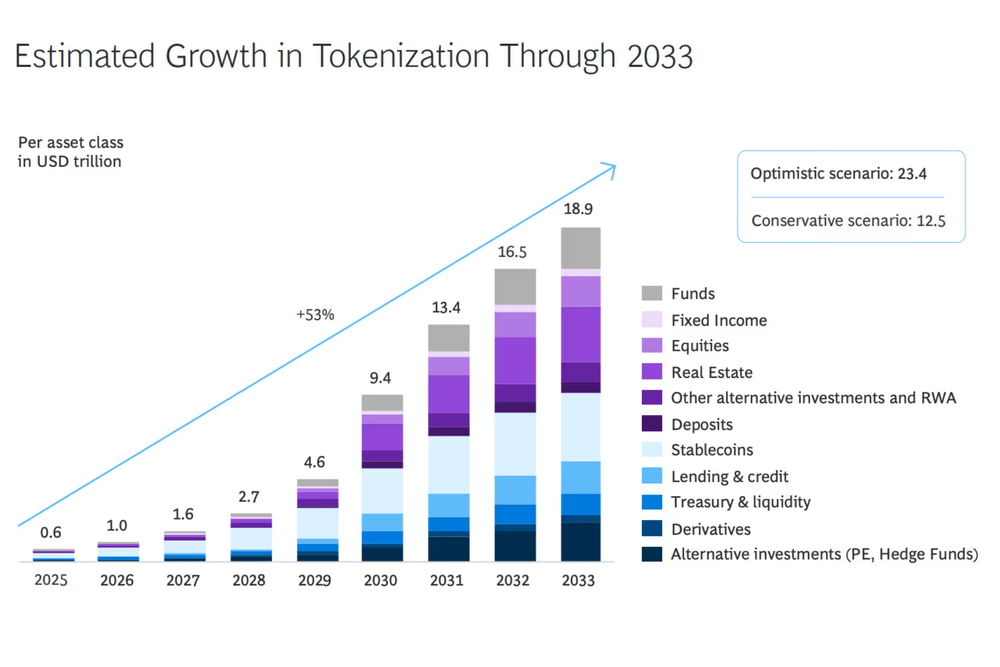
When Larry Fink declared that “the next generation for markets will be tokenization of securities,” the financial world took notice. The numbers back him up: Boston Consulting Group projects the tokenized asset market will reach $18.9 trillion by 2033. The NYSE announced plans for a tokenization platform. BlackRock’s BUIDL fund has crossed $2.5 billion.
But look closer at what’s being built: treasuries, equities, money market funds. Assets that are already liquid, accessible, and standardized.
According to estimates cited by JP Morgan and Bain, tokenization of alternative funds could represent an area of increased interest and participation, though meaningful adoption remains in its early stages.
Where the Giants Aren’t Looking
Alternative assets like agriculture, commodities, carbon credits, or collectibles barely register. These assets are typically illiquid, fragmented, and operationally complex, making them difficult to access for all but the largest institutions.
This isn’t an oversight. It’s a strategic choice. The major players are tokenizing what they know: liquid assets with existing infrastructure.
FractiFi, a European startup founded by Matias Hagen, Yorick Timmers, and Ymir Egilson, takes a different approach from larger players in the space.
The proof is practical: working with real counterparties and real capital. Starting by bundling agriculture products and supply chains, before expanding into a broader platform for all alternatives.
“Everyone’s racing to tokenize the assets that need it least,” says Yorick Timmers, co-founder. “Treasuries are already liquid. Tokenizing them is an optimization. But these yield-bearing alternatives are illiquid and locked away from most investors. Tokenization has the potential to broaden access in ways that were previously difficult or impractical using traditional structures.“
For asset owners, this could enable more direct engagement with a global investor base. For institutions, it may offer new pathways to engage with asset classes that have historically been operationally complex or inefficient to access at scale.
“We mapped the entire landscape before building anything,” adds Matias Hagen, co-founder. “The more we looked, the clearer the gap became. While large institutions tend to focus on familiar segments, other areas of the market continue to evolve more quietly and with fewer established players.“
The Infrastructure Barrier
If the potential is significant, one reason progress has been uneven is the lack of mature infrastructure needed to support it at scale.
When teams attempt to bring alternative assets on-chain today, they face a fragmented vendor landscape. One provider for tokenization, another for compliance, another for custody, another for reporting. Every layer requires bespoke legal work per asset and jurisdiction. Every project rebuilds the same plumbing from scratch.
“You can’t build a $400 billion market by duct-taping six vendors together for every deal,” says Hagen. “That’s the barrier we’re removing.“
FractiFi’s approach: collapse the entire stack—onboarding, tokenization, compliance, treasury rails, lifecycle management, reporting—into a single integrated platform. Not a tool that plugs into existing systems, but the system itself. One platform that handles the full asset lifecycle from structuring to secondary trading.
Ymir Egilson, co-founder of Europe’s leading enterprise software group, leads the technical buildout. “Infrastructure like this takes years to replicate,” he says. “Every asset we process makes the system harder to compete with.”
Compliance by Design
For alternative assets, the biggest barrier often isn’t technical; it’s regulatory. Tokenizing yield-bearing alternatives means navigating securities law, investor accreditation, and cross-border compliance. Most projects treat this as an afterthought and hit a wall when they try to scale.
FractiFi is taking the opposite approach: building compliance into the platform architecture from day one, pursuing licensing in key jurisdictions, and designing for institutional requirements from the start.
“You can have the best technology in the world, but if you can’t get it past regulators, you have nothing,” says Timmers. “We’re not moving fast and breaking things. We’re building something institutions can actually use.”
The Bet
FractiFi isn’t trying to outcompete the giants in capital markets. They’re going where those players aren’t.
The end vision: a world where institutions and individuals access yield-bearing alternatives as easily as they buy stocks today, and where asset owners tap into global capital without navigating a maze of intermediaries. A world where retail investors build diversified portfolios of real assets previously reserved for professionals, and asset owners unlock liquidity without selling.
The discussion reflects differing priorities. As established companies focus on refining existing approaches, ideas are being explored for how these assets are structured, administered, and accessed in the future.
“This is the part of the market where tokenization actually changes things,” says Timmers. “That’s where we want to be.“
While financial giants race to tokenize treasuries and equities, a sizable segment of the alternative asset market remains relatively underdeveloped. One startup is focusing on this area as a possible source of long-term value creation.
When Larry Fink declared that “the next generation for markets will be tokenization of securities,” the financial world took notice. The numbers back him up: Boston Consulting Group projects the tokenized asset market will reach $18.9 trillion by 2033. The NYSE announced plans for a tokenization platform. BlackRock’s BUIDL fund has crossed $2.5 billion.
But look closer at what’s being built: treasuries, equities, money market funds. Assets that are already liquid, accessible, and standardized.