Dubai’s New Dual-License Rules Could Reshape How British Companies Enter the Gulf
For years, a Dubai free zone company, which structures most foreign founders choose, allowing full ownership without a local partner, could not sell directly into the UAE mainland market without either appointing a local distributor or incorporating an entirely separate mainland entity.
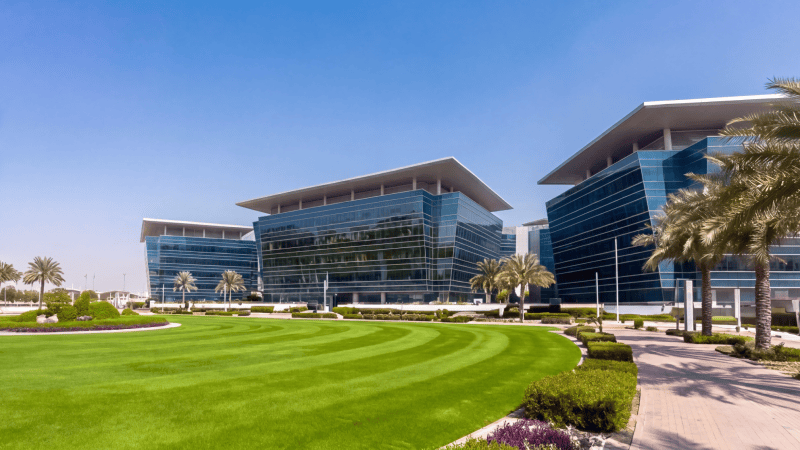
Dubai South Business Hub
You're reading Entrepreneur United Kingdom, an international franchise of Entrepreneur Media.
British interest in Dubai as a base for Gulf expansion has moved well past anecdote. Dubai Chambers recorded 562 new British company registrations in the first quarter of 2026 alone, taking the total number of active UK firms registered with the chamber past 10,300, more than four times the figure recorded at the end of 2020. Non-oil trade between Dubai and the UK has climbed from AED 23.1 billion in 2021 to AED 42.6 billion in 2025, and that growth has continued alongside the recent conclusion of negotiations on a UK-GCC Free Trade Agreement, which UAE and UK officials have both signalled will focus next on reducing the practical friction points still facing cross-border business.
One of those friction points has just been addressed, and it hasn’t attracted nearly the coverage it deserves outside specialist legal circles. For years, a Dubai free zone company, which structures most foreign founders choose, allowing full ownership without a local partner, could not sell directly into the UAE mainland market without either appointing a local distributor or incorporating an entirely separate mainland entity. Dual licensing existed, but only through a handful of individual memoranda of understanding between Dubai’s Department of Economy and Tourism and specific free zones, negotiated case by case rather than offered as a general right available across the sector.
Executive Council Resolution No. 11 of 2025 changes that structure meaningfully. It replaces the old patchwork with a single Dubai-wide framework under which a qualifying free zone company can obtain mainland trading rights as a branch of its existing entity, rather than as a new company requiring its own memorandum of association, its own establishment card, and its own beneficial ownership filing. Three permit routes are now available: a branch license and a remote branch, both priced at roughly AED 10,000 a year, and a six-month temporary permit at around AED 5,000 for shorter-term mainland activity. The Department of Economy and Tourism may process these applications within five to ten business days, depending on the circumstances, a potentially faster route than standing up a second company from scratch.
For a British founder weighing whether a Dubai free zone can genuinely support a growth strategy that eventually needs mainland or government-facing clients, this may help address a gap that previously led some founders to adopt a potentially more costly dual-entity structure earlier than their businesses required. It does not erase every distinction: mainland revenue earned through a dual license is taxed at the UAE’s standard 9% corporate rate regardless of how the free zone side of the business is taxed, and a company’s separate 0% treatment on qualifying free zone income depends on keeping the two revenue streams in clearly documented, unmixed financial records. Get that bookkeeping wrong and a business risks its free zone tax position over what was meant to be an incidental mainland contract.
There is also a practical governance upside that gets less attention than the fee schedule. For a founder already managing one set of UAE compliance obligations, that consolidation is not a minor convenience. It can mean one fewer register to maintain, one fewer renewal date to track, and one fewer place where a filing could be missed.
What makes this change worth watching from a UK vantage point is less the specific fee schedule and more the direction of travel it represents. As the UK-GCC Free Trade Agreement moves from negotiation towards implementation, practical considerations such as licensing structures, market access routes and the cost of testing a market before fully committing may influence whether a British SME can operate profitably in the Gulf. These tend to matter more than the headline trade figures.
Whether that translates into a meaningfully larger wave of British market entry, or simply a smoother path for the founders already coming, will depend on how consistently DET processes these applications at scale over the next year. But the regulatory direction is now clear, and it’s one more data point suggesting that the Dubai free zone model, often discussed purely as a tax and ownership story, is increasingly also a market-access story, which is the part of it that will matter most to British businesses actually deciding where to put their next office.
Prices and availability are accurate as of the time of publication and are subject to change without notice. Please check the retailer’s website for the most up-to-date pricing information.
British interest in Dubai as a base for Gulf expansion has moved well past anecdote. Dubai Chambers recorded 562 new British company registrations in the first quarter of 2026 alone, taking the total number of active UK firms registered with the chamber past 10,300, more than four times the figure recorded at the end of 2020. Non-oil trade between Dubai and the UK has climbed from AED 23.1 billion in 2021 to AED 42.6 billion in 2025, and that growth has continued alongside the recent conclusion of negotiations on a UK-GCC Free Trade Agreement, which UAE and UK officials have both signalled will focus next on reducing the practical friction points still facing cross-border business.
One of those friction points has just been addressed, and it hasn’t attracted nearly the coverage it deserves outside specialist legal circles. For years, a Dubai free zone company, which structures most foreign founders choose, allowing full ownership without a local partner, could not sell directly into the UAE mainland market without either appointing a local distributor or incorporating an entirely separate mainland entity. Dual licensing existed, but only through a handful of individual memoranda of understanding between Dubai’s Department of Economy and Tourism and specific free zones, negotiated case by case rather than offered as a general right available across the sector.
Executive Council Resolution No. 11 of 2025 changes that structure meaningfully. It replaces the old patchwork with a single Dubai-wide framework under which a qualifying free zone company can obtain mainland trading rights as a branch of its existing entity, rather than as a new company requiring its own memorandum of association, its own establishment card, and its own beneficial ownership filing. Three permit routes are now available: a branch license and a remote branch, both priced at roughly AED 10,000 a year, and a six-month temporary permit at around AED 5,000 for shorter-term mainland activity. The Department of Economy and Tourism may process these applications within five to ten business days, depending on the circumstances, a potentially faster route than standing up a second company from scratch.
Entrepreneur UK
Entrepreneur Staff