How Two IIT Founders Reimagined Sales AI From Bangalore
Overlayy
Opinions expressed by Entrepreneur contributors are their own.
You're reading Entrepreneur United Kingdom, an international franchise of Entrepreneur Media.
Sales teams across industries face a persistent problem: despite investing in tools like CRM platforms, call transcription software, and agents that automate regular client interactions, representatives lack actionable intelligence they can use during live customer conversations. Institutional knowledge from successful deals remains buried in recordings and scattered email threads, meaning it can’t be used when it matters most, making it a costly inefficiency for many.
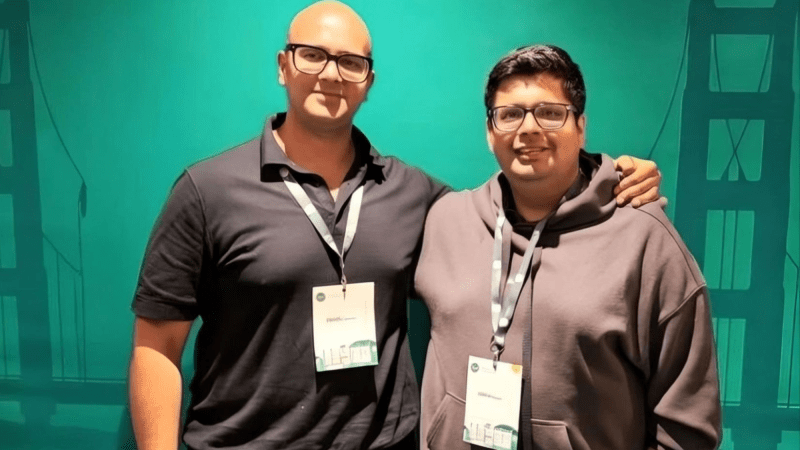
Anmol Chaman and Snehil Saluja set out to close that gap when they launched Overlayy, an AI-powered sales intelligence platform that aggregates data from different fragmented data points to deliver real-time guidance to sales representatives during live customer conversations.
Operating from Bangalore with a five-person team, the co-founders had to deal with limited access to design partners, fewer warm introductions to enterprise customers, and the differences in time zones between the U.S. and U.K. markets they were targeting. Despite these challenges, the team gained early traction and built industry recognition for their startup’s growth and potential.
Finding The Missing Spot In Sales Tech
The thesis behind Overlayy emerged from a pattern Chaman observed across revenue organizations: the playbooks created by sales leadership existed as static documents disconnected from the patterns and tools that were being used to chase and close actual deals across the organization.
“Any company has their CRM plus extra marketing and call transcription tools capturing a lot of data,” Chaman says. “What we realized is: for every business, there are a lot of signals, but those tools don’t essentially help take revenue forward.”
Institutional knowledge from successful deals, including how top performers pitched to similar customers, handled objections, or positioned pricing, remained buried in call recordings and communication channels with no way to easily share information from one platform to another. Additionally, offline conversations and in-person meetings generated important insights into both specific clients and potential future ones that never entered the system at all.
Overlayy’s approach was to aggregate these disparate sources into one. The platform pulls information from CRM entries, recorded calls, email exchanges, and marketing touchpoints into a single point of contact. It also applies pattern recognition to see strategies that worked in past deals and surfaces that intelligence to individual representatives in real-time, tailored to the specific customer or objection they faced.
Because of this, instead of replacing existing tools, Overlayy acts as an extra layer on top of a company’s current sales infrastructure, connecting them to take static historical data and turn it into dynamic guidance.
Building From India Against US Competitors
Operating from Bangalore while targeting enterprise customers in the United States and United Kingdom meant the founders faced structural disadvantages their San Francisco counterparts didn’t. Access to design partners for user research and product feedback was limited to three or four companies at any given time, a fraction of what competitors with access to local networks could assemble. Neither founder had operated in a formal enterprise sales function before starting the company, meaning they learned the market while building for it.
“One thing I realized we did well versus a lot of other companies building in a similar space is building from India while competing with companies in the States,” Chaman recalls.
These constraints forced a discipline around being as efficient in their execution as possible. The team built products that had to be better than their competitors despite having far less user data and market access.
Chaman, an aerospace engineer turned entrepreneur, acted as the CEO with a focus on GTM and product strategy, where he drew on his experience driving revenue growth as Head of Growth at Nudge and being a founding member at multiple startups that grew from 0 to millions in revenue. Saluja, serving as CTO, brought engineering experience from building mobile teams at Attentive AI, a company backed by Sequoia and Insight Partners, and from his role as an employee at Blitz, where he architected their warehousing management system.
That technical foundation allowed the small team to build and iterate on a feature-rich agentic platform at record speed, which proved crucial to the platform’s future.
Recognition From Elite Evaluators
The execution velocity attracted attention from institutional gatekeepers. Overlayy placed in the top ten percent of over ten thousand startups evaluated by Y Combinator for the Winter 2025 cohort. The company also placed within the top ten percent of applicants at a16z Speedrun. While Overlayy was not ultimately selected for these programs, its performance highlighted how leading evaluators independently recognized the team’s strength and product potential.
Better Capital, a competitive India-focused venture fund, led Overlayy’s two-hundred-fifty-thousand-dollar seed round. These recognitions came within months of launch, as the company rapidly expanded its customer base and achieved meaningful early revenue growth within its first seven months.
The founders also began engaging more directly with the AI research community by co-authoring SalesQA, a B2B sales conversation benchmark for artificial intelligence. That work positioned them as experts in the field instead of simply another newcomer in an already crowded market.
“We started talking to a bunch of people already in the industry: product managers, CPOs, CROs at different companies,” Chaman said. “That’s when we got the feeling: the market is insanely competitive. We built something great. The product, the execution DNA is amazing.”
Choosing Partners Over Purely Optimizing Terms
As traction accumulated, the founders began attracting outside interest from potential partners and investors. The options validated their execution but it also meant the founders had to undergo careful strategic evaluation. Chatting with a variety of industry veterans, they reaffirmed their belief that the go-to-market AI space had become extraordinarily competitive, making the choice of partner critical to long-term success.
For Chaman and Saluja, the deciding factor was vision alignment. The right partner would share their core belief that AI needs to be a tool to amplify human relationship-building in sales, not replace it. Having multiple options meant the founders could be more selective, prioritizing partners who understood their approach and saw eye-to-eye with their vision.
For first-time founders building from outside traditional tech circles, Overlayy’s trajectory illustrates a practical lesson: traction creates leverage, and using that leverage to find aligned partners may matter more than optimizing purely for deal terms.
Sales teams across industries face a persistent problem: despite investing in tools like CRM platforms, call transcription software, and agents that automate regular client interactions, representatives lack actionable intelligence they can use during live customer conversations. Institutional knowledge from successful deals remains buried in recordings and scattered email threads, meaning it can’t be used when it matters most, making it a costly inefficiency for many.
Anmol Chaman and Snehil Saluja set out to close that gap when they launched Overlayy, an AI-powered sales intelligence platform that aggregates data from different fragmented data points to deliver real-time guidance to sales representatives during live customer conversations.
Operating from Bangalore with a five-person team, the co-founders had to deal with limited access to design partners, fewer warm introductions to enterprise customers, and the differences in time zones between the U.S. and U.K. markets they were targeting. Despite these challenges, the team gained early traction and built industry recognition for their startup’s growth and potential.
Finding The Missing Spot In Sales Tech
The thesis behind Overlayy emerged from a pattern Chaman observed across revenue organizations: the playbooks created by sales leadership existed as static documents disconnected from the patterns and tools that were being used to chase and close actual deals across the organization.