Inside Abram’s Kaizen Program Founded By Abram Anderson
Apr 21, 2026

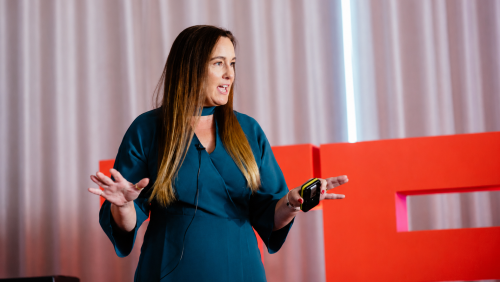
Abram Anderson, Founder of Abram's Kaizen Program
Abram Anderson does not describe himself as someone who overcame adversity to build a business. He describes himself as someone who got depressed, borrowed a concept from a car factory, and accidentally lost 40 pounds.
The car factory part is literal. Before Abram Anderson was a nutritionist, before he was a published author, before he was a public speaker, and before he built a coaching program that has served more than 6,000 women, he graduated high school early and became a college student studying automated manufacturing. It was there that he encountered the Toyota Production System — a methodology in which workers make small improvements at every step of the assembly line, producing a finished product that is exponentially better than if corrections were saved for the end. The Japanese term for this principle is kaizen: continuous improvement.
The concept has been studied extensively outside manufacturing. Peer-reviewed research published in BMJ Open Quality found that kaizen’s emphasis on incremental, process-level adjustments produced measurable improvements in healthcare settings when applied consistently over time. A separate study in PLOS One concluded that when implemented effectively, kaizen reinforced collaboration, increased engagement, and supported sustained behavioural change among participants. The underlying logic — that small, continuous corrections outperform large, delayed interventions — has become one of the more well-documented principles in organisational and behavioural science.
“I was 20 years old and getting out of college, and I wasn’t trying to get in shape,” says Abram Anderson, Founder of Abram’s Kaizen Program. “I was just trying to get out of depression. I knew what to do, I just wasn’t doing it. When I learned about the Toyota Method, I thought: what if you applied that to health? Not fix everything at the end, but make one small improvement at every step.”
The results were both unexpected and formative. By focusing on incremental improvements to his mental health rather than weight loss specifically, Abram Anderson reports that he lowered his stress levels, improved his wellbeing, and lost 40 pounds as what he describes as a byproduct. He was not counting calories. He was not tracking protein. He was applying the kaizen principle to himself — the same principle that would eventually become the foundation of Abram’s Kaizen Program.
Science offers a plausible mechanism for this sequence. Research reviewed in Current Obesity Reports has demonstrated that chronic stress elevates cortisol, a hormone associated with increased appetite, fat storage — particularly around the abdomen — and insulin resistance. A prospective study published in Obesity found that higher baseline cortisol and chronic stress each independently predicted greater weight gain over a six-month period. In other words, addressing the stress response first — as Abram Anderson describes doing is consistent with a growing body of evidence suggesting that cortisol regulation may be a precondition for sustainable weight management, not a secondary concern.
That personal experience planted the seed, but Abram’s Kaizen Program did not take its current form until 2014, when his wife needed to lose weight and nothing in his conventional nutritionist’s toolkit produced results. What followed was an investment of more than $200,000 in direct mentorship from figures including Mel Robbins, Dr. Michael Greger, James Clear, Dr. Jason Fung, and Tim Ferriss — and the result, according to Abram Anderson, of his wife losing 60 pounds in two months. That outcome gave him both the methodology and the conviction to build Abram’s Kaizen Program into a full-time business.
The approach aligns with broader research on behaviour change. James Clear, whose Atomic Habits has sold more than 25 million copies, built an entire framework around the premise that tiny, incremental changes compound into significant outcomes over time — the same core insight that kaizen formalised decades earlier on Toyota’s factory floor. A meta-analysis published in Obesity Reviews found that behavioural weight management interventions emphasising sustained lifestyle modification — rather than acute caloric restriction — produced improvements not only in weight but in depression, self-efficacy, and mental health-related quality of life.
Today, Abram Anderson operates Abram’s Kaizen Program from the Philippines, where he and his wife married more than a decade ago. They live with their children, who attend an international school. He wakes at 4 or 5 a.m., works on the program’s curriculum and AI coaching system, takes client calls and staff meetings when his American clients wake up, and spends the rest of his day in deep work and family time.
“I completely stopped taking days off,” Abram Anderson says. “I used to work 27 days and take 3 off. Now I just work every day. Because it feels so in alignment with what I want. It forces me to be in better shape, forces me to have a better relationship with my kids. If my kids need help with homework, I’m there.”

The word that recurs most often when Abram Anderson describes his philosophy is “easy.” Easy weight loss. Easy adherence. An easy life. He has not diversified into supplements, has not launched adjacent product lines, has not pursued corporate partnerships. He has done one thing which is Abram’s Kaizen Program, refined continuously for a decade.
“I can do one thing forever, and it just makes my life easier,” Abram Anderson says.
“I don’t know my competitors. I don’t know what other programs offer. I just focus on making Abram’s Kaizen Program better. That’s the Kaizen method applied to business.”
It is, perhaps, an unusual posture for a health industry entrepreneur. But for someone who borrowed his core philosophy from a Japanese car factory and tested it first on his own depression, the commitment to incremental improvement over dramatic reinvention has a certain consistency.
Abram Anderson does not describe himself as someone who overcame adversity to build a business. He describes himself as someone who got depressed, borrowed a concept from a car factory, and accidentally lost 40 pounds.
The car factory part is literal. Before Abram Anderson was a nutritionist, before he was a published author, before he was a public speaker, and before he built a coaching program that has served more than 6,000 women, he graduated high school early and became a college student studying automated manufacturing. It was there that he encountered the Toyota Production System — a methodology in which workers make small improvements at every step of the assembly line, producing a finished product that is exponentially better than if corrections were saved for the end. The Japanese term for this principle is kaizen: continuous improvement.
The concept has been studied extensively outside manufacturing. Peer-reviewed research published in BMJ Open Quality found that kaizen’s emphasis on incremental, process-level adjustments produced measurable improvements in healthcare settings when applied consistently over time. A separate study in PLOS One concluded that when implemented effectively, kaizen reinforced collaboration, increased engagement, and supported sustained behavioural change among participants. The underlying logic — that small, continuous corrections outperform large, delayed interventions — has become one of the more well-documented principles in organisational and behavioural science.