Strategic Simulation Is AI’s Next Frontier for Enterprise Decision-Making and Leadership
very important strategic decision exists inside a living system where institutions, markets, competitors, and policymakers continually respond to one another
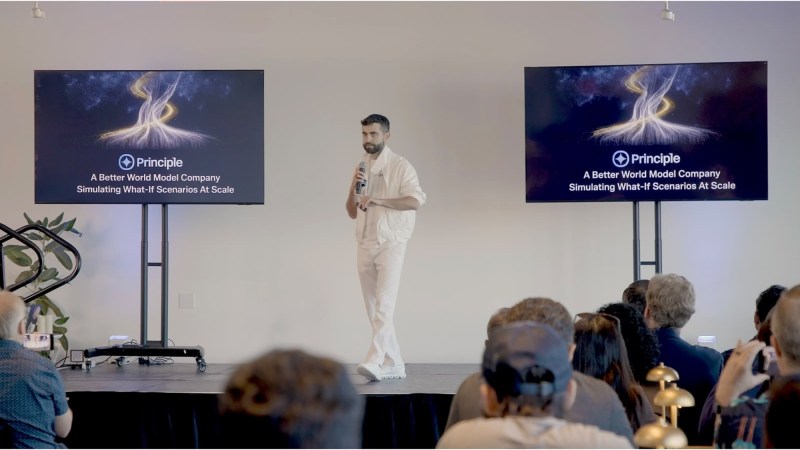
Artur Kiulian
You're reading Entrepreneur United Kingdom, an international franchise of Entrepreneur Media.
Strategic simulation is emerging as a new category within artificial intelligence, as organizations seek ways to evaluate complex decisions before committing resources in increasingly unpredictable environments. Principle, an AI-powered strategic simulation platform, is focused on helping leaders explore how entire business ecosystems may respond to major decisions, from competitors and regulators to markets, boards, and other institutional stakeholders.
The rise of AI simulation has accelerated broader market interest. In recent years, several companies developing AI systems for synthetic research, digital twins, and predictive modeling have attracted substantial investor attention. One AI digital twin company secured a $100 million investment to develop models that simulate individual responses. Meanwhile, an AI prediction laboratory focused on forecasting complex events also completed a major financing round at a valuation of $335 million. Together, these developments highlight growing confidence that simulation-based technologies could reshape how organizations analyze uncertainty.
However, not all simulation approaches address the same problem. Many emerging platforms are designed around understanding customers, testing consumer preferences, or modeling individual behavior. Enterprise strategy introduces a different challenge: leaders must consider how multiple powerful actors may react simultaneously. A competitor may change pricing, a regulator may introduce new rules, investors may reassess risk, or geopolitical events may alter entire markets. Principle positions its approach around this broader institutional layer, where strategic outcomes depend on the interaction of many interconnected participants.
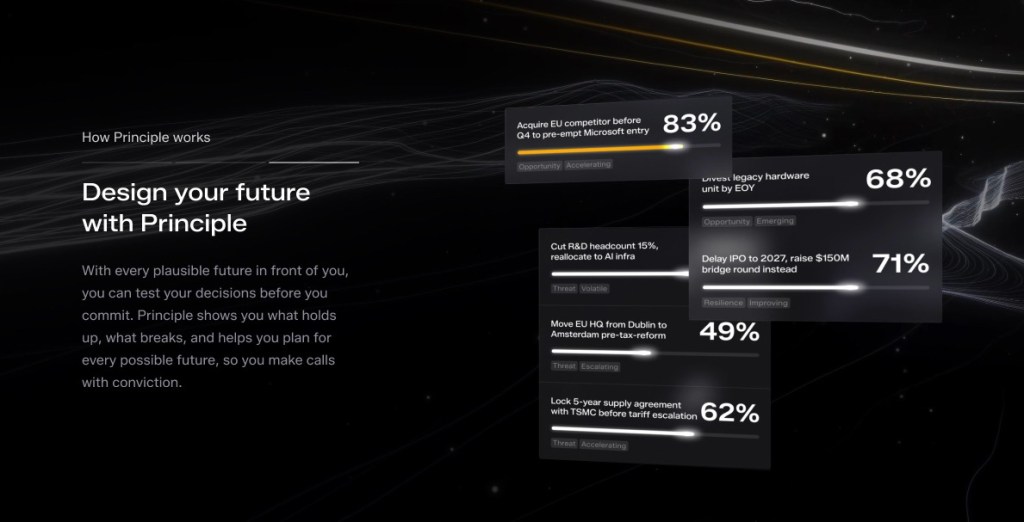
For executives, this challenge is becoming increasingly familiar. A strategy presentation created today can quickly become outdated when a new tariff changes supply chains, a geopolitical conflict disrupts assumptions, or a competitor makes an unexpected move. Principle notes that traditional consulting analyses and planning documents often capture a moment in time. However, they do not always show how decisions propagate through an organization and across an industry. The ability to test possible responses before committing significant resources is becoming increasingly valuable.
According to Artur Kiulian, Principle’s founder and CEO, strategic decisions should be viewed as interactions within living systems rather than isolated choices. “Every important strategic decision exists inside a living system where institutions, markets, competitors, and policymakers continually respond to one another,” he says. “Simulation can offer leaders an opportunity to explore those interactions before major commitments transform possibilities into realities.”
Principle’s platform is designed to create strategic simulations that represent key stakeholders and evaluate how different scenarios may unfold. When executives approve a strategic initiative, the decision must move through multiple layers of an organization. Business units translate strategy into roadmaps, managers define priorities, and teams establish key performance indicators. A conventional strategy deck may explain the intended direction, but it does not necessarily reveal how different stakeholders could respond or how those responses might affect execution.
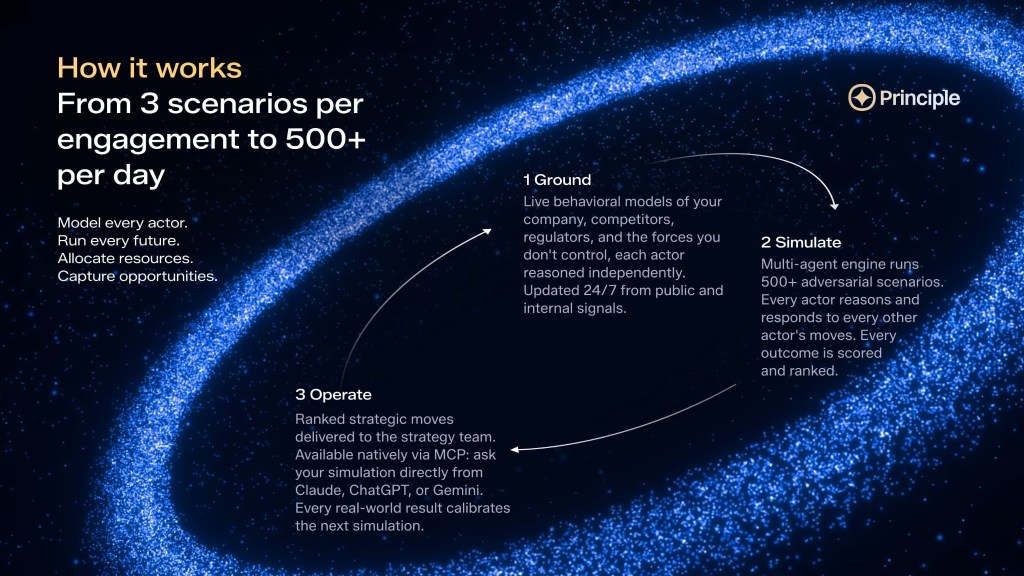
Principle aims to provide a simulation layer that helps organizations understand these downstream effects and align teams around more informed assumptions. “Our objective has never been to replace executive judgment,” Kiulian says. “Leadership brings experience, context, and vision to every important decision. Simulation contributes another perspective by helping leaders explore how complex systems may evolve across different scenarios before significant resources are committed.”
Supporting this vision is a leadership team with experience across artificial intelligence, entrepreneurship, and scientific research. Principle co-founder and CTO Anton Polishko has contributed research in simulation-driven decision methodologies while working at Google, including the SIGIR ’24 paper “Minimizing Live Experiments in Recommender Systems: User Simulation to Evaluate Preference Elicitation Policies.” The work examined how robust user behavior simulations could reduce dependence on costly live experiments by allowing recommendation strategies to be evaluated in simulated environments before deployment.
Principle’s leadership team has also contributed research examining how artificial intelligence systems interpret information and form predictions. Their paper “Measuring Source-Induced Bias in LLM Forecasts with Prediction Markets” was accepted to ICML, a prestigious AI/ML conference, exploring how information sources can influence model forecasts and how prediction markets can provide calibration for measuring those effects.
The company’s team further reflects its focus on scientific rigor. Mykola Khandoga, Principle Chief AI Scientist, was recognized with the 2025 Breakthrough Prize in Fundamental Physics for contributions including precision measurements of Higgs boson properties, discoveries involving strongly interacting particles, studies of rare processes, and research conducted through experiments at CERN’s Large Hadron Collider.
“I spent nearly two decades leading innovation inside a Fortune 500, and the hardest part was not generating ideas; it was knowing how the whole system would react once you committed, and how to adapt when the market shifted. Principle gives leaders that capability before the resources are spent. That’s what drew me here,” says Safir Bellali, who recently joined the team to lead strategic client engagements. Bellali was formerly Head of Digital Innovation at VF Corp and led digital innovation initiatives across luxury, automotive, and creative industries for clients like LVMH, Rivian, and Epic Games.
Access to information alone is no longer enough as organizations face faster cycles of disruption. The strategic advantage increasingly comes from understanding how information connects, how decisions influence systems, and how possible futures may develop before they arrive.
Kiulian believes simulation could become a critical capability for leaders operating in uncertain environments. “Information has become remarkably accessible,” he says. “Its greatest value often emerges when leaders can examine how different pieces interact across possible futures. Simulation encourages that broader perspective by allowing organizations to evaluate alternatives before those decisions become permanent.”
For executives, the promise of strategic simulation is the ability to see around corners: identifying risks, opportunities, and possible outcomes faster than traditional planning methods allow. As AI continues to evolve, organizations may increasingly rely on simulation not only to understand what has happened, but to explore what could happen next.
Strategic simulation is emerging as a new category within artificial intelligence, as organizations seek ways to evaluate complex decisions before committing resources in increasingly unpredictable environments. Principle, an AI-powered strategic simulation platform, is focused on helping leaders explore how entire business ecosystems may respond to major decisions, from competitors and regulators to markets, boards, and other institutional stakeholders.
The rise of AI simulation has accelerated broader market interest. In recent years, several companies developing AI systems for synthetic research, digital twins, and predictive modeling have attracted substantial investor attention. One AI digital twin company secured a $100 million investment to develop models that simulate individual responses. Meanwhile, an AI prediction laboratory focused on forecasting complex events also completed a major financing round at a valuation of $335 million. Together, these developments highlight growing confidence that simulation-based technologies could reshape how organizations analyze uncertainty.
However, not all simulation approaches address the same problem. Many emerging platforms are designed around understanding customers, testing consumer preferences, or modeling individual behavior. Enterprise strategy introduces a different challenge: leaders must consider how multiple powerful actors may react simultaneously. A competitor may change pricing, a regulator may introduce new rules, investors may reassess risk, or geopolitical events may alter entire markets. Principle positions its approach around this broader institutional layer, where strategic outcomes depend on the interaction of many interconnected participants.
Entrepreneur UK
Entrepreneur Staff