Jeff Bezos at VivaTech: “We are just warming up” – the race to build life beyond Earth
Bezos says space industry will extend Earth beyond imagination
Shutterstock
Opinions expressed by Entrepreneur contributors are their own.
You're reading Entrepreneur United Kingdom, an international franchise of Entrepreneur Media.
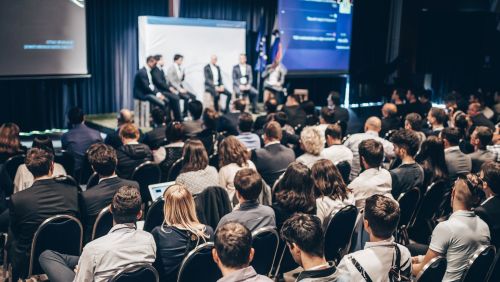
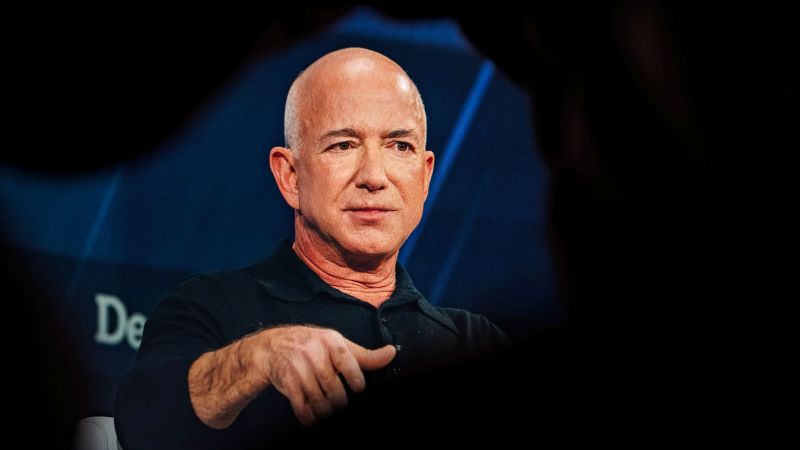
Speaking at VivaTech in Paris, Jeff Bezos described a future in which humanity moves beyond Earth not as a distant fantasy, but as an industrial inevitability. At the edge of what sounds like science fiction, he was still speaking in the language of engineering. Inside rocket combustion chambers where temperatures reach “5,000, 6,000 degrees Fahrenheit”, materials are pushed beyond their limits. “It’s beyond the melting points of any materials,” he said matter-of-factly. The challenge, he explained, is not just building engines, but building the systems that stop them destroying themselves in the process.
That means regenerative cooling, complex turbopumps, advanced alloys and manufacturing techniques that barely existed a generation ago. Even then, there is no guarantee of reliability. At Blue Origin, Bezos said, the focus has been on proving endurance. One of the company’s engines recently completed a 41-minute continuous test – the longest in the history of spaceflight propulsion. The previous record, set by NASA’s Space Shuttle main engine, stood for 36 minutes for more than three decades. “These engines are very complex,” he said. “This is a very challenging thing.”
But the technical difficulty is only part of the story. For Bezos and Blue Origin, the real ambition lies beyond Earth entirely. “We are just warming up,” he said. The company’s lunar programme is built on a simple idea: permanence. Dave Limp, who leads Blue Origin’s space systems division and also spoke at the VivaTech session, said the goal is not exploration for its own sake, but infrastructure – a sustained human and industrial presence beyond Earth. “We want to go there, and we’re going to stay on the Moon,” he said. That begins next year with the launch of Blue Origin’s Mark 1 lunar lander, capable of delivering three metric tons to the Moon’s surface. It will be, Limp said, the largest payload ever landed there. Later missions will escalate quickly: human-rated landers, orbital rendezvous tests, environmental systems capable of sustaining crewed missions, and repeated landings designed to build cadence. “This is our pathfinder mission,” Limp said. “These are coming off the assembly line now.” The goal is not just to return to the Moon, but to industrialise access to it.
The Moon as infrastructure
For Bezos, the Moon is not a symbolic return to Apollo-era achievement but a practical stepping stone. “The Moon is the first best step,” he said. “There are many reasons for that.” Chief among them is physics: “You can get there in three and a half days, and you can return in three and a half days. You can go anytime you want.” Unlike Mars, which requires narrow launch windows every two years, the Moon is always accessible and far easier to leave. “The gravity well is so much lower than Earth,” Bezos explained. “When you get materials from the Moon, you can lift them off with 28 times less energy.” That difference, he argued, changes everything, enabling a future industrial system in space that relies on lunar resources rather than lifting everything from Earth. “There’s water ice in permanently shadowed craters,” he said. “That can be converted into liquid oxygen and liquid hydrogen. One day, you’ll refuel lunar landers there.”
In that future, the Moon becomes not a destination but a logistics hub. The debate over Moon versus Mars was also addressed during the VivaTech discussion, where Bezos was clear: “Moon first. Mars and everywhere else, too.” Skipping steps, he argued, does not accelerate progress. “We did it before,” he said of Apollo, “but that was geopolitics, the race with the Soviets. Now is the right time.” He added that moving industry off Earth could ultimately help restore the planet. “One of our long-term visions is that all polluting industry can be done off Earth,” he said, noting, “This is the only way in which the world is worse today than it was 500 years ago. Everything else is better.”
Building the space economy stack
If the Moon is the destination, the question becomes what infrastructure is required to get there. Dave Limp described this as the “stack”: rockets, landers, propulsion systems, materials science, manufacturing and orbital industry. “You have to be incredibly vertically integrated in this area,” he said. Blue Origin has developed new alloys designed for extreme conditions inside rocket engines and built large-scale additive manufacturing systems that can print engine components. “We literally print engines,” he said. The company is also developing satellite and communications infrastructure, including high-bandwidth networks and optical links between space and Earth, alongside Project Sunrise, an orbital computing initiative. Limp said these systems are designed for a future where space is embedded within the global economy. “Eventually orbital compute will be a better option than terrestrial compute,” he said.
AI and the “dream-build loop”
Alongside this, Bezos outlined an AI programme called Prometheus, designed to accelerate engineering itself by compressing the time between idea and production. “Today there’s a dream-build cycle that can take ten years,” he said at VivaTech. “Can we make it five? Then three? Then one?” Civilisation, he argued, is defined by invention cycles, and accelerating them creates prosperity. Unlike general-purpose AI systems, Prometheus is focused on engineering data such as simulations and physical design. “You can’t design real physical objects just by reading about them,” he said. The aim is not to replace engineers but to amplify them: “It’s not going to replace people. It’s going to be a tool that helps them invent faster.”
He rejects fears of redundancy, arguing instead that AI expands human possibility, and that we are limited not by capability, but by imagination. “We are limited not by our capabilities, but by what we can actually do.” He pointed to the gap between imagination and execution, where ideas for products and businesses never materialise because building them is too difficult. “If we can accelerate the dream-build loop, all of those ideas become possible.” The constraint, he suggested, shifts from capability to imagination.
Decisive by design
Bezos also spoke about decision-making culture at Blue Origin, saying he wants it to become “the most decisive company in the world”, where speed depends on the nature of the decision. “Some decisions are irreversible and should be made slowly. Others are reversible and should be made quickly,” he said. He described the current moment as unusually fertile for innovation: “We are in the middle of a bunch of golden ages – biotech, AI, space – all of it.” For entrepreneurs, he added, “there has never been a better time to start a company.” The message from VivaTech was ultimately one of acceleration – technological, industrial and civilisational. Space, in Bezos’ framing, is not an escape from Earth but an extension of it. And for him, the timeline is only just beginning: “We have not even begun.”
Speaking at VivaTech in Paris, Jeff Bezos described a future in which humanity moves beyond Earth not as a distant fantasy, but as an industrial inevitability. At the edge of what sounds like science fiction, he was still speaking in the language of engineering. Inside rocket combustion chambers where temperatures reach “5,000, 6,000 degrees Fahrenheit”, materials are pushed beyond their limits. “It’s beyond the melting points of any materials,” he said matter-of-factly. The challenge, he explained, is not just building engines, but building the systems that stop them destroying themselves in the process.
That means regenerative cooling, complex turbopumps, advanced alloys and manufacturing techniques that barely existed a generation ago. Even then, there is no guarantee of reliability. At Blue Origin, Bezos said, the focus has been on proving endurance. One of the company’s engines recently completed a 41-minute continuous test – the longest in the history of spaceflight propulsion. The previous record, set by NASA’s Space Shuttle main engine, stood for 36 minutes for more than three decades. “These engines are very complex,” he said. “This is a very challenging thing.”
But the technical difficulty is only part of the story. For Bezos and Blue Origin, the real ambition lies beyond Earth entirely. “We are just warming up,” he said. The company’s lunar programme is built on a simple idea: permanence. Dave Limp, who leads Blue Origin’s space systems division and also spoke at the VivaTech session, said the goal is not exploration for its own sake, but infrastructure – a sustained human and industrial presence beyond Earth. “We want to go there, and we’re going to stay on the Moon,” he said. That begins next year with the launch of Blue Origin’s Mark 1 lunar lander, capable of delivering three metric tons to the Moon’s surface. It will be, Limp said, the largest payload ever landed there. Later missions will escalate quickly: human-rated landers, orbital rendezvous tests, environmental systems capable of sustaining crewed missions, and repeated landings designed to build cadence. “This is our pathfinder mission,” Limp said. “These are coming off the assembly line now.” The goal is not just to return to the Moon, but to industrialise access to it.