Make Smarter Strategic Decisions Using AI
Artificial intelligence (AI) is here and becoming increasingly more embedded in the day‑to‑day work of marketing teams and business leaders alike.
Shutterstock
Opinions expressed by Entrepreneur contributors are their own.
You're reading Entrepreneur United Kingdom, an international franchise of Entrepreneur Media.
Recent data shows that a vast majority of digital marketers now use AI tools in their workflows, with some research indicating that 88 % of marketers rely on AI in their daily tasks. But this rapid adoption brings a paradox into sharp focus: while AI is now ubiquitous, many organisations still treat it as a tool for doing more, rather than as a catalyst for thinking smarter. That matters deeply in strategic decision‑making. In environments where speed, agility, and insight matter more than ever, AI can be a powerful ally but only if leaders understand what it can realistically help with and what it cannot.
Why AI alone isn’t a strategy
In the majority of businesses, discussions about how to incorporate AI focus on driving efficiency through faster content creation, automated reporting, or algorithmic campaign optimisation. These are important, but they are not a strategy. A strategy is about why we do something, what outcomes we seek, and how we make choices amid uncertainty. AI is perfect at analysing data patterns, generating rapid insights and simulating scenarios based on a brief. But it does not excel at replacing human judgment; this defines strategic intent. This distinction matters because an overreliance on AI without clear strategic priorities can lead to fast outcomes that are misaligned with actual business goals. The dangerous scenario for all businesses is to pursue speed without a strategy, as this increases the risk of executing the wrong things at scale.
From automation to insight: What AI is actually good at
AI shines when it helps us understand complexity and make more informed decisions, not just more automated ones.
1. Elevating data‑driven decision making
The power in AI is in processing volume, things like massive datasets that would overwhelm the human analyst. This could be customer behaviour, real-time marketing campaign data, or marketing environment insights. AI will identify patterns and correlations that may not be visible to the naked eye. For example, machine learning tools can detect shifts in customer sentiment or purchasing trends long before traditional analytics catch them. This provides leaders with an early signal to pivot strategy. But crucially, these tools don’t decide what outcome is valuable; they flag potential opportunities or risks. Strategic thinking remains vital for interpreting AI outputs through the lens of your business context.
2. Testing scenarios and forecasting outcomes
Advanced AI models excel at running simulations and forecasts. Rather than asking “what happened?”, they help answer “what might happen?” and “what if…?”. This is invaluable for scenario planning, stress-testing assumptions, and allocating resources under uncertainty. These simulations can be used to stress-test decisions before they are made and to prepare for multiple outcomes.
3. Enhancing creative and strategic thinking
Contrary to popular belief, AI isn’t just a number‑cruncher; it can also be a generative partner in strategic thinking. AI tools can help generate hypotheses, uncover angles you might not have considered, or quickly synthesise research. But the creative leap is in deciding which ideas align with your brand promise and which deserve investment, and it remains uniquely human.
Common pitfalls in strategic AI use:
Even with these advantages, many organisations are making avoidable mistakes.
Mistaking volume for value. Producing more content, more variants, or more outputs faster is not inherently strategic. Without a guiding framework, more becomes noise. To stand out from the noise, you have to be strategic and intentional.
Underestimating context. AI doesn’t inherently understand your market’s nuances, organisational priorities, competitive advantages, or customer values. Giving it a clear strategic context is essential for sound output. This will also make the outputs less generic and more tailored to your unique business.
Overlooking skills and governance. Many teams use AI without formal training or guidelines. Research from Salesforce has shown that a significant percentage of professionals say they don’t know how to get the most value or use AI safely. This leads to inconsistent quality, ethical risk, and poor decision outcomes.
How to use AI to guide smarter strategic decisions
So what does good AI‑informed strategic decision‑making look like? Here are five principles that successful leaders follow:
1. Define clear strategic questions first: Articulate the question you’re trying to answer first before turning to any AI tool. Are you trying to understand the drivers of customer churn? Prioritise product investments? Identify new market segments? Think of AI as the analytical engine behind a question, not the starting point. For example, instead of asking “What messages should we run in our next campaign?”, start with “What is the primary strategic outcome we seek this quarter?” The AI task then becomes identifying patterns that inform the outcome, and past performance data and contextual information can be included to make the output as specific as possible to your business scenario.
2. Use AI to illuminate, not replace, human judgment: AI will highlight insights and gather research, but it shouldn’t be used to make the trade-offs. For instance, a model might show that specific customer segments are more profitable. But a human leader still needs to decide whether pursuing those segments aligns with brand values, capacity, and long‑term goals. Human oversight will also prevent the AI from reinforcing harmful incentives, such as favouring short‑term metrics over sustainable growth, which could damage the organisation’s long-term viability.
3. Invest in developing skills and AI literacy: Many marketers use AI tools daily, but few have received formal training. AI literacy: understanding both the capabilities and limitations of these technologies is essential. When teams know what AI can and cannot do, they can better judge whether its suggestions are actionable and can fully utilise critical thinking. Organisations that invest in literacy and governance will reap returns not just in efficiency but in strategic clarity.
4. Build feedback loops between AI and strategy: AI should not operate in a vacuum. Human feedback should be used to train and refine AI models.
Focus on areas such as:
- Using AI-derived insights in weekly strategy meetings.
- Evaluate if the recommendations improve KPIs.
- Adjust both your AI inputs (data, constraints, context) and strategy based on real‑world outcomes.
This creates an iterative learning loop in which strategy and AI capabilities evolve together.
5. Enforce ethical and contextual guardrails
As AI becomes more sophisticated, the risks around bias, privacy, and misalignment grow. To avoid this, establish and enforce ethical frameworks and contextual guardrails to ensure AI outputs are not only accurate but also appropriate. This means:
- Monitoring for biased data or outcomes. This is where human oversight is crucial.
- Ensuring clarity on customer consent and privacy. Only use the information and data gathered for the intended purposes.
- Aligning AI insights with organisational values.
A strong ethical foundation protects long‑term reputation and stakeholder trust. These can then become strategic assets to the organisation.
AI is the compass, strategy is the map
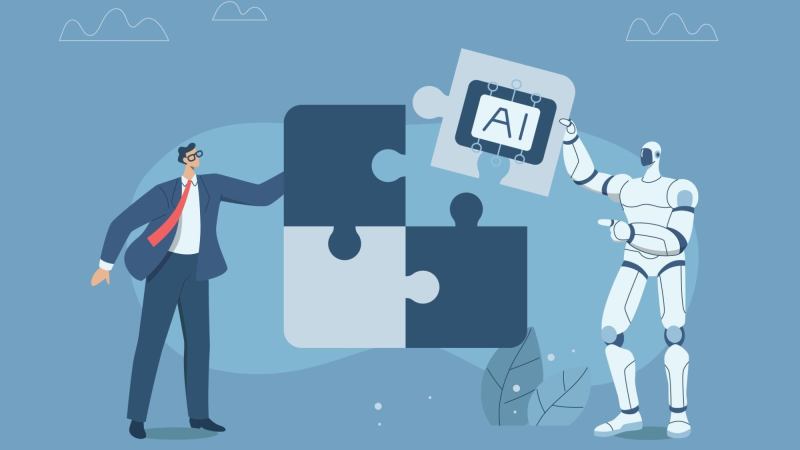
As AI continues to transform what’s possible in business analysis and operational efficiency, humans must continue to strategise. Ask why, what matters most, and question the choices available based on the AI-derived insight. AI can be a powerful compass that points us in the right direction, but the map still needs to be drawn by strategic thinkers who understand their business and its context. In the end, the smartest decisions aren’t those made by AI; they are decisions made with AI, grounded in human experience, judgment, and purpose.
Recent data shows that a vast majority of digital marketers now use AI tools in their workflows, with some research indicating that 88 % of marketers rely on AI in their daily tasks. But this rapid adoption brings a paradox into sharp focus: while AI is now ubiquitous, many organisations still treat it as a tool for doing more, rather than as a catalyst for thinking smarter. That matters deeply in strategic decision‑making. In environments where speed, agility, and insight matter more than ever, AI can be a powerful ally but only if leaders understand what it can realistically help with and what it cannot.
Why AI alone isn’t a strategy
In the majority of businesses, discussions about how to incorporate AI focus on driving efficiency through faster content creation, automated reporting, or algorithmic campaign optimisation. These are important, but they are not a strategy. A strategy is about why we do something, what outcomes we seek, and how we make choices amid uncertainty. AI is perfect at analysing data patterns, generating rapid insights and simulating scenarios based on a brief. But it does not excel at replacing human judgment; this defines strategic intent. This distinction matters because an overreliance on AI without clear strategic priorities can lead to fast outcomes that are misaligned with actual business goals. The dangerous scenario for all businesses is to pursue speed without a strategy, as this increases the risk of executing the wrong things at scale.
From automation to insight: What AI is actually good at
AI shines when it helps us understand complexity and make more informed decisions, not just more automated ones.

Jenna Tiffany • Founder and Strategy Director at Let’sTalk Strategy
Jenna Tiffany is founder and Strategy Director at marketing agency Let'sTalk Strategy and isan award-winning... Read more