Beyond the Highway: How a LiDAR Manufacturer Found Its Way into Mines, Ports, and Warehouses
Seyond
The sensors were built to prevent crashes. Nobody planned for them to end up in a copper mine.
Seyond, the California-headquartered LiDAR company, has spent the past several years watching its technology migrate far outside the lanes it was originally built to occupy. What started as a sensor supplier to NIO, the Chinese electric vehicle manufacturer, has grown into a company whose hardware now guides unmanned logistics vehicles through warehouses, reads the geometry of ship locks at coastal ports, and scans the terrain of open-pit mining operations where GPS signals alone cannot be trusted.
LiDAR, short for Light Detection and Ranging, fires laser pulses at objects and measures how long it takes for the light to return. The result is a three-dimensional map of the surrounding environment, accurate to centimeters, refreshed dozens of times per second. When autonomous vehicles first drew public attention roughly a decade ago, LiDAR was the technology most discussed. But the automotive window turned out to be narrower and slower to monetize than the industry expected. Companies that had poured capital into car-facing sensors found themselves sitting on hardware capable of far more than managing lane changes on a highway.
Seyond’s answer to that gap was not incremental. The company assembled four distinct product families covering detection ranges from a fraction of a meter to 500 meters, using both 905-nanometer and 1550-nanometer wavelength architectures. A robotaxi on a city street and an autonomous haul truck on a dusty mining road can both run on products from the same catalog. By December 2025, the company reports it had deployed close to 800,000 units across more than 500 clients.
From the Factory Floor to the Open Pit
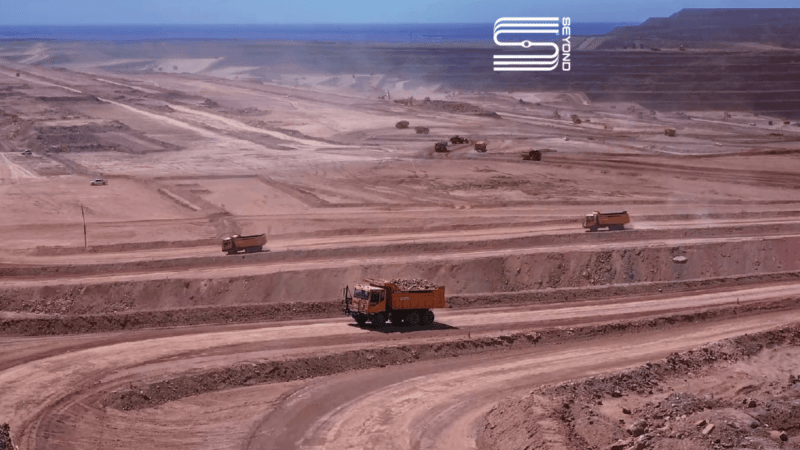
The move toward heavy industry came through accumulated necessity rather than a single strategic decision. Mining operations feature extreme dust, variable lighting, uneven terrain, and distances that extend well beyond what standard automotive sensors can handle. Seyond’s Falcon K, the company’s ultra-long-range sensor, was originally developed to give autonomous highway vehicles the reaction time they needed at speed. According to Seyond, its 500-meter range proved equally useful at a mining site, where an autonomous excavator must detect both a rock face and a human worker hundreds of meters away simultaneously.
Ports presented a different set of problems entirely. A container terminal confronts machines with stacked containers, moving cranes, trucks reversing through tight corridors, and ship locks that must be aligned to within centimeters. Seyond’s Robin W, a mid-range sensor with a wide field of view, has found applications in smart port infrastructure, generating dense spatial data across cluttered areas. Cameras alone struggle in fog, glare, and the low-light conditions that are routine at coastal facilities. A sensor that can still return accurate three-dimensional data under those circumstances may become less of an option and more of a requirement.
The Warehouse Problem
Warehouses are where volumes have been highest. The global logistics sector is under constant pressure to move goods faster with fewer workers. Automated guided vehicles and autonomous mobile robots now populate fulfillment centers operated by some of the largest retailers and logistics providers worldwide. These machines need to detect shelving, pallets, other robots, and the occasional human walking through a zone designated for automation. Seyond’s Hummingbird D1, a short‑range solid‑state sensor built specifically for close‑range environments, made its debut at CES 2026 as a mass‑production‑ready device.
What separates Seyond from most competitors is the deliberate architecture of the full lineup rather than the sophistication of any single product. Most LiDAR companies built strength in one range category and struggled to serve customers who needed both long-range highway sensing and short-range robot sensing without sourcing from two vendors. Seyond’s single-source approach removed that procurement friction. A port authority, a logistics company, and a vehicle manufacturer can all work with the same supplier, using the same software interfaces and service contacts.
That architecture took nearly a decade to complete. Seyond was founded in 2016 under the name Innovusion, then rebranded, and spent years developing hardware before the full lineup reached commercial readiness. Operating a US-based facility for automotive-grade three-dimensional LiDAR manufacturing provides clients in regulated industries with a domestically sourced supply chain that aims to meet compliance requirements that many international alternatives cannot.
A sensor built to help cars see. It ended up mapping terrain with no lanes, no traffic lights, and no road markings. That, more than any single product release, is what Seyond’s decade of work actually produced.
The sensors were built to prevent crashes. Nobody planned for them to end up in a copper mine.
Seyond, the California-headquartered LiDAR company, has spent the past several years watching its technology migrate far outside the lanes it was originally built to occupy. What started as a sensor supplier to NIO, the Chinese electric vehicle manufacturer, has grown into a company whose hardware now guides unmanned logistics vehicles through warehouses, reads the geometry of ship locks at coastal ports, and scans the terrain of open-pit mining operations where GPS signals alone cannot be trusted.
LiDAR, short for Light Detection and Ranging, fires laser pulses at objects and measures how long it takes for the light to return. The result is a three-dimensional map of the surrounding environment, accurate to centimeters, refreshed dozens of times per second. When autonomous vehicles first drew public attention roughly a decade ago, LiDAR was the technology most discussed. But the automotive window turned out to be narrower and slower to monetize than the industry expected. Companies that had poured capital into car-facing sensors found themselves sitting on hardware capable of far more than managing lane changes on a highway.