Emotional Precision: The Quiet Craft Behind Dynamic Fenestration

Dynamic Fenestration has built its reputation on handcrafted windows and doors, but for Martin Ross, Business Development Director, it is clear that the company’s real medium is more difficult to define. For Ross, fenestration is not an accessory to architecture. It carries meaning and emotion, influencing how people experience and move through a space.
“People are increasingly feeling more isolated even though we are more connected,” he says. “This is an attempt to put people back in touch with their own sense of belonging.” It is an unexpected mission statement from a company best known for bronze, steel, wood and glass, yet Ross treats materiality as a form of language rather than construction. His role, he suggests, is not to sell a product but to protect an experience.
Craft as Human Connection
Ross speaks openly about the tensions shaping architecture today. Technology is accelerating. Automation is rising. AI is reshaping the labor landscape. Against that backdrop, he sees craft not as nostalgia but as one of the few spaces where personal identity is still expressed directly.
“With luxury products, it is often the subtle imperfections in fabrication that make it truly desirable,” he says. “Those imperfections are not made by machines.” He compares handcrafted fenestration to a paragraph written from the heart, something that carries emotional truth rather than algorithmic polish.
The idea is not romanticism for its own sake. Ross believes the shift toward handmade, tactile materials is part of a larger global search for meaning. “It reflects a shift in how luxury is understood today,” he explains. “Luxury is a connection to meaning and the artisan. Handmade products have an emotional connection that is becoming less common.”
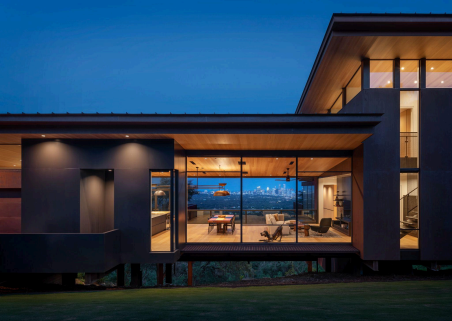 Dynamic Fenestration
When Fenestration Becomes Architecture
Dynamic Fenestration works with many of the world’s most exacting architects, and Ross is quick to point out that windows and doors are not decorative elements. They are the architecture. “Fenestration is architecture,” he says. “It is not a line item. It defines the building.”
He describes a custom home like a jigsaw puzzle. Commodity products may approximate a designer’s intent, but they rarely fit the picture with the crispness required for a fully resolved aesthetic. “If every piece is not quite right, the alignments are not there,” he says. “The lack of finesse becomes what sits between you and the vision of the architecture.” The human eye, he insists, knows when something feels right. Alignment is not simply geometry. Alignment is emotion.
Ross prefers to join architects at the earliest conceptual stage. The goal is not to upsell a system but to understand the desired emotional effect. “What is the experience you are designing,” he asks them, “and how do we make every detail belong to that story?” Some clients want antiseptic modernism, a surface of glass and reflection. Others want warmth, patina and the organic character of reclaimed materials. Dynamic has even sourced centuries-old American chestnut from historic barns for clients who wanted windows and doors embedded with literal history. As Ross puts it, “There is a great example of emotional connection.”
Material as Memory
Ross speaks in greater detail about materials such as wood and bronze, particularly the stories and associations they carry. Bronze, he says, has been emotionally understood as a noble material since antiquity. Patinated metal carries movement, age, and permanence. Wood is equally communicative. He points to academic research showing that children learn better in classrooms with wood surfaces and natural daylight. “People automatically respond to it,” he says. “So if you are building a multi-million dollar house, why not use what we know and make it part of your life?”
For Ross, materials are never isolated. They exist in dialogue with the architecture and the behavior of the people inside it. Fenestration becomes the membrane that orchestrates these relationships. In a world of artificial surfaces and disposable products, Dynamic’s approach tries to restore physicality, presence, and resonance.
The Quiet Moment
The most revealing part of Ross’s philosophy emerges when he describes the moment a homeowner steps into a completed space. He does not talk about sightlines or finishes. He talks about feeling. “It should feel right to them,” he says. “A place of refuge, a place of serenity, where you collect your thoughts and feel safe.” That sense of emotional grounding, he believes, is one of architecture’s most powerful functions.
Ross tells the story of clients who receive windows and doors crafted from the reclaimed chestnut of barns built in the 1700s and 1800s. With each delivery, Dynamic includes a written history of the original structure, the land it stood on, and the era it came from. “It is an American legacy built into your home,” he says. The piece of material is more than wood. It is a narrative, a memory, and a form of belonging that cannot be mass-produced.
The Legacy Makers
Ross often returns to the idea that architecture is not simply built for the present moment. It can shape memory and contribute to a sense of continuity over time. Dynamic’s role, as he describes it, is to help create those enduring foundations. “We are only successful when our clients are successful,” he says. Their work is meant to disappear into the architecture, not announce itself, allowing the experience of the space to take precedence. “We are trying to be a collaborative partner in architecture intended to have a lasting presence.”
Dynamic Fenestration’s work is tangible and precise, yet Ross’s guiding principle is almost spiritual. “It is not what you make, it is what you make possible,” he says. In his world, windows and doors become less about performance and more about presence. They are thresholds of emotion, portals of memory, and instruments through which a building becomes a place.
That, Ross believes, is the real architecture.