Can The UK Win At Scale?
Sir Martin Sorrell explains why Britain struggles to scale global innovation successfully.
WPP
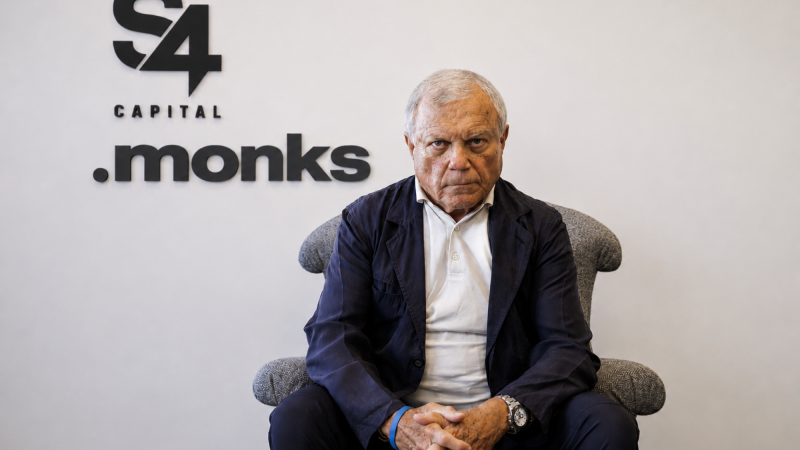
Martin Sorrell, from WPP to S4 Capital
Opinions expressed by Entrepreneur contributors are their own.
You're reading Entrepreneur United Kingdom, an international franchise of Entrepreneur Media.
TheUK has never struggled to invent the future. From the Industrial Revolution to modern computing, its universities, laboratories and entrepreneurs have always produced discoveries that have transformed the world. The problem has always been turning invention into ownership. Too often, UK breakthroughs are conceived here, financed elsewhere, scaled overseas and eventually absorbed by global giants.

Few people have watched that pattern unfold more closely than Sir Martin Sorrell. After building WPP into the world’s largest advertising and communications group and later founding S4 Capital for the digital age, he has spent four decades tracking the movements of capital, technology and consumer behaviour before they become obvious. Now his attention is fixed on artificial intelligence (AI). For Sorrell, AI is not another technological cycle; it is the infrastructure of the next global economy. Its impact will be felt across every industry, from marketing and retail to healthcare and biotechnology, transforming how companies operate, create and compete. But he believes many businesses are approaching it backwards.
“There is no point automating chaos,” he argues. The winners will not be those that simply add AI to existing systems, but those that first redesign how they work. AI is not a strategy. It is an amplifier. In healthcare and life sciences, where regulation remains essential, the principle is no different. The future belongs to organisations that can combine first-party data, intelligent workflows and personalisation at scale. The advantage will not come from having the biggest budgets, but from learning, adapting and executing faster than everyone else.
The advertising industry has undergone a historic shift. A $1.2tn global market, it is now roughly three-quarters digital – a figure Sorrell expects to approach 80% by the end of the decade. But he challenges one of the biggest assumptions of the digital age: that media has become more fragmented. In reality, he argues, it has become more concentrated. Google, Meta, Amazon and TikTok now control an extraordinary share of global advertising spend, with algorithms increasingly determining where attention flows and how brands reach consumers. “The options are actually becoming fewer,” Sorrell says. For businesses, this changes the nature of marketing. The old model of broadcasting one message to millions is being replaced by personalised communication at unprecedented scale. AI makes it possible to create, test and optimise thousands of variations of content in real time -something once available only to the world’s largest companies. But as access to these tools becomes universal, a new question emerges: if everyone has the same technology, where does competitive advantage come from? For Sorrell, the answer remains human. AI can accelerate creativity, but judgement, originality and strategic thinking will determine who stands apart.
He recalls a conversation involving Coca-Cola’s leadership shortly after generative AI began transforming creative industries. If everyone can produce competent advertising using the same software, how does a global brand remain distinctive? The answer, Sorrell believes, is reassuringly human. AI raises the baseline. It improves average work. It accelerates production. It expands possibilities. It does not eliminate judgement. Taste. Curiosity. Original insight. For all AI’s astonishing capabilities, someone still has to ask the right questions, understand human behaviour and recognise an idea worth pursuing. Creativity does not disappear; it simply migrates higher up the value chain.
Ironically, as machines become more capable, original human thinking may become more valuable. Sorrell acknowledges AI’s potential to transform employment, with automation likely to replace many routine roles while reducing demand for some forms of labour. Although economists debate whether new industries will offset these losses, he remains cautious. He sees AI as a starting point, not the endpoint. Beyond it lies quantum computing – a technology he believes could surpass today’s advances and fundamentally reshape what businesses consider possible. Against this backdrop, Sorrell sees the UK’s economic debate as too focused on decline rather than growth. While other nations compete to lead emerging technologies, the UK remains absorbed by taxation, regulation and short-term pressures instead of productivity, investment and innovation. He argues that history rewards countries willing to embrace technological change before certainty arrives.
That is the challenge the UK now faces. It possesses exceptional universities. It continues to attract remarkable scientific talent. Its researchers remain among the world’s most respected. What it has yet to demonstrate, Sorrell argues, is the same determination to build enduring commercial champions around those discoveries. The country has become remarkably good at inventing the future. It has become considerably less effective at owning it. The uncomfortable truth, according to Sorrell, is that the UK’s problem has never been intelligence. It has been conviction. For decades, the country has excelled at producing breakthrough research while repeatedly failing to build the businesses that commercialise it. The names are familiar enough to have become almost folklore. Cambridge researchers develop world-changing technologies. University spinouts pioneer remarkable discoveries. Young founders create companies capable of redefining industries. Then, almost inevitably, American investors arrive with deeper pockets, larger ambitions and markets willing to reward risk rather than merely tolerate it.
The technology leaves. The wealth follows. The UK congratulates itself on another brilliant invention while surrendering ownership of its future. Sorrell has watched the cycle repeat often enough that it no longer surprises him. “We have all these wonderful universities,” he says, “the scientific capability is there.” What is missing, he argues, is everything that comes afterwards. History is littered with examples of countries that pioneered technologies only for others to capture their commercial value. Innovation alone does not create prosperity. Markets do. Capital does. Leadership does. A culture that celebrates entrepreneurial ambition rather than viewing it with suspicion does. It is here that Sorrell believes the UK has drifted off course.
Sorrell argues the issue is cultural as much as economic. While America celebrates entrepreneurship, the UK often views commercial success with suspicion, influencing where talent and investment flow. Despite world-class strengths in medical research, genetics, pharmaceuticals and AI, founders often look abroad to scale. Sorrell maintains that while regulation is necessary, the UK has become better at managing risk than pursuing opportunity. He recalls the national conversation surrounding AI. While other countries debated how quickly AI could accelerate economic growth, the UK appeared more interested in how it should be regulated. He understands the argument. Powerful technologies require guardrails. AI presents genuine ethical questions around privacy, misinformation and security. Governments have responsibilities that private companies do not. Yet there is, he believes, an important distinction between regulating innovation and leading it. “The Americans innovate,” he says. “The Chinese imitate. The Europeans regulate.”
Sorrell contends Britain often regulates new industries before building them, putting opportunity at risk. He extends this criticism to finance: despite vast institutional capital, too little reaches high-growth companies. Instead, investors favour safer assets such as property and government-backed investments. While logical individually, Sorrell believes this limits national economic ambition. Every pound invested in certainty is a pound not invested in tomorrow. Sorrell argues the UK celebrates entrepreneurship while its financial system rewards caution over ambition. The contradiction is measurable: London’s global financial standing has declined, major technology companies increasingly list elsewhere, and venture capital lacks the scale of Silicon Valley.
For founders building global businesses, these signals matter. Capital is more than money; it is confidence, and once lost, it is hard to recover. Sorrell argues the challenge is growing because entrepreneurship itself has changed. The digital economy has removed geographic limits: founders can operate anywhere, teams and investors are global, and talent and capital are increasingly mobile. Governments, however, often still assume entrepreneurs are tied to one place. “If you’re a young entrepreneur,” Sorrell asks, “running a successful business, why would you necessarily stay?”
For founders, the decision is not just about tax but the wider environment: regulation, investment access and the cultural attitude towards wealth creation. Sorrell argues that as talent and capital become more mobile, many choose to build elsewhere. He warns this matters because emerging industries – AI, quantum computing, synthetic biology, precision medicine and advanced manufacturing – will shape global economic power. Countries that lead them will attract investment and talent; those that fall behind may become dependent on others. Yet Sorrell does not see the UK’s decline as inevitable. He sees a country with world-class universities, scientific expertise and global connections, but one that has failed to turn those strengths into greater economic success. The opportunity, particularly in healthcare, remains significant.
He believes the next decade will bring major opportunities in healthcare as biotechnology, AI, personalised medicine and preventative care converge. The winners will not just create treatments but reshape how healthcare is delivered. Sorrell highlights weight-loss medicines as an example of technology with wider economic impact, potentially reducing healthcare costs and shifting focus from treating disease to prevention. But he argues opportunity will be unevenly distributed: the US will remain dominant through capital and innovation, while regions such as Latin America, the Middle East and Asia-Pacific offer significant growth potential. The message for founders is clear: competition is intensifying. Success requires more than great technology; companies must understand where capital, customers and supportive markets are emerging. “Be efficient,” Sorrell says. In the AI era, that means more than cutting costs – it means redesigning organisations around a new operating model. This is the shift many healthcare founders have yet to fully embrace.
For decades, professional services followed a simple model: more people and more hours meant more revenue. AI disrupts that equation by shifting value from effort to outcomes. Sorrell sees this already transforming marketing, where traditional agency models are being replaced by faster, more automated, output-based approaches. “The big change,” he says, “is shifting from a time and materials model to an output-based model.” The impact goes beyond pricing. Companies built around selling hours often resist efficiency, while outcome-based businesses make it central. Sorrell argues the winners will not just use AI to work faster – they will rethink why work is done that way in the first place.
The UK needs more than policy changes – it needs confidence. Building globally significant companies must become an expectation, not an exception. Technological revolutions require leadership, risk-taking and the willingness to embrace uncertainty. He points to Silicon Valley and China as examples of ecosystems built on ambition, arguing that the UK has the talent and ideas but lacks urgency. Yet he remains convinced of its potential. Countries are transformed not only by governments, but by entrepreneurs, investors and scientists willing to take risks. The challenge is creating an environment where they choose to stay. His message to healthtech and biotechnology founders is simple: think ambitiously, act despite uncertainty and do not wait for perfect conditions. The greatest companies are often built when technology, timing and determination align.
Sorrell has built his career by anticipating major shifts, from global advertising to digital media and data. Now he sees AI transforming how companies are built and operated. In this new era, speed, adaptability and creativity may matter more than size and legacy. For entrepreneurs, it is an opportunity; for governments, a warning: capital and talent move to where they are welcomed. The final question, then, is not whether the UK has the capability to compete. It does. The question is whether it has the confidence to do so. As Sorrell puts it, the raw material is there. The universities. The scientists. The entrepreneurs. The ideas. What is missing is belief. His final message to founders is simple: “Be bold.” But listening to him, it sounds less like advice for entrepreneurs than a challenge to an entire country. A reminder that the future rarely belongs to those who merely understand change. It belongs to those willing to build it.
TheUK has never struggled to invent the future. From the Industrial Revolution to modern computing, its universities, laboratories and entrepreneurs have always produced discoveries that have transformed the world. The problem has always been turning invention into ownership. Too often, UK breakthroughs are conceived here, financed elsewhere, scaled overseas and eventually absorbed by global giants.
Few people have watched that pattern unfold more closely than Sir Martin Sorrell. After building WPP into the world’s largest advertising and communications group and later founding S4 Capital for the digital age, he has spent four decades tracking the movements of capital, technology and consumer behaviour before they become obvious. Now his attention is fixed on artificial intelligence (AI). For Sorrell, AI is not another technological cycle; it is the infrastructure of the next global economy. Its impact will be felt across every industry, from marketing and retail to healthcare and biotechnology, transforming how companies operate, create and compete. But he believes many businesses are approaching it backwards.
“There is no point automating chaos,” he argues. The winners will not be those that simply add AI to existing systems, but those that first redesign how they work. AI is not a strategy. It is an amplifier. In healthcare and life sciences, where regulation remains essential, the principle is no different. The future belongs to organisations that can combine first-party data, intelligent workflows and personalisation at scale. The advantage will not come from having the biggest budgets, but from learning, adapting and executing faster than everyone else.

Patricia Cullen • Features Writer
Entrepreneur Staff